


Thousands get jobs as PRAN-RFL revives abandoned mills

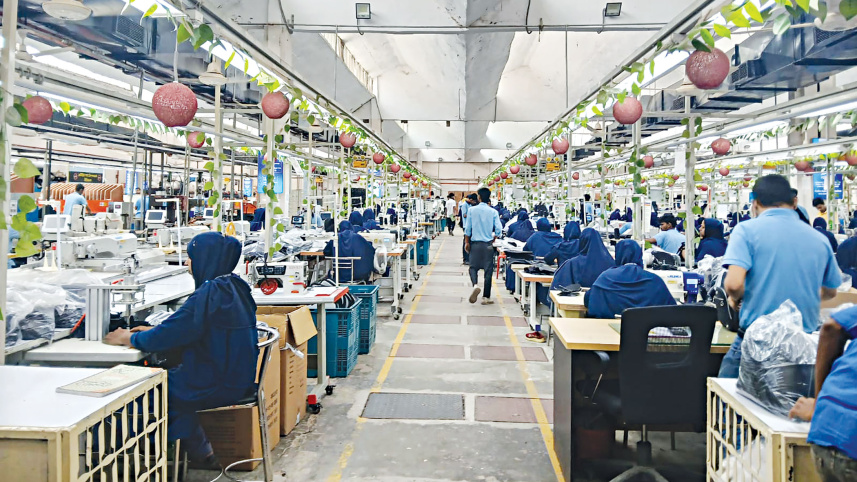
A few years ago, Champa Begum moved from Rajshahi to Gazipur for factory work, leaving behind her young daughter. Today, the 30-year-old no longer has to make that choice.
Begum now works at a factory barely 12 km from her home in Paba upazila, Rajshahi. The move back home has reduced living costs and allowed her to rebuild her daily life with family.

Her story reflects a broader change underway.
PRAN-RFL Group has restarted three idle state-owned factories in Rajshahi, including Rajshahi Textile Mill and Rajshahi Jute Mill, under a public-private partnership (PPP) model. The initiative has already employed many locals, with plans to scale up, reducing the need for migration to major cities.
Workers say the opportunity to work close to home has brought both economic relief and personal stability.
Nearly 2,500 workers have secured jobs following the revival of the once-abandoned Rajshahi Textile Mill
Export goods -- non-leather footwear and luggage -- are being produced at the revived factories. Officials said utilising idle state-owned mills and land could boost foreign exchange earnings despite sectoral constraints.
A NEW LIFE
Nearly 2,500 workers have secured jobs following the revival of the once-abandoned Rajshahi Textile Mill, which began operations in 1979 but shut down in 2003 due to mounting losses. After more than two decades of inactivity, the factory has resumed production under a private-sector initiative to revive idle facilities through PPPs.
The factories now produce non-leather footwear, luggage, backpacks, trolleys, and women’s handbags. Over the past two years, RFL has invested approximately Tk 325 crore in the footwear and luggage sectors, with another Tk 200 crore planned this year and a further Tk 800 crore targeted over the next three years.
PRAN-RFL has already created 4,500 jobs across the three Rajshahi factories and plans to expand to more than 11,000. Nationwide, the company has generated around 12,000 jobs in footwear and luggage over the past two years and aims to create an additional 30,000 over the next three years.
Currently producing around 48 lakh pairs of shoes per month, the company plans to scale up to 1.5 crore pairs within three years to meet growing global demand. Rising production costs in China are prompting buyers to shift sourcing to Bangladesh, particularly for non-leather footwear.
The global footwear market is valued at $400 to $500 billion. In FY2024-25, Bangladesh exported footwear worth $1.19 billion, with non-leather footwear contributing $522 million-- growing over 25 percent year-on-year, according to the Export Promotion Bureau.
JOBS WHERE THEY ARE NEEDED
For workers like Champa Begum, the impact of such an initiative is immediate and personal.
“If we work far away, the child’s education suffers,” she said. “It’s much better when jobs are available locally,” she said.
Others share similar experiences. Rajshahi University graduate Sultana Khatun, 32, said the opportunity to work locally came at the right time.
“Amid higher inflation, this has somewhat reduced the burden on us.”
Mustafa K Mujeri, executive director of the Institute for Inclusive Finance and Development, welcomed the move to open up state-owned mills for private sector acquisition and reopening.
“Such measures are urgently needed to address the country’s unemployment challenge,” he said.
 For all latest news, follow The Daily Star's Google News channel.
 Amid persistently high inflation, the government should strike a balance between strengthening social protection and actively supporting the private sector to expand job creation, he noted.
Without a stronger push for employment generation, he warned, macroeconomic pressures could further deepen labour market vulnerabilities.
DECENTRALISING INDUSTRIAL DEVELOPMENT
PRAN-RFL operates eight footwear and luggage factories across Narsingdi, Rajshahi, Rangpur, and Pabna, with two more facilities in Chattogram under renovation.
The group exports to 45 countries, with the United States and Europe as key markets. Export earnings from non-leather footwear and luggage rose to Tk 177 crore in FY25 from Tk 92 crore the previous year-- an increase of over 90 percent.
“We are receiving strong purchase orders, but failure to deliver on time means losing opportunities. Reviving closed factories is our fast-track solution,” said Kamruzzaman Kamal, marketing director at PRAN-RFL Group.
He added that utilising idle government jute mills and unused land nationwide could significantly boost foreign exchange earnings.
RFL’s Rahat Hossain Roni said Bangladesh’s large rural workforce gives it a competitive advantage over rivals such as Vietnam and Cambodia, which are well-positioned to absorb production shifting out of China.
On wages, he said the company complies with national minimum standards and offers productivity-linked incentives.
“The fixed salary is just the entry-level; beyond that, earnings increase with performance,” he said.
He also noted that workers returning from Dhaka benefit from higher purchasing power in smaller cities.
“If someone comes from Dhaka to Rajshahi at the same wage, they’ve already gained roughly 30 percent in purchasing power.”
However, challenges remain. Skilled labour shortages persist in rural areas, and 30 to 40 percent of raw materials are still sourced from China, leading to delays of up to a month.
Roni urged the government to streamline customs and bonded warehouse processes to ease bottlenecks and enhance competitiveness.
Comments