


Women’s participation in economic units stagnates
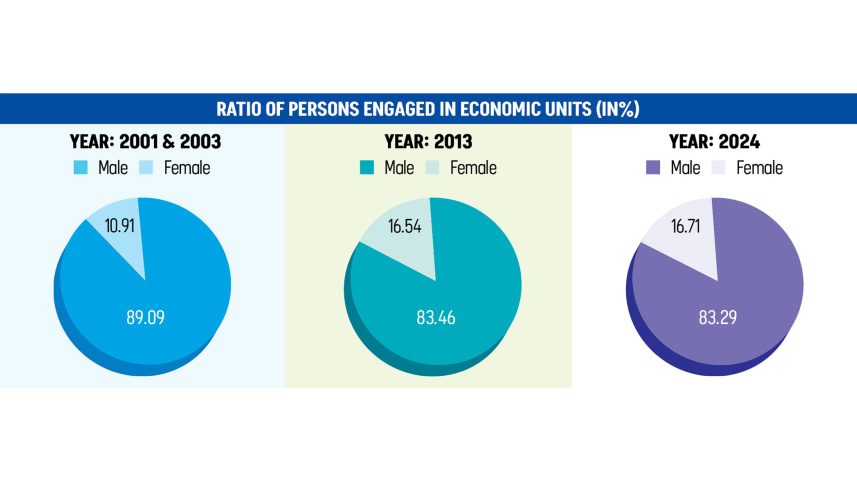
The ratio of women engaged in economic units in the country has remained stagnant over the decade to 2024, even though overall economic activities expanded during the period.
The latest economic census finds that the ratio of women in economic establishments was 16.71 percent in 2024, which was only 0.17 percentage points higher than the 16.54 percent recorded in 2013.

An economic unit is any person, household, business or organisation engaged in producing and providing goods and services in the economy.
Over three crore people were engaged in 1.17 crore economic units in 2024. Of them, 51 lakh were women, according to the census published by the Bangladesh Bureau of Statistics (BBS) last month.
“This is not very encouraging, as the ratio has remained unchanged despite an increase in their participation in economic activities,” said Fahmida Khatun, executive director of the Centre for Policy Dialogue (CPD).
The census data showed that the number of economic units jumped 50 percent from 78.18 lakh in 2013.
However, the number of people engaged grew 25 percent between 2013 and 2024. Participation by men and women grew 25 percent and 26 percent, respectively, during this period.
The CPD said female participation should have increased, given the rise in female literacy. An increasing number of female graduates are coming out of universities every year. The contrast raises the question of whether they are getting opportunities or whether they have the right skill sets required.
“Nowadays, it is difficult for lower-middle-income families to lead a decent life based on the income of one person. Mindsets are changing, and many educated women want to work as economic needs have increased,” she said.
The BBS census data showed that the percentage of women engaged in economic units was 18 percent in urban areas against 15 percent in rural areas.
Fahmida said policymakers should look into ways in which the engagement of women could be increased.
The BBS data showed that the ratio of women engaged in economic units rose sharply between 2003 and 2013. During this period, the percentage of women engaged in economic units rose to 16.54 percent from 10.91 percent in 2003.
Yet the last three economic censuses show strong male dominance in the job market.
According to the 2024 economic census, female entrepreneurs head 3 percent of economic establishments, with the ratio being slightly higher at 3.33 percent in rural areas than 3.08 percent in urban areas.
“This indicates that the majority of economic establishments in the country are headed by men, with very little participation from women,” said the BBS in its latest census.
Soma Dey, associate professor of Women and Gender Studies at the University of Dhaka, said automation and technological advancement have changed the nature and types of jobs. “In these areas, opportunities for men have widened. But women have not seen similar opportunities outside certain professions.”
She cited the falling share of female workers in the largest export-oriented garment industry and said emerging threats are not being addressed.
“There has been little change in social attitude towards women. Gender stereotypical roles are nurtured and promoted. Girls are not encouraged to be economically empowered or to become the breadwinners for their families,” she said.
“In workplaces, misogynistic attitudes prevail.”
Soma said the overall policies of the state are pro-women, but they are not properly implemented.
 For all latest news, follow The Daily Star's Google News channel.
 “Strong political commitment and coordinated efforts among agencies are needed to remove these structural inequalities.”
Comments