


60% of farmers unbanked
Almost 60 percent of farmers in Bangladesh are unbanked, a businessperson shared yesterday.
Fahad Ifaz, co-founder and chief executive officer of iFarmer, said the biggest sources of credit for farmers are still local moneylenders and traders.
 For all latest news, follow The Daily Star's Google News channel.
 They rely on such informal sources for capital paying very high interest rates, which can range between 30 and 70 percent, he said, quoting studies.
He was addressing a seminar titled "Smart Agriculture: Issues and Challenges in Value Chain Development", organised by the Dhaka Chamber of Commerce and Industry (DCCI) at its office in the capital yesterday.
iFarmer is a Bangladeshi agri-tech startup that connects individual farmers, who possess the skill to farm but lack the capital, with individual investors who want to invest their money in agribusiness.
However, Ifaz added that the government contends that the rate of unbanked farmers is far lower than 60 percent.
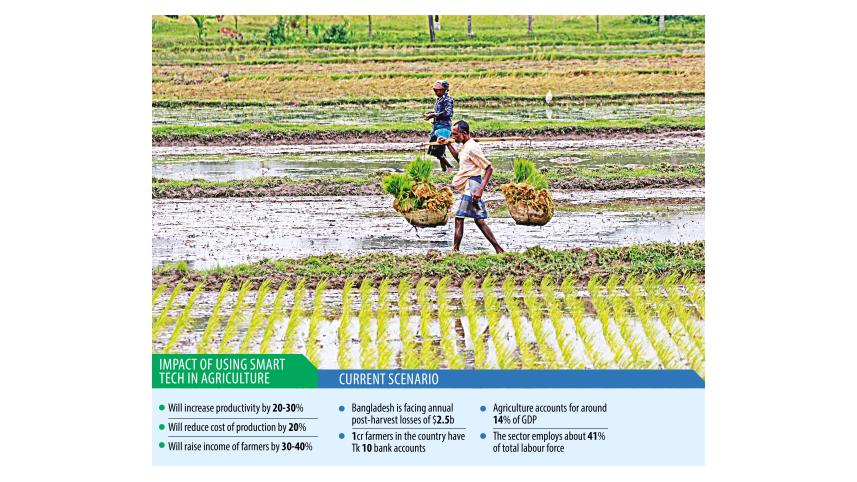
About 1 crore farmers in the country have Tk 10 bank accounts, he said, but simply opening an account does not mean they are transacting through banking channels, he added.
The agriculture sector, which comprises mostly marginalised producers who work on their own initiative on small plots of land, accounts for around 14 percent of Bangladesh's GDP and employs about 41 percent of the country's total labour force.
He went on to say that farmers are still hindered by a lack of data-driven solutions. For example, a lack of data means farmers cannot avail services like insurance in case of climate risks.
Ifaz added that the continued use of primitive farming methods and technologies means the growth of agricultural productivity is sub-par compared to other sectors.
The co-founder of iFarmer said the government has 18 departments for agriculture research, development, and extension.
And while the policies adopted by these organisations have led the agriculture sector into a sustainable trajectory, there is a lack of tech-based solutions from the fourth industrial revolution (4IR) which could effectively address productivity issues, he added.
But with the imminent impact of the 4IR, the agriculture sector needs to embrace policies facilitating access to digital finance, digital markets, and a culture of automated advanced technological innovation, he said.
During his presentation, Ifaz added that several studies have shown that the transportation process accounts for roughly 40 percent of agri-product waste.
Additionally, consumer access and food processing still follow traditional linkage methods.
Ifaz said Bangladesh is grappling with significant annual post-harvest losses of $2.5 billion, which leads to 44 percent of all perishable food produced in the country being wasted each year.
This stems from a dearth of appropriate storage and transport facilities, as well as a lack of post-harvest knowledge at the farmers' end.
Mohammad Sakib Khaled, senior manager (programme) of Swisscontact, recommended formulating policies facilitating the implementation of tech-based solutions and ensuring digital literacy.
Adoption of smart agriculture practices could potentially increase agricultural productivity by 20-30 percent in Bangladesh, said Ashraf Ahmed, president of the DCCI.
Smart agriculture practices also reduce input costs by up to 20 percent and increase farmers' income by 30 to 40 percent, he said.
"We see at least 40-45 percent post-harvest loss from the farmers to the consumers," Ahmed said.
To mitigate post-harvest losses, availability of cold chain and smoother transportation systems are necessary, he said.
"Moreover, we should develop a waste management system so that we can recycle the agriculture wastages into other products."
Inefficiencies in the supply chain, market access barriers and limited value addition are few bottlenecks for the development of value chain in Bangladesh's agriculture sector, the leading trade body chief said.
He also emphasised the need for building an updated database to create a smart agriculture environment.
State Minister for Commerce Ahasanul Islam Titu said a need-based locally-tailored farmer-friendly technology is required to implement smart agriculture system in the country.
The state minister said it is equally important to ensure better and logical prices both for the producers and the consumers and for that the presence of a smooth supply chain is a must.
The Logistic Policy-2024 is going to be a game changer for the businessmen, Titu said.
ICT-backed research and innovation will be needed to diversify Bangladesh's export basket, he said.
Comments