


Bangladesh offers cost edge for Chinese firms: Bangladesh China Club VP
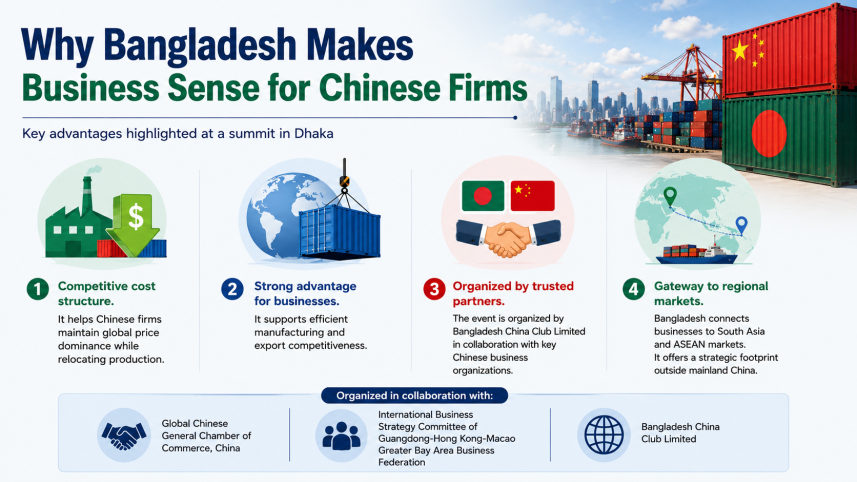
Bangladesh offers a competitive cost structure that enables Chinese firms to maintain global price dominance while relocating production, said Mohammad A Hafiz, vice president of the Bangladesh China Club Limited.
This creates a strong advantage for companies seeking efficient manufacturing alternatives while preserving profitability and export competitiveness in international markets, he added.

Hafiz made the comments during his presentation at a daylong summit in the capital today.
The event was organised by the Bangladesh China Club Limited in collaboration with representatives from the Global Chinese General Chamber of Commerce, China, and the International Business Strategy Committee of the Guangdong-Hong Kong-Macao Greater Bay Area Business Federation.
Hafiz also said that Bangladesh serves as a gateway to the broader South Asian and ASEAN markets, providing businesses with a strategic footprint outside mainland China.
Its geographic position and growing regional connectivity make the country an attractive hub for trade, investment, and supply chain diversification, he added.
In addition, Bangladesh has demonstrated proven leadership through a strong track record of managing successful multi-billion-dollar projects and international syndicated financing in the region, he said.
This experience reflects the country’s growing capability to support large-scale industrial development and long-term foreign investment partnerships, he added.
Hafiz also said that Bangladesh is addressing concerns related to energy stability by establishing new government-to-government frameworks for long-term LNG supply and expanding floating storage and regasification unit infrastructure to ensure uninterrupted industrial continuity.
The country is also improving regulatory compliance through stronger labour law standards and enhanced professional service rules designed to protect institutional investments, he added.
In addition, specialised asset management companies and strategic advisers are being utilized to ensure that investment capital is directed toward operational growth rather than passive debt accumulation, he added.
Bangladesh continues to demonstrate strong political commitment by maintaining solid bilateral ties and engaging in dedicated policy-level dialogues to create a secure and stable environment for foreign direct investment, he said.
He added that total bilateral trade between Bangladesh and China reached $24.05 billion, heavily driven by $22.88 billion in Chinese exports to Bangladesh compared to just $1.17 billion in Bangladeshi exports to China.
Saif Uddin Ahmed, chief executive officer at the Bangladesh Foreign Trade Institute, said that in the current era of global turbulence, including issues such as US reciprocal tariffs and geopolitical tensions involving the US-Israel war on Iran, Chinese investors may find opportunities to invest in and relocate their factories to Bangladesh.
Mohammad Mamdudur Rashid, managing director of the United Commercial Bank PLC, said the bank actively facilitates trade transactions and supports Chinese partners in foreign direct investment in Bangladesh, with a dedicated Chinese desk staffed by Mandarin-speaking colleagues to ensure smooth communication and efficient service.
He further outlined future areas of collaboration, including green energy and climate technology, agribusiness and food processing, logistics and supply chains, healthcare and pharmaceuticals, education and skill development, fintech and digital banking, and tourism and hospitality.
Muzaffar Ahmed, chairman of the Sustainable and Renewable Energy Development Authority, said that Bangladesh is one of the fastest-growing economies in Asia and has made significant progress in industrialization, infrastructure development, export growth, digital transformation, and energy development.
He said that the power, energy, and mineral resources sector offers significant opportunities for international investors and strategic partners, while the government remains committed to ensuring energy security, sustainable development, and a clean energy transition for future generations.
 For all latest news, follow The Daily Star's Google News channel.
Comments