


Bangladesh targets top-20 position in global telecom services: PM’s telecom adviser
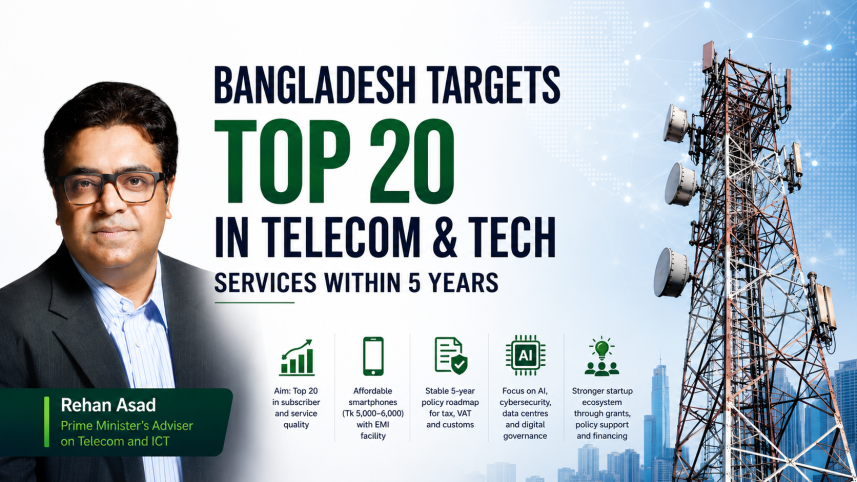
Bangladesh plans to position itself among the world’s top 20 countries in telecom and technology services within the next five years through a holistic digital economy strategy focused on connectivity, affordable access, startup growth, electronics manufacturing and skilled human resources.
The vision was outlined by Rehan Asad, the prime minister’s adviser on telecom and ICT, at a seminar titled “Telecom future: new government's vision” organised by the Telecom and Technology Reporters' Network Bangladesh (TRNB) at InterContinental Dhaka today.

Faqir Mahbub Anam, minister for telecom and ICT, and Md Emdad Ul Bari were also present at the programme.
“We are not only aiming to become a top-20 subscriber country, we want to become a top-20 service-quality country,” Rehan said, noting that Bangladesh already ranks among the top countries globally in terms of telecom subscribers but lags behind in service quality indicators.
According to different estimates, the telecom and ICT sector’s current contribution to Bangladesh’s GDP ranges from less than 1 percent to around 6 percent, but the figure could rise to 15 percent if the government develops a supportive ecosystem around the industry, he said.
“Yes, there will be challenges … But there is no reason why this sector cannot contribute 15 percent of GDP,” he said.
Rehan said that alongside network expansion, affordable devices and digital services are needed to ensure digital inclusion.
“We are talking about 4G and 5G, but if we do not focus on devices, then 4G and 5G mean nothing,” he said.
According to him, smartphone penetration in Bangladesh remains below 50 percent, while the cheapest smartphones still cost around Tk 10,000, making them unaffordable for many low-income users.
To address this, the government is working with local manufacturers, telecom operators, banks and mobile financial service providers to produce smartphones priced between Tk 5,000 and Tk 6,000 and introduce equal monthly instalment (EMI) facilities for consumers.
“If we can enable EMI, a farmer or rickshaw puller may be able to buy a smartphone through monthly payments,” he said.
The adviser also highlighted the need for stable and predictable policies to attract investment into the telecom and technology sectors.
“One of the biggest complaints from businesses is policy unpredictability. We want to provide a five-year roadmap for VAT, tax and customs policies so businesses can plan ahead,” he said.
He acknowledged concerns over the telecom sector’s high tax burden, saying operators face effective tax rates of up to 56 percent, significantly higher than the global average.
On spectrum policy, Rehan said the government’s priority is no longer limited to maximising revenue collection.
“Our priority is creating the ecosystem, the value chain and overall economic development,” he said.
The adviser also identified AI, cybersecurity, data centres and digital governance as key pillars of the government’s future technology strategy.
“Cybersecurity is absolutely critical,” he said, adding that both the public and private sectors would need to work together to improve the country’s cyber resilience.
He also drew comparisons with countries such as Vietnam and India, saying Bangladesh has the potential to become a major electronics manufacturing and export hub if it can ensure investment-friendly policies and support for entrepreneurs.
Rehan also said the government plans to strengthen the startup ecosystem through grants, policy support and financing facilities for young innovators and entrepreneurs.
 For all latest news, follow The Daily Star's Google News channel.
Comments