


Businesses trapped in bureaucratic gridlock
Execution of trade and investment-related policies is often slowed not by a lack of ideas but by poor coordination among government agencies, leaving businesses burdened by red tape and bureaucratic delays.
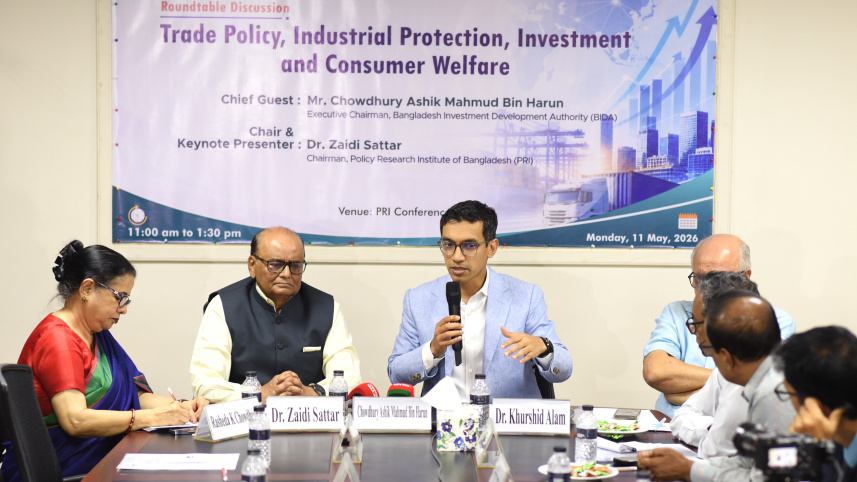
Speaking today at a roundtable, titled “Trade Policy, Industrial Protection, Investment Impacts and Consumer Welfare”, organised by the Policy Research Institute of Bangladesh (PRI) in Banani, experts said fragmented policymaking and inconsistent implementation continue to make the country’s business environment challenging despite broad agreement on the need for reforms.

“A government is a very fragmented system where different agencies often operate with their own interests and priorities, making coordinated reform efforts difficult despite broad agreement on policy changes,” said Ashik Chowdhury, executive chairman of the Bangladesh Investment Development Authority (Bida).
He said businesses continue to struggle with importing raw materials, clearing goods through ports and navigating multiple layers of bureaucracy, while poor coordination among agencies and operational inefficiencies raise costs for both companies and consumers.
Chowdhury added that the government has forwarded dozens of recommendations to the National Board of Revenue (NBR), including proposals for deregulation and a more predictable VAT structure.
The discussion also focused on Bangladesh’s long-standing protectionist trade policies and their impact on competitiveness.
Presenting the keynote paper, Zaidi Sattar, chairman of PRI, said tariff protection in Bangladesh has continued for decades without clear time limits or performance conditions.
“The industrial policy that we have is not one that you would like to see in the 21st century,” Sattar said, arguing that Bangladesh still follows an outdated “infant industry” protection model long after many sectors have matured.
He said the original purpose of protection was to give industries time to reduce production costs and become globally competitive, but many sectors in Bangladesh continue to rely heavily on tariff support rather than improving efficiency.
Sattar also pointed to what he described as a strong “anti-export bias” in trade policy. While export subsidies average around 7 percent, nominal protection rates stand at about 28 percent, allowing domestic industries to benefit more from tariff barriers than export incentives.
Rasheda K Choudhury, former adviser to the interim government, said policy discussions in Bangladesh largely revolve around businesses, tariffs and investment, while consumers remain “at the bottom” with little attention paid to their hardships.
She urged policymakers to strike a better balance between industrial protection and consumer welfare.
Echoing concerns over policy inconsistency, Taskeen Ahmed, president of the Dhaka Chamber of Commerce and Industry (DCCI), said protectionist policies and an overcentralised tax regime are holding back industrial growth and trade competitiveness.
He said businesses must also acknowledge their own shortcomings, but argued that many of the sector’s problems stem from conflicting government policies and excessive dependence on the NBR.
Former NBR member Md Farid Uddin questioned the overlapping responsibilities among agencies such as the Industries Ministry, Bida, Beza, Hi-Tech Park Authority and BSCIC.
Adding to the discussion, economist M Masrur Reaz said Bangladesh’s tax and tariff policies are designed primarily to raise revenue rather than support investment and expansion, discouraging foreign investment and weakening local industries’ competitiveness.
 For all latest news, follow The Daily Star's Google News channel.
Comments