


Finding home, identity, and art in ‘Parsa’s Pithas’
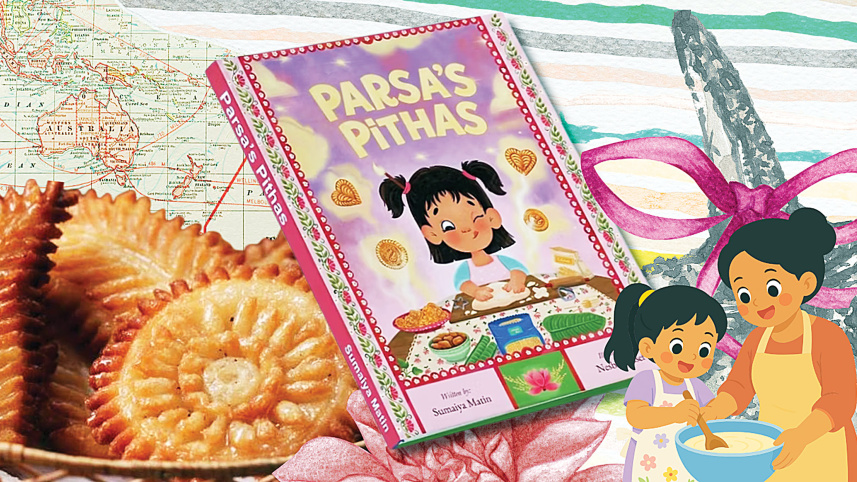
How do you stay connected to your own culture and roots while living thousands of miles away from home? This is the question at the heart of Sumaiya Matin’s debut children’s book Parsa’s Pithas. Set in Canada, the book tells the heartwarming story of a seven-year-old girl named Parsa who, through making pithas with her mother, is able to learn more about her Bangali roots and traditions while also gaining more confidence in her ability to express herself through her art.
The book opens with the young protagonist frustrated at her inability to draw the “perfect” sky. In dire need of a distraction, Parsa decides to take a break from her school art project to instead help her mother make nakshi pakon pithas for the Bangla New Year. However, as the two begin to make the pithas, Parsa’s frustration returns when she realises that she cannot make pithas as smoothly and intricately as her mother. First struggling to make the right consistency of dough, and then betrayed by the breaking of a toothpick, Parsa struggles with a question that every artist has asked themselves at least once —does art have to be perfect in order to be good?

Bangali culture and its traditions. The stories of Bangladeshi women told to Parsa by her mother in the book, combined with the vibrant and colourful illustrations by Nesba Yousef, act as the perfect introduction to Bangladeshi history.
For Parsa, the answer to this question is found in her mother’s stories about the Bangladeshi women who first made nakshi pakon pithas. Learning about the girls in Bangladesh who made art with whatever they had—rice flower, sticks, stones, and thorns of date palm trees—inspires Parsa to jump over the hurdle of perfectionism and focus her energy and creativity in expressing herself in her own unique way rather than trying to replicate what others are doing.
It is in this intertwining of cultural lessons with a story of a young girl persevering and learning not to give up that Parsa’s Pithas achieves immaculately what every good children’s book sets out to do—act as “mirrors, windows, and sliding glass doors” for children around the world.
First introduced by children’s literature scholar, Rudine Sims Bishop, the concept of “mirrors, windows, and sliding glass doors” is a metaphor for the different ways in which children can see themselves and the world around them in children’s books. Mirrors signify children seeing their own experiences reflected in the books they read, windows symbolise children learning about different cultures through books, and sliding glass doors refer to children using their imaginations to enter experiences that are different from their own. Bishop argues that all three of these reading experiences are essential to the development of a growing child. What makes Parsa’s Pithas so remarkable is that it is able to do all three of these things at the exact same time.
Written primarily with Bangladeshi diaspora children in mind, the book puts to pages an experience that is not often represented in books or media. Though there are an abundance of Bangladeshi children’s books with representation of Bangladeshi characters, we seldom see books made specifically for children who are learning to navigate their Bangladeshi roots and identity while living away from Bangladesh. Acting as a mirror, the story of Parsa and her mother keeping Bangali traditions alive by celebrating Bangla New Year all the way in Canada allows children of the Bangladeshi diaspora to finally see their own unique experiences and struggles be represented on paper.
Acting as a window, Parsa’s Pithas being a book that is written in English and available on the international market, offers many children, both in Bangladesh and outside, an insight into the Bangali culture and its traditions. The stories of Bangladeshi women told to Parsa by her mother in the book, combined with the vibrant and colourful illustrations by Nesba Yousef, act as the perfect introduction to Bangladeshi history. Furthermore, by framing the cultural lessons within the narrative of a young girl struggling with her artistic expression, the book is able to introduce Bangladeshi culture and values not as something that is unfamiliar and distant, but rather as something that everyone can learn from and incorporate into their own lives.
Lastly, it is in this invitation to participate, that the book shines the brightest. Going a step further than just introducing Bangladeshi culture to readers, with a full recipe for nakshi pakon pithas and an activities section, the book invites readers not only to learn, but fully immerse themselves in the culture they just read about.
It is here also that Matin’s message of embracing uniqueness over trying to replicate things perfectly comes in full clutch. For children in the diaspora, taking part in their culture may not always look the same as what it does for children living in Bangladesh. Many of them may be working with different tools, ingredients, and circumstances. However, as Parsa learns, just because something is different does not mean it is any less meaningful or beautiful in its own right. Afterall, sometimes to keep a culture alive is to be brave and resourceful enough to make it your own.
Shanjida Nowshin Chowdhury is a lecturer in the Department of English and Modern Languages at North South University.
 For all latest news, follow The Daily Star's Google News channel.
Comments