


Remembering Humayun Azad, the feminist
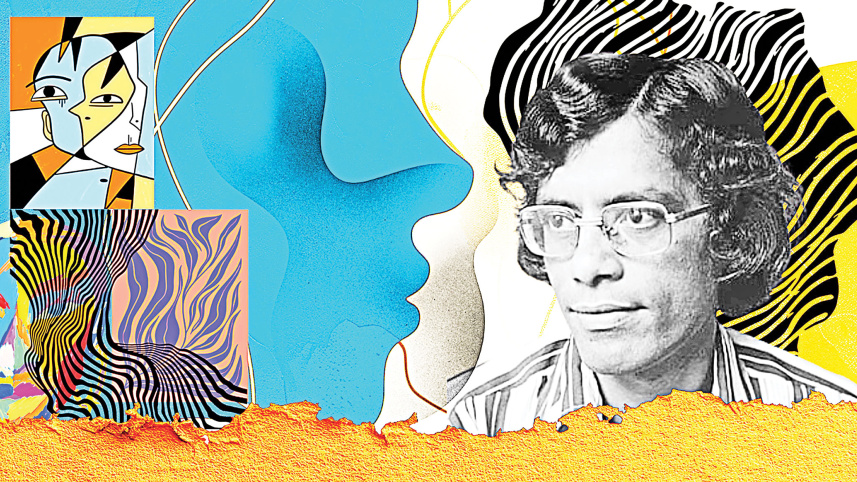
Humayun Azad has been described by different adjectives: progressive, anti-traditionalist, and anti-establishment- at different times. But less discussed is his work on feminist literature in Bangladesh. He wrote one of the most accessible books on feminist literature in Bangla, Nari (Agamee Prakashani, 1992). Lesser known still is that he translated one of the most seminal books on feminist theory, The Second Sex (1949), by Simone de Beauvoir in Bangla, titled Ditiyo Lingo, that was published in 2001.
Azad was a radical feminist, and he made that clear in the opening sections of Nari. His chief enemy is patriarchy, which he shows operates across race, class, and political ideology. Throughout the book, he details how, from ancient mythology to modern literature, from cavemen to modern, even progressive men, patriarchy affects everything. He draws from Mary Wollstonecraft, Friedrich Engels, Simone de Beauvoir, Kate Millett, and Catharine A. MacKinnon, among others.

Azad was writing in a time when the two top leaders in the two largest political parties in Bangladesh were female, and both of them went on to become Prime Ministers. Despite it being hailed as a success in a conservative nation like Bangladesh, Azad was never convinced. Rather, he maintained that both of these leaders were deeply reactionary, and demanded the emancipation of all women, not only of the elite class. This reflects how universal and radical he wanted his feminist commitments to be.
The novelist in his writings did not even spare one of his favourite poets. Through his deep knowledge of the Tagore canon, Azad exposes the deep misogyny lurking behind the romantic poetry of Rabindranath. He pinpoints how reactionary his thoughts on women were. Victorian misogyny was prevalent in Tagore’s literature, and Tagore was also critical of women’s liberation movements in his time, which Azad explores through Tagore’s essays.
A subtle irony surfaces when Azad explores the criticism of Sigmund Freud and the concept of Envy in psychoanalytic literature. In his other works, Azad is quite celebratory of science and is a proponent of scientific optimism, a notable example being Mohabissho (Agami Prokashoni, 2000), among many others. But in Nari, he exposes how science can be affected by patriarchy, and it is not as universal as it claims to be. He maintains that the reason Freud was so successful in spreading his misogynistic conception of the world was that he wrapped it in a scientific fashion. Not all of these insights were his own, but it is important to note how the opponents of women’s liberation still rely on different scientific arguments to support their position, without considering that the scientific endeavour in question might itself be a patriarchal production.
Probably an unusual but highly interesting focus of Azad is his attempt to discuss sex education, a subject still highly taboo in the Bangladeshi context. His description is brief, but the inclusion of such matters in Nari signals priority—he believes it is the duty of the state and society to teach young girls about their bodies and bodily autonomy. These are concepts we are still not comfortable with, even 35 years after the publication of the book, and probably this is part of the reason this aspect of Azad is less discussed.
Azad was not uncritical of the influence of patriarchy in his fellow progressives as well. He was conscious of the fact and demonstrated it through the example of Jean-Jacques Rousseau. Rousseau was one of the leading philosophers in the French Revolution, but despite claiming “Liberty, Equality and Fraternity” for all in theory, achieved them only for men in practice. In fact, Rousseau was not fond of liberty when it came to women despite being known as one of the forefathers of western liberalism. Progressive spheres, even in Azad’s time, were not free of patriarchy, as they are not now, and to ensure justice, we must be wary of that as well.
But can Azad be free from his own criticism?
This is an excerpt. Read the full article on The Daily Star and Star Books and Literature websites.
Sadman Ahmed Siam, as the name suggests, is indeed a sad man. Send him happy quotes at: siamahmed09944@gmail.com.
 For all latest news, follow The Daily Star's Google News channel.
Comments