


Why we should let adaptations be adaptations
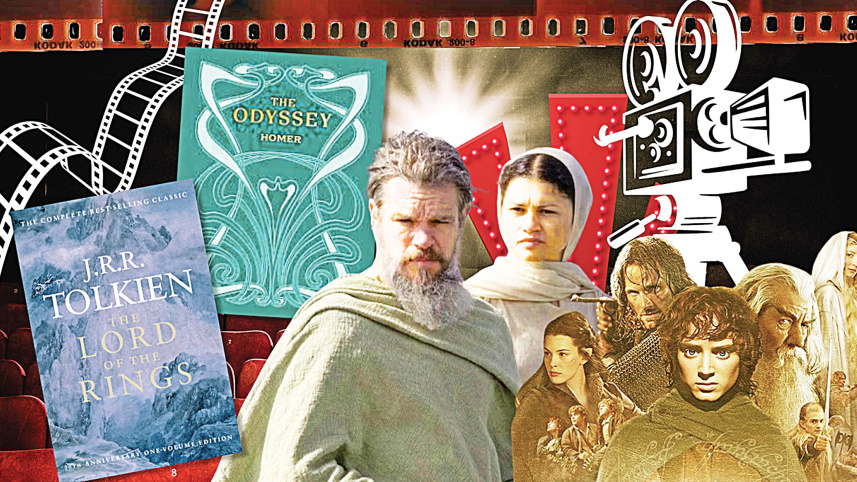
From the moment it was first announced to its theatrical release, Christopher Nolan’s The Odyssey (2026) has sparked immense debate amongst fans and critics alike. While some have praised the film for its breathtaking cinematography and innovative use of filming techniques, others have criticised what they perceive as a lack of narrative depth and fidelity to the original source material. Amidst the flood of online opinions, one voice that stands above the rest is that of classics scholar, Emily Wilson, whose 2017 translation of Homer’s epic is considered one of the most accessible versions of the poem for modern readers.
Wilson’s critique, among other things, focuses largely on the lack of depth of the female characters and removal of certain scenes from the film that, according to her, were essential to the moral complexity of the original text and packed a particularly strong punch. While a lot of Wilson’s criticism of the film holds true, one cannot help but wonder whether a true verdict on Nolan’s film can ever be achieved if it is consistently being compared to its source material. With all this in mind, before we decide whether an adaptation has succeeded or failed, perhaps we must first allow these works to be what they were always meant to be: adaptations, not reproductions.

There are a few reasons why we should let adaptations be adaptations:
We tend to think of the “original text” as something set in stone: the first version of the text written by the author, or maybe even the first edition of a book published to readers. However, a quick look into literary history reveals that the idea of the original text is not stagnant, but something that is constantly in motion. Take Homer’s The Odyssey for instance. Emerging in ancient Greece, the story of Odysseus’s epic journey was passed down through oral tradition—sung, recited, acted out by many different people across generations before it was eventually written down for us to read. In this regard, the original text isn’t one piece of writing written by a single person, but rather a story that has been shaped over the years by the many people who have heard it, carried it, and passed it on.
Even in a more modern context, where the first published work may be deemed as “the original”, if ultimately tied to the author’s intent, the original text can change depending on how the author chooses to look at their own work. J R R Tolkien for example, throughout his lifetime made several changes to The Hobbit (George Allen & Unwin, 1937) after its publication to help it better fit into the storylines he later set out in The Lord of the Rings (1954) trilogy. Other authors such as Christopher Castellani, Lindsay Ward, and JoDee Neathery among others have also expressed their interests in wanting to revise or edit their old work. This just goes to show that if the original text itself is prone to change, the same liberties can be extended to adaptations of those very texts.
With different modes of storytelling, there comes the need to evaluate how stories translate across different formats. Every adaptation by its nature is an interpretation where key decisions have to be made regarding what to preserve, what to discard, and what to alter. How exactly are these decisions made? More often than not, it comes down to what that particular story means to the person who is interpreting the text. If we are to look at both Wilson and Nolan’s adaptations of The Odyssey for instance, it becomes increasingly clear that a personal connection to the text can often dictate what we deem to be most important about it.
Nolan’s ‘The Odyssey’, while not above criticism, has undoubtedly helped introduce this timeless epic to a new generation of readers, a feat that even Wilson herself could not help but acknowledge in her otherwise strongly worded review of Nolan’s film.
Back in 2017, Emily Wilson was the first ever woman to publish a complete translation of The Odyssey from Greek to English. At that time, her translation received both acclaim and criticism due to its focus on a more contemporary understanding of the epic. Most notably, her focus on fleshing out female characters and describing Odysseus as a “complicated man” with moral ambiguity caused a stir among purists who believed that it was wrong to hold Homer’s story and characters to modern standards of morality. Wilson’s main line of defense at the time was that every translation is different as the translator inevitably interprets the text through their own cultural context, values, and understanding of the story.
Applying this same logic to Nolan’s The Odyssey, critiques regarding his storytelling choices can be tempered when considering that his adaptation focused largely on visual storytelling and therefore prioritises elements of the epic that can be communicated through imagery, spectacle, and performance, rather than through Homer’s original narrative form or Wilson’s focus on moral complexity.
We’ve established by now that interpretation lies at the heart of adaptation. The next question to then emerge from this discussion may ask, whose interpretation do we consider valid? In his famous essay “The Death of the Author” (Aspen, 1967), Ronald Barthes argues that once published, the meaning of a text is not solely in the hand of the writer, but the reader who may now choose to read and interpret the text beyond the realms of what the author originally intended. As such, in many ways the ownership of the text shifts from the author to the reader.
Considering this argument, one cannot claim that Nolan, or anyone else for that matter, has a responsibility to remain completely faithful to the text because the core idea of what the story itself is or means, does not exclusively belong to one person. As a reader, Nolan has the right to engage with The Odyssey and reimagine it in ways that make most sense to him. Even in the face of criticism from the author themselves—and in this case Wilson’s criticism of Nolan’s use of her translation as the main inspiration or source material for his film adaptation—it does not change the fact that Nolan’s adaptation is valid in its own right. Ultimately, in adapting the text, Nolan is not simply reproducing, but interpreting the story through his own creative lens; a reading that does not suddenly become illegitimate simply because it does not align with what Wilson originally intended.
Lastly, and perhaps the most important reason we must let adaptations be adaptations is because without them so many classics may remain unknown to new generations. Think of how many people first picked up Shakespeare after watching Baz Luhrmann’s Romeo + Juliet (1996), or how the film Clueless (1995), for an entire generation, became the gateway to reading Jane Austen. Adaptations help make classics more accessible to new audiences which in turn help them stay relevant even centuries after they are first released into the world.
Nolan’s The Odyssey, while not above criticism, has undoubtedly helped introduce this timeless epic to a new generation of readers, a feat that even Wilson herself could not help but acknowledge in her otherwise strongly worded review of Nolan’s film. Publishers Weekly reports that across all editions, the book sales of The Odyssey have gone up by 76% surrounding the film’s release.
Ultimately, it is perhaps this excuse to return to beloved stories that we should be looking for in adaptations. The Odyssey has survived for as long as it has precisely because it had been told and retold for centuries upon end, catering to new generations of audiences. So, when it comes to adaptations, maybe it is time we stopped judging how accurately they are able to reproduce the past, but rather how well they can carry these stories on into the future.
Shanjida Nowshin Chowdhury is a lecturer in the Department of English and Modern Languages at North South University.
 For all latest news, follow The Daily Star's Google News channel.
Comments