


Rabindranath, Nazrul, Jibanananda: Predecessor and contemporary
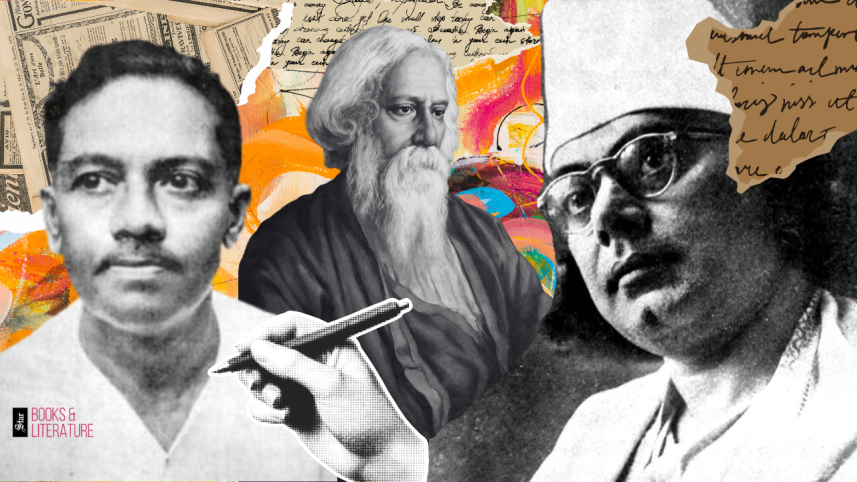
The relationship among Rabindranath Tagore, Kazi Nazrul Islam, and Jibonananda Das can be understood through the ideas of predecessor and contemporary though the terms apply differently depending on perspective.
Rabindranath Tagore was the predecessor of both Kazi Nazrul Islam and Jibanananda Das, yet all three were also contemporaries for a considerable period. Nazrul and Jibanananda, both born in 1899, belonged to the same generation and emerged as Tagore’s successors in Bengali poetry. Being 38 years younger than Tagore, they inherited a literary tradition already transformed by his genius while forging their own distinct poetic identities. Intriguingly, despite the generational gap, the three poets shared a remarkable period of poetic contemporaneity spanning about 22 years—from 1919, when Nazrul and Jibanananda began publishing, until Tagore’s death in 1941.

Being at once predecessor and contemporaries, Rabindranath Tagore, Kazi Nazrul Islam, and Jibanananda Das naturally knew one another and, to varying degrees, interacted personally as well as intellectually. Their overlapping literary careers created opportunities for mutual recognition, influence, appreciation, and critical engagement. Exploring the nature of their interactions, the ways they perceived one another as poets, and the literary dialogues, if any, that emerged among these three towering figures of modern Bengali poetry promises to be revealing and fascinating.
We know that W. B. Yeats, Ezra Pound, and T. S. Eliot were contemporaries whose literary lives intersected in significant ways, although their relationships were neither equally close nor equally sustained. Pound played a decisive role in Eliot’s early poetic career; indeed, Eliot entrusted the manuscript of The Waste Land (1922) to Pound, whose editorial interventions proved invaluable. Eliot and Yeats also knew one another and engaged critically with each other’s work, while Pound’s relationship with Yeats—who was the oldest of the three—though more complex, was nonetheless intellectually fruitful. By contrast, the relationship among Rabindranath Tagore, Kazi Nazrul Islam, and Jibanananda Das presents a markedly different picture. Although Rabindranath and Yeats developed a close friendship and collaborated meaningfully in writing the celebrated introduction and promoting the English Gitanjali (1912), no comparable pattern of sustained literary collaboration or critical exchange appears to have developed among the three great Bengali poets.
What W. B. Yeats, Ezra Pound, and T. S. Eliot accomplished in English poetry finds a broad parallel in what Rabindranath Tagore, Kazi Nazrul Islam, and Jibanananda Das accomplished in Bangla poetry: they collectively guided their respective poetic traditions through the transition from the late Renaissance and Romantic inheritance toward literary modernism.
Although Kazi Nazrul Islam is often remembered chiefly as the Rebel Poet and a fierce critic of the British Raj, he was also receptive to the emerging currents of literary modernism. His anticolonial politics did not prevent him from experimenting with new poetic forms, complex imagery, and cosmopolitan influences. In this respect, Nazrul stands alongside Rabindranath Tagore and Jibanananda Das as one of the principal figures who helped steer Bangla poetry toward modernism. Although some literary historians would hesitate to call Nazrul a fully modernist in the way that Jibanananda Das is, it is a more widely accepted formulation that Nazrul was a transitional or proto-modernist figure whose innovations significantly contributed to the emergence of modernism in Bangla poetry.
With these literary analogies in view, let us turn to the relationship between Rabindranath Tagore and Kazi Nazrul Islam, beginning with Rabindranath’s attitude towards Nazrul and then considering Nazrul’s response to his illustrious predecessor. Their association constitutes one of the most compelling chapters in the history of modern Bengali literature. Separated by a generation and distinguished by markedly different poetic sensibilities, they nevertheless remained bound by a profound and reciprocal esteem. Their temperaments, aesthetic commitments, and ideological emphases often diverged, yet these differences never diminished the authenticity of their admiration for one another. On the contrary, their relationship exemplifies how creative individuality can coexist with intellectual generosity. The mutual respect they shared was neither perfunctory nor strategic; it was deeply felt, consistently expressed, and amply documented in their writings, public statements, and personal gestures.
Tagore dedicated his dance-drama “Basanta” (1923) to Nazrul. The dedication reads, “To Sriman Poet Kazi Nazrul Islam”, with affectionate blessings. This was a remarkable gesture, considering Rabindranath rarely dedicated works to younger contemporaries. Tagore recognised Nazrul’s extraordinary genius very early. Despite Nazrul’s rebellious voice and unconventional style, which in many respects did not accord with Rabindranath Tagore’s own poetic philosophy and aesthetic ideals, Tagore welcomed the younger poet as a powerful new force in Bengali literature. Recognising his extraordinary talent, he readily acknowledged Nazrul as a “Sriman Kabi” (“Honoured Poet”), a gesture that testified not only to his generosity of spirit but also to his discerning appreciation of literary genius beyond differences in temperament and artistic vision.At a time when many Bengali poets wrote under the overwhelming influence of Tagore, Nazrul established an entirely different poetic voice—fiery, revolutionary, musical, and Islamic as well as secular and universal in cultural references. Tagore valued this originality.
Although Tagore did not leave behind a long critical essay on Nazrul’s poetry, his actions and correspondence consistently show that he regarded Nazrul as: a poet of exceptional originality, a powerful new voice, and one of the most important younger Bengali poets of his age.
Many critics have argued that Tagore’s affinity for British culture—apparently in diametric contrast to Nazrul’s anti-colonial mindset—was reflected not only in certain aspects of his outlook but also in his continued use of the anglicised form of his family name, Tagore, rather than the more phonetically faithful Thakur. They contend that, despite his profound love for the Bengali language and culture, Rabindranath never chose to abandon the English spelling of his surname. Such arguments, however, remain open to debate and should be viewed within the broader historical context of colonial Bengal, where anglicised spellings of Bengali names had become commonplace among many educated families. In fact, the spelling “Tagore” was inherited from earlier generations of Rabindranath’s family. Nazrul, however, was largely untroubled by such petty prejudices. His modernist approach to life fostered an intellectual generosity that allowed him to transcend ideological differences and acknowledge Tagore’s enduring literary greatness.
Rabindranath Tagore’s deeply rooted anti-colonial convictions, though expressed with greater restraint than Nazrul’s fiery militancy, are perhaps most clearly discernible in his response to Nazrul’s imprisonment in 1923 following the publication of Dhumketu (1922). At that critical moment, Tagore sent Nazrul a telegram urging him to preserve his strength and not to squander his life in protest: “Give up hunger strike. Our literature claims you.”
Tagore’s advice bears a striking resemblance to the central moral dilemma in Bertolt Brecht’s “Life of Galileo” (first performed in 1943). Faced with the threat of the Inquisition, Galileo publicly recants his scientific convictions—not out of cowardice, but in order to preserve his life and continue his intellectual work in secret. By remaining alive, he is able to complete and transmit his Discorsi (1638), thereby ensuring that scientific truth ultimately survives political and religious oppression. Likewise, Tagore urged Nazrul not to squander his life in futile self-sacrifice but to preserve his strength so that he might continue enriching Bengali literature and inspiring the struggle against colonial injustice through his creative genius. In both instances, survival is presented not as surrender but as a strategic means of sustaining a greater intellectual and moral resistance.
Reciprocatively Nazrul admired Tagore profoundly throughout his life. Although Nazrul became the poet of rebellion and social revolution, he never rejected Tagore’s literary greatness. Evidences include Nazrul’s repeated reference to Tagore as Kabiguru (Revered Poet-Guru), Bishwakobi (World Poet), and Kabishomrat (Poet-Emperor). These were not mere honorifics; they reflected Nazrul’s conviction that Tagore was the greatest creative force in modern Bengali literature. He openly acknowledged Tagore as the supreme literary figure of Bengal while insisting that younger poets should also cultivate their own voices.
Following Rabindranath Tagore’s death in 1941, Nazrul composed a heartfelt elegiac poem, “Rabihara” (Bereft of the Sun), and wrote songs mourning the passing of the poet whom he regarded as the supreme creative force in Bengali literature. In this respect, Nazrul’s response invites comparison with Walt Whitman’s elegiac tributes to Abraham Lincoln, particularly “O Captain! My Captain!” and “When Lilacs Last in the Dooryard Bloom’d”. In both cases, the death of a towering national figure inspired poetry that transcended personal grief to become an enduring expression of a nation’s cultural bereavement.
But there were subtle differences too. Tagore’s worldview tended toward spiritual humanism, philosophical reflection, and gradual social transformation. Nazrul’s poetry was more immediate and militant. He denounced colonialism, religious hypocrisy, class oppression, and social injustice with explosive energy. Yet these differences were aesthetic and artistic rather than personal.
Nazrul dedicated his collected poems, Sanchita (1925), to Rabindranath. The dedication reads: “At the revered lotus feet of the World Poet.” This was one of the strongest literary tributes a younger poet could offer to his senior contemporary.
In the 1920s and 1930s, some young writers argued that Bengali literature should move beyond Tagore. Nazrul rejected this antagonistic attitude. He maintained that creating a new literature did not require rejecting Tagore. One of his best-known remarks is: “No one can become great in Bengali literature by denying Rabindranath.” This sentence is widely quoted in Bengali literary discussions. However, scholars note that its exact original source is difficult to establish, so it is safest to treat it as a well-known attributed statement rather than a fully verified quotation.
Tagore represented a mature, universal humanism; Nazrul embodied youthful revolt. Together they enriched Bengali literature from complementary directions. The relationship between Tagore and Nazrul was marked by mutual admiration rather than rivalry. Tagore recognized Nazrul’s exceptional originality and encouraged him, while Nazrul revered Tagore as the greatest literary figure of his age. Their differing artistic visions created a productive diversity that became one of the defining strengths of modern Bengali literature.
Rabindranath Tagore’s assessment of Jibanananda Das was mixed and evolved over time. His comments can be divided into three stages. After reading Jibanananda’s first collection, Jhara Palak (1927), Tagore reportedly wrote not a very welcoming note to him: “Works of a high order possess an inner serenity. Where I find a disturbance of that serenity, I begin to doubt their permanence.” But this was not a total dismissal of Jibanananda’s talent. Rather, Tagore felt the poems were restless and lacked the composure he associated with enduring poetry. About a decade later, after reading Dhusar Pandulipi (1936), Tagore sent Jibanananda a brief but warm note on March 12, 1937: “I have enjoyed reading your poems. Your writing has aesthetic delight, originality, and the joy of keen observation.” This is Tagore’s most unequivocal praise of Jibanananda. He singled out three qualities: “rasha” (aesthetic appeal), “shawkiota” (originality), and “takie dekhar anando” (the delight of close observation).
When Jibanananda’s poem “Mrityur Aage” appeared in the first issue of Kobita magazine (1935) edited by Buddhadeva Bose, Tagore wrote to the editor: “Jibanananda Das’s vivid, colourful poem has given me great pleasure.” Between 1927 and 1935, Rabindranath Tagore’s perception of Jibanananda Das’s poetic aesthetics underwent a significant transformation. It was perhaps this evolving understanding that shaped his discriminating critical assessment of the poetic achievements of Kazi Nazrul Islam and Jibanananda Das.
 For all latest news, follow The Daily Star's Google News channel.
 Many scholars believe Tagore never fully grasped the radically modern, existential quality of Jibanananda’s poetry. Tagore’s aesthetic ideal emphasised harmony and fullness of life, whereas Jibanananda explored solitude, uncertainty, fractured time, and a haunting sense of history. As a result, Tagore appreciated Jibanananda’s originality and imagery but did not explicitly recognise him as the major poetic innovator he is regarded as today.
Reversely, Jibanananda Das’s assessment of Rabindranath Tagore was both deeply reverential and critically independent. He regarded Tagore as the greatest poet in Bengali literature while insisting that later poets must find their own voice rather than merely imitate him.
In his essays, especially in Kobitar Kotha (1962), Jibanananda repeatedly acknowledged Tagore’s extraordinary stature. One of his best-known statements is: “Rabindranath’s genius and imaginative power are unparalleled in our literature.” Jibanananda believed that no Bengali poet could ignore Tagore’s achievement. Jibanananda argued that because Tagore’s influence was so immense, younger poets faced a unique challenge. They had to absorb his legacy but avoid becoming mere imitators. He wrote that a poet born after Tagore must discover a new poetic language and sensibility appropriate to his own age. This idea became central to Bengali modernism.
Jibanananda did not reject Tagore. Instead, he argued that history changes literature. The modern world—with its wars, urban alienation, scientific thought, and fractured consciousness—required new forms of poetry. Thus, while Tagore remained indispensable, later poets could not simply continue writing in his manner.
Unlike many of his contemporaries, Jibanananda Das did not write extensive critical essays evaluating Kazi Nazrul Islam or his poetry. There is no major essay by Jibanananda devoted exclusively to Nazrul comparable to the criticism written by Buddhadeva Bose or Abu Sayeed Ayyub.
What we do know is, Jibanananda acknowledged Nazrul’s importance in the evolution of modern Bengali poetry. His own early poems, especially those in Jhara Palak (1927), clearly show the influence of Nazrul’s energetic rhythm, diction, and romantic-revolutionary tone before Jibanananda developed his own distinctive voice.
In his essays on poetry—particularly Kobitar Kotha—Jibanananda discussed the nature of modern poetry in general rather than offering sustained assessments of individual contemporaries. Nazrul is mentioned only in passing, not as the subject of detailed criticism. There is no well-authenticated statement by Jibanananda praising or criticising Nazrul’s poetry in the memorable way that Rabindranath commented on Jibanananda, or that Nazrul reportedly joked about Jibanananda’s fondness for metaphor.
Nazrul, according to later reminiscences, is said to have once teased Jibanananda’s dense imagery with the quip that “metaphor is more important than mother” to him. Whether reported exactly in those words or paraphrased, the anecdote reflects contemporary perceptions of Jibanananda’s highly metaphorical style rather than a formal literary critique.
The anecdote has been repeated by later critics and essayists, but there is no contemporary published source that definitively records when or where Nazrul said it. It should therefore be treated as an oft-repeated literary reminiscence rather than a fully documented quotation.
Beyond this anecdote there is no known essay, review, or lecture in which Nazrul offers a sustained critical assessment of Jibanananda’s poetry. This is unsurprising because by the early 1940s, when Jibanananda’s mature reputation was beginning to emerge with works like Banalata Sen and Mahaprithibi, Nazrul had already become seriously ill and lost his ability to write and speak productively.
So, unlike Rabindranath Tagore, who left documented comments on Jibanananda, Nazrul did not leave an authenticated body of criticism on him. What survives is essentially that famous humorous remark, whose authenticity cannot be verified beyond later recollections.
One more revealing anecdote, once narrated to the present writer by Dr Naresh Guha, former Professor of Comparative Literature at Jadavpur University, and an eminent poet and literary critic, deserves mention here. Dr Guha recalled that, while walking near Jadavpur in Kolkata one day, he unexpectedly saw Jibanananda Das approaching from the opposite side of the road. Although Jibanananda was well known for his reserved nature and his tendency to avoid casual encounters, on this occasion he walked directly up to Guha and remarked, almost as if speaking to himself, “There are some people who are born popular, and Nazrul is one of them.” Without waiting for a response, he quietly walked away. Whether intended as admiration, observation, or a mixture of both, the remark suggests Jibanananda’s recognition of Nazrul’s extraordinary public appeal—a quality that contrasted sharply with his own quieter and more introspective literary persona. His reserved disposition may well have contributed to the delayed recognition of his extraordinary poetic achievement.
The literary relationship among Rabindranath Tagore, Kazi Nazrul Islam, and Jibanananda Das is best understood through the dual concepts of predecessor and contemporary. Tagore was the acknowledged precursor, while Nazrul and Jibanananda, born in the same year, belonged to a younger generation that inherited and transformed his legacy. Their overlapping literary careers, spanning approximately 22 years (1919 to 1941), created one of the most fertile periods in Bengali literary history. Like Yeats, Pound, and Eliot in English poetry, they collectively guided their poetic tradition through a profound transition—from the humanistic and Romantic inheritance of the Bengal Renaissance to the diverse sensibilities of modernism. Their relationships were marked not by rivalry but by influence, critical engagement, and mutual recognition. Together they laid the intellectual and aesthetic foundations of modern Bengali poetry, leaving a legacy that continues to shape Bengali literary thought and artistic practice.
Abdus Selim is an eminent academic and translator. He can be reached at selim70plus@gmail.com.
Comments