


A book on education, and a rare moment of hope
A few months ago, while waiting for my matter to be called in court, I watched a young lawyer rise to make a submission. He was sincere. He was nervous. He had clearly spent time reading his brief. But within minutes, the problem became obvious. He could not organise his thoughts— his sentences were broken, even his argument had no beginning, middle, or end. When the judge asked him a simple question about the authority he was relying on, he struggled to explain what the case actually held.
This was not an isolated incident. Anyone who regularly practices in our courts has seen versions of this scene. Young lawyers often come to the profession with degrees, certificates, and impressive enthusiasm, but without the habits of research, clarity of language, disciplined reasoning, and persuasive expression. Some of these weaknesses belong to legal education. But many begin much earlier. Rhetoric and grammar do not suddenly appear in law school. The ability to read carefully, speak clearly, think in sequence, and write with some elegance should be built from childhood. That is the promise of a good primary education. In Bangladesh, that promise is too often broken.

In the legal profession, we see the consequences every day. A weak school system eventually becomes a weak university system. A weak university system eventually produces weak professionals. The courts then inherit the damage. Poor drafting slows justice. Poor research weakens advocacy. Poor language clouds arguments, and poor reasoning undermines the rule of law. Education, therefore, is not only a matter for schools and teachers. It is a matter for the entire republic.
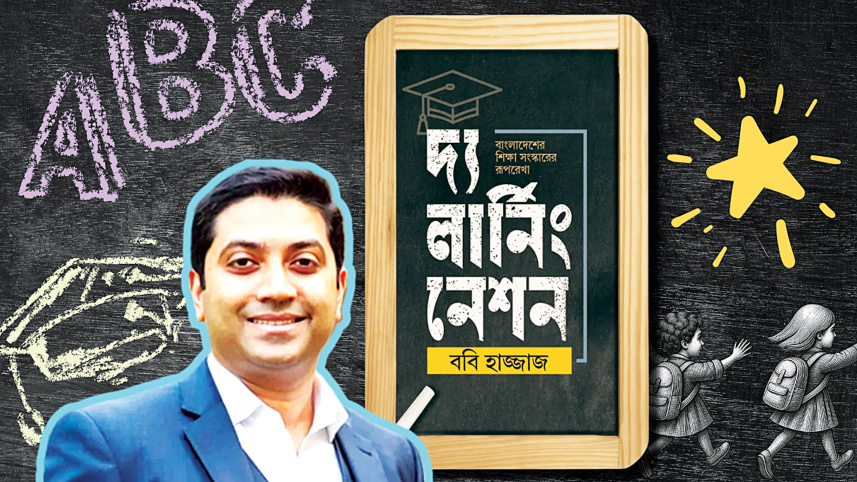
It is from this concern that I read The Learning Nation with unusual interest. Books by politicians are often ceremonial. They are written to record speeches, advertise achievements, or preserve slogans. But this book is different. It is a serious attempt to understand why Bangladesh’s education system has failed to convert national ambition into real human capability. More importantly, it tries to offer a path forward.
I have known Bobby Hajjaj for some years as a political leader. I have also known him as a teacher, a public speaker, and a person with a restless interest in ideas. Still, I confess that I was pleasantly surprised by the intellectual depth of the book. It is not merely a minister’s note. It is not a list of promises. It is a structured argument about education as state-building.
If this government continues to place capable people in positions where their knowledge matches their responsibility, then perhaps good things can still be expected. And if primary education is finally treated as the foundation of national life, then one day, in our courts and beyond them, we may see a generation that can read with care, speak with confidence, argue with grace, and think with freedom.
That distinction matters. In Bangladesh, we often discuss education in narrow terms: schools, books, exams, buildings, teachers, stipends, and pass rates. All of these are important. But the book asks a deeper question: what kind of citizen is the education system supposed to produce? A child who can pass an exam but cannot think is not truly educated. A student who can memorise a textbook but cannot speak with confidence, write with clarity, or solve practical problems is not prepared for life. A nation that expands schooling without improving learning is only producing the appearance of progress.
One of the strengths of the book is that it treats primary education as the foundation of everything else. This should be obvious, but in policy circles it is often forgotten. We spend too much time debating university rankings, foreign degrees, and elite institutions, while millions of children struggle with basic reading, numeracy, and expression. Hajjaj’s emphasis on language literacy, numerical literacy, civic understanding, communication skills, and joyful learning is therefore timely and necessary.
The book is also valuable because it does not romanticise reform. It recognises that Bangladesh’s education problems are not caused by one bad policy or one weak institution. They are systemic. Teacher quality, classroom hours, curriculum design, assessment integrity, governance, financing, parental expectations, technology, school infrastructure, and political priorities all interact with one another. A child’s learning depends not only on the textbook but also on whether the teacher is trained, the school day is meaningful, the assessment rewards understanding, parents trust the school, and the state actually monitors outcomes.
As a lawyer, I found the book’s institutional approach especially important. Education reform cannot survive if it is treated as a slogan of one minister or one government department. It requires durable institutions, clear responsibilities, measurable outcomes, and public accountability. In that sense, the book speaks not only to educationists but also to constitutional lawyers, administrators, and anyone interested in governance.
The discussion on teacher training and professional development is particularly strong. Bangladesh cannot build a serious education system if teachers are treated as clerical employees rather than nation-builders. Recruitment, training, career progression, dignity, supervision, and incentives must be aligned. The author seems to understand that a teacher who is unsupported, undertrained, and demoralised cannot produce confident children, no matter how ambitious the curriculum may be.
That said, the book has a few limitations. One area where I wished for more discussion is legal education. The author rightly focuses on the broad education pipeline, especially primary and foundational learning. But the crisis in legal education deserves separate attention. Our law graduates often leave university without sufficient training in legal writing, jurisprudential reasoning, statutory interpretation, comparative constitutional thinking, or courtroom advocacy. If the book had drawn a stronger line from primary literacy to professional legal competence, it would have helped readers in my field see the full chain of failure more clearly.
A second, smaller concern is that some of the reform ideas are highly ambitious. Ambition is welcome, but future editions may benefit from sharper sequencing between immediate actions, pilot projects, and long-term institutional reforms.
These are minor criticisms. They do not reduce the importance of the work. If anything, they show that the book deserves to be engaged with seriously, not merely praised ceremonially.
What gives the book its particular significance is the author’s present role. It is rare in Bangladesh to see a political leader in charge of a ministry who has also written a serious, academic, policy-oriented book on the very subject of that ministry. This matters because education reform requires more than good intentions. It requires knowledge, patience, administrative courage, and the ability to connect ideas with institutions. A minister who understands the theory of the problem is better placed to ask the right questions in office.
Of course, a book alone cannot reform a system. Nor can one minister, however capable, transform education overnight. But ideas matter. Seriousness and competence matter. For too long, our public life has suffered from the belief that any person can be placed in any position and still produce results. Education teaches us the opposite. Skill, preparation, and knowledge are not luxuries. They are the difference between noise and progress.
For that reason, Hajjaj’s book should be welcomed not only as a book but as a signal. It suggests that policy can still be thoughtful, that politics can still be connected to learning, and that public office can still attract people who have done the intellectual work before entering the room of decision-making.
If this government continues to place capable people in positions where their knowledge matches their responsibility, then perhaps good things can still be expected. And if primary education is finally treated as the foundation of national life, then one day, in our courts and beyond them, we may see a generation that can read with care, speak with confidence, argue with grace, and think with freedom.
Barrister Shahedul Azam is Advocate, Supreme Court of Bangladesh and Partner, Credence LP.
 For all latest news, follow The Daily Star's Google News channel.
Comments