


The ever-enduring Adit

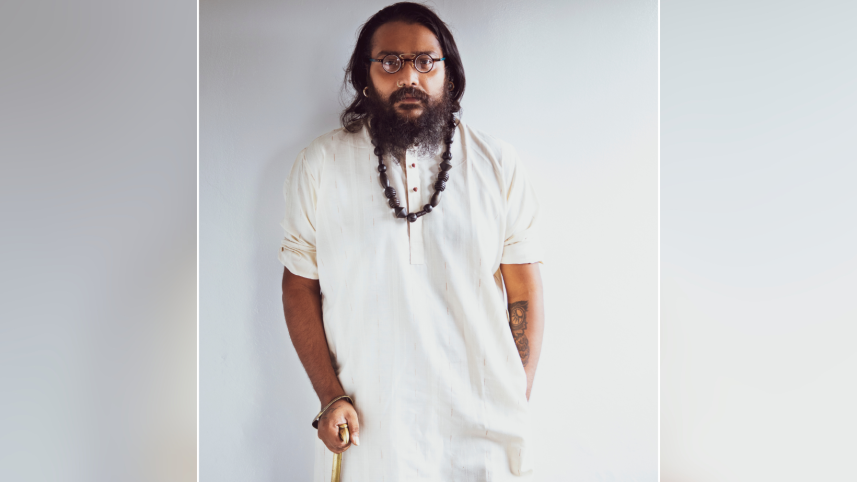
Adit Rahman is one of the prominent music directors in Bangladesh, known for his distinctive arrangements and his willingness to experiment with sound. Over the years, he has worked across albums, films, advertisements and visual projects, creating music that often brings together traditional Bangladeshi sounds with contemporary arrangements. His notable works include songs such as “Mon Doriya”, “Aaj Ei Akash”, “Opekkha”, “Tomari Mohey”, “Hridoyer Jhorey”, “Jochona” and “Ghum Hoye”, among others. He has also worked on projects including “Patar Bashori”, “Nasek Nasek”, “Mast Qalandar” and “Shondhatara” for Coke Studio Bangla.
In an exclusive interview with The Daily Star, Adit reflects on his journey, his approach to music and the often overlooked role of a music director.

For Adit, music was never simply a career choice. His interest began with the sounds behind a song rather than the singer in front of it. “Whenever I listened to music during my childhood, I was always attracted to everything that was playing apart from the voice. I understood at a very young age how important the music behind a singer is. I wanted to know what was playing in the background,” he said.
His interest eventually led him to learn guitar from legendary singer-songwriter Hyder Husyn. However, the lessons were not limited to learning the instrument. “My first guru was Hyder Husyn. He trained my ears. He would play a song and ask me what instruments were playing, and which ones were playing correctly and which ones were not,” he recalled.
His professional journey in the mainstream industry began when he approached Shayan Chowdhury Arnob and offered to assist him. That opportunity led him to work on “Monpura”. Adit considers Arnob his second guru. “My professional world actually started through Arnob da. He told me that he was working on a film called ‘Monpura’ and that I could assist him if I wanted to. Through him, I became a music director for a film for the first time,” he shared. “Arnob da really taught me and paved my path to the professional world. I am still learning so much from them.”

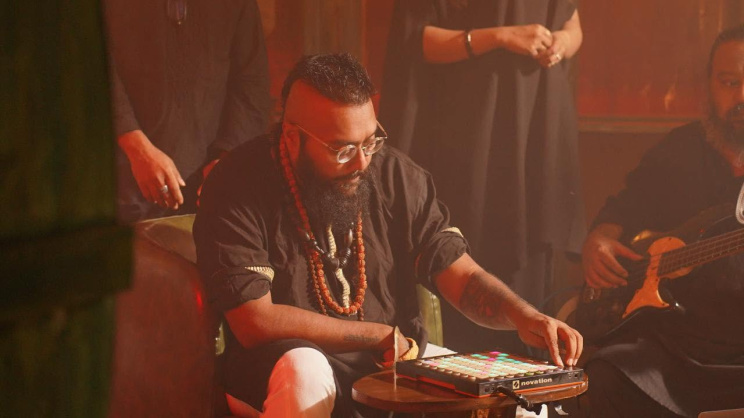
Adit’s approach to music has always been centred on experimentation. He believes that music can be found in almost every sound around us. “Every kind of sound we hear in the world carries some kind of note. It can be a car horn, thunder and lightning, the sound of an air conditioner or a fan. Every sound around us carries something.”
This belief has encouraged him to use unusual instruments and sounds in his work. He has experimented with saxophone, accordion, cello and clarinet, among others. At one point, he even travelled to Goa to record a handpan played by a French musician. “I always had a weakness for live instruments. I try to use interesting instruments that people in our country have not experienced before. When these new sounds come onto my canvas, something unique comes out,” he said.
For Adit, being different is not simply a creative choice. It is something he learned from his mentors. He said, “My gurus taught me one thing: try to be unique. Your music arrangement and your sound design should not be conventional or like everyone else’s. Otherwise, what makes it different?”
His work on “Patar Bashori” is one example of this approach. While working on the song, he imagined a tango influence and experimented with using a harmonium instead of an accordion, along with tabla.
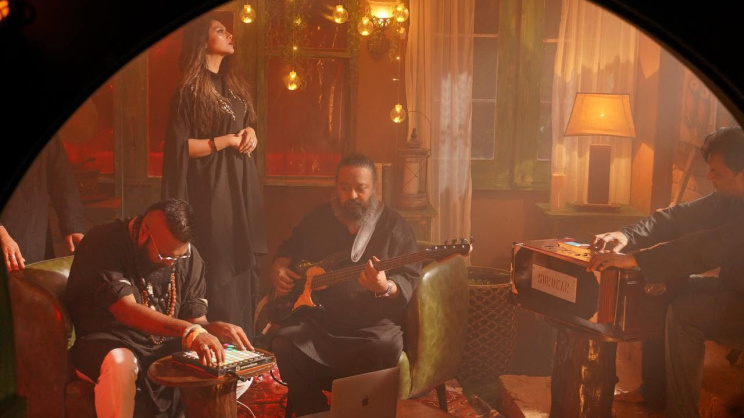
Despite working in a commercial industry, Adit says he has never been able to create music simply by thinking about what the audience might like. “There are two kinds of songs. One is made by thinking about the audience, and another is made by thinking about what the artiste wants to do. I have always thought about what I am thinking, how I imagine my sound and what kind of sound I want to hear. If the audience likes my sound, that is a great blessing for me. When a song comes to me, I give more importance to what I am feeling,” he said.
He believes this can sometimes be a weakness, but it is also what protects an artiste’s individuality. “Every artiste is an individual and every artiste has their own taste. If the audience likes my style, they will. If they do not, that is my bad luck.”
For Adit, every song is something deeply personal. “Every creation is your child. Just as I cannot say which of my two daughters I love more, I cannot say which of my creations I love more,” he said.
He also spoke passionately about a part of the music industry that he believes remains poorly understood: the role of the music director. “It hurts me when people still ask me, ‘What does a music director do? One person wrote the lyrics and another composed the melody, so what does the music director do?’” he said.
According to Adit, a finished song involves far more work than what listeners usually notice. “When a song is raw, how you arrange it, what instruments you use and which musicians you select are all very important. There are many steps involved. A guitar take is just as important as a vocal take,” he explained.
He gave “Patar Bashori” as an example. The song required a change in scale because the two singers could not comfortably perform it in the same scale. “Maybe one person in ten lakh told me that I changed the scale in the middle of the song. The reason was that Sunidhi and Ishaan could not sing on the same scale. These are the kinds of things that happen in music direction which people do not notice.”
Adit says he would like greater recognition for music directors and musicians as artistes. “I am an artiste. Why should my passport say freelancer? There should be recognition for the profession of a music director,” he said.

He also believes musicians need better infrastructure and dedicated spaces to perform. “There is no place in Bangladesh that is dedicated to musicians,” he said. He stressed the need for government support, suggesting that abandoned heritage sites could be restored and turned into creative spaces. “We are competing with the world through platforms like Coke Studio Bangla, but even today, we do not have a single venue in the country where we can say that this is our place to perform live,” he said.
Adit also tries to support young artistes around him because he feels he did not receive enough of that kind of guidance when he was starting out. “I try to guide the people around me about what would be right, what would not be right and what could be done.”
His current ambition is to work with new artistes from across Bangladesh. He wants to travel around the country and discover new voices and musicians. He reflected that this is his biggest passion at the moment. “I want to work with completely new artistes. I want to travel around different districts of Bangladesh and create new artistes.”
This desire also influenced his recent project with Gaanchill Music, featuring four songs that had remained unreleased for years. Rather than waiting for large budgets and elaborate productions, he decided to release the music and showcase the musicians around him. “I have around 250 songs sitting on my computer. Suddenly I felt that whether I have a small budget or a big budget, I should release my songs. If I wait for a very good video, the songs will remain unreleased,” he said.
He believes releasing music is a responsibility. “If I can create a song and still keep it locked away, I feel that is wrong. It should be released. Even if one lakh people criticise it and one person likes it, perhaps I made the song for that one person,” he added.

After years of creating music across different platforms, Adit continues to approach his work with the curiosity of someone still learning. For him, music remains less about following a formula and more about listening, experimenting and creating something that feels true to him.
“Music is like breathing to me. I cannot separate it from myself,” he said.
And perhaps that explains why, even after years in the industry, Adit still chooses to follow the sound he hears in his own head first.
 For all latest news, follow The Daily Star's Google News channel.
Comments