


Traditional Puthi Path revives folk heritage in remote Chalan Beel village

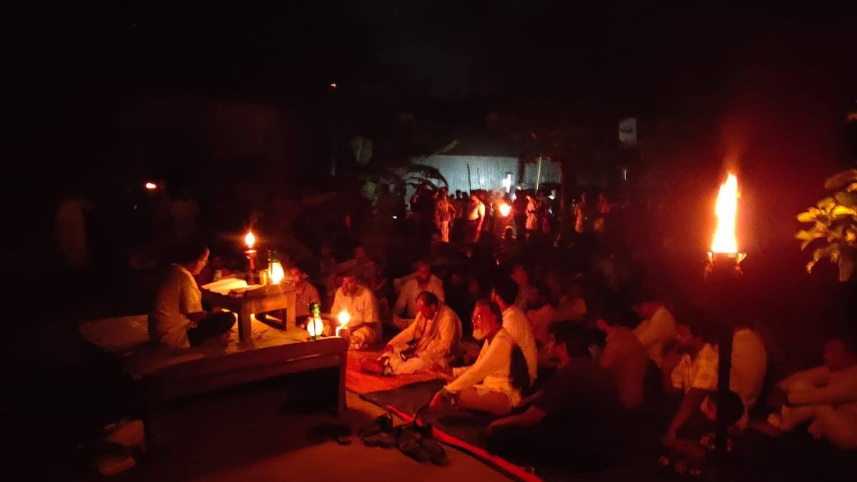
The flickering glow of traditional oil lamps illuminated a quiet village courtyard in Chalan Beel on Thursday night, as locals gathered to revive a nearly forgotten tradition of rural Bengal — Puthi Path.
Despite the availability of electricity, the organisers deliberately kept the courtyard of Kitab Pramanik’s home in Sonahara Para village, Bilchalan Union of Chatmohar upazila, dimly lit with kupi bati and prodeep. Villagers sat on traditional woven mats, recreating the atmosphere of an 18th-century rural Puthi Path gathering.

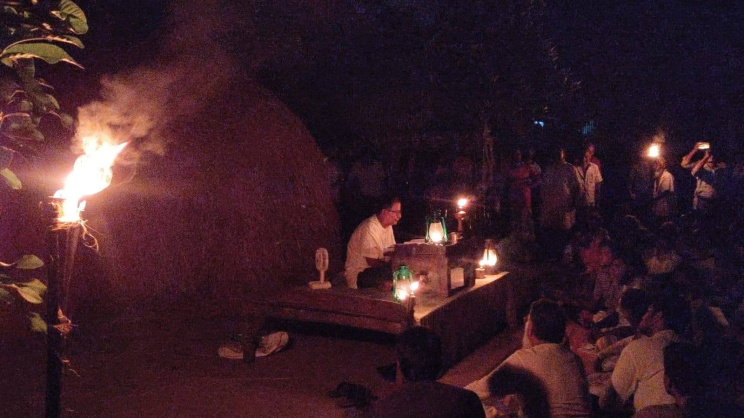
The event was organised by local cultural activists seeking to reconnect the community with its folk heritage. The initiative was led by physician and cultural organiser Dr S M Atikul Alam, who has been working to revive the literary and cultural traditions of rural Bangladesh.
“Puthi Path is a traditional form of folk literature in rural Bangladesh. In earlier times, villagers would gather for Puthi Path sessions after a long day of hard work. Local artists recited the texts in distinctive melodies, providing people with relief from their daily struggles and inspiring them for the following day,” said Atikul.
Men and women from the village gathered in the open courtyard as reciters presented the traditional manuscripts in melodic voices. The soft light from the oil lamps and lanterns added to the nostalgic atmosphere.
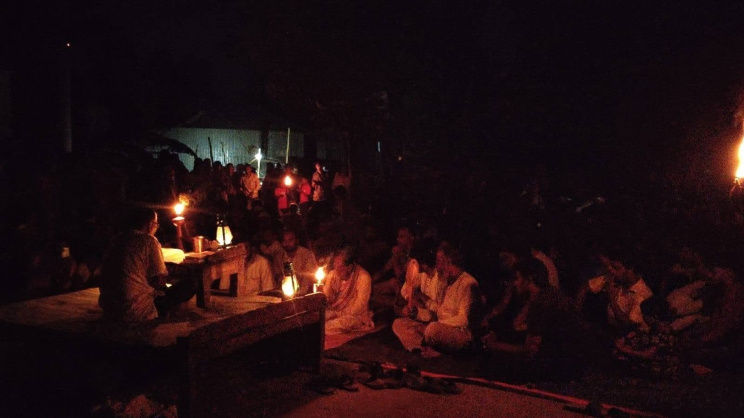
According to Atikul, the tradition has gradually disappeared from rural life with the rise of satellite television, mobile phones and the internet.
“Modern technology and satellite media have pushed this art form towards extinction. Through this event, we wanted to recreate the authentic atmosphere of a traditional Puthi Path gathering. We hope to organise similar programmes in the future to help preserve our rural traditions,” he said.
During the evening, local cultural figure Asaduzzaman Dulal recited from the classic manuscript Hanif Palowan and Biwi Sonavan. Another practitioner, Md Loimuddin Pramanik, performed a recitation of Gazi Kalu O Champabati.
Puthi literature emerged in Bengal around the late 18th century, with poet Fakir Garibullah of Hooghly regarded as one of its early pioneers. His work Amir Hamza is considered among the notable examples of the tradition. Unlike earlier forms of medieval Bengali literature, Puthi literature incorporated Persian and Arabic vocabulary along with words and expressions from local dialects.
The tradition eventually spread across different parts of Bengal, becoming a popular form of rural entertainment and a means of passing down stories, history and cultural memory.
S M Mizanur Rahman, a social worker in Chatmohar and organiser of the Chalan Beel movement, recalled listening to Puthi Path during his childhood.
“We used to listen to Puthi Path from our grandparents, but reciters have become very difficult to find today,” he said. “Puthi Path was also a way of telling historical stories. It is important to preserve these folk traditions so that younger generations can remain connected to their cultural roots.”
The programme was coordinated by a group of local youths, including Sajal Biswas, Biplob Acharya, Niyamul Mukta, Lecturer Abdul Mannan, Amlan Bhattacharya, Sourav Kundu and Shuvo Karmakar.
The gathering drew appreciation from attendees, many of whom urged the organisers to arrange similar programmes regularly to keep the region’s folk traditions alive.
 For all latest news, follow The Daily Star's Google News channel.
Comments