


Reserving seats for women on public transport

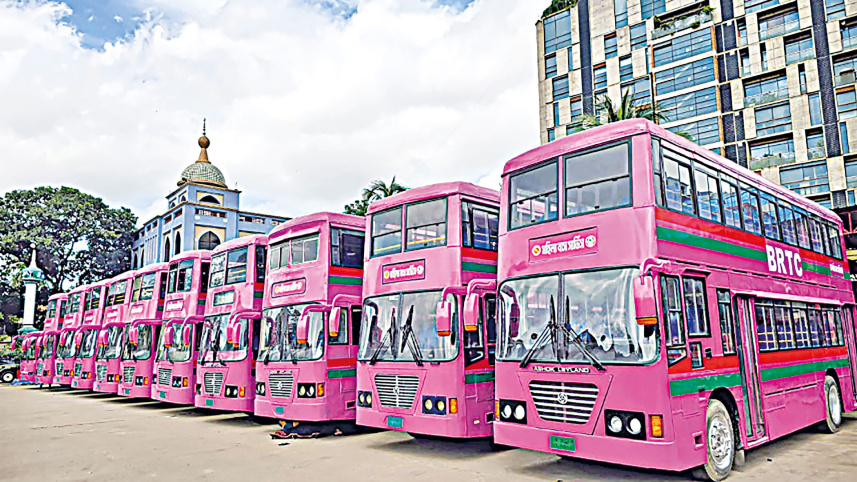
In our day-to-day lives, we often hear derogatory remarks involving designated women’s seats on public transport. Such retorts highlight a pervasive misunderstanding of what the reserved seats are all about. Many commuters unfortunately believe women have to forfeit access to non–reserved seats since they are already granted access to reserved seats. Needless to say, this approach is not consistent with the constitutional and legal framework of Bangladesh.
The reserved-seat rule was introduced in Bangladesh in 2008, when transport authorities agreed that public buses would reserve nine seats for women, children, and elderly and disabled persons. This government-mandated requirement was later incorporated into section 34(1) of the Road Transport Act, 2018. Section 34(1) permits the transport authority to designate seats for women, disabled people, children, and the elderly. Furthermore, while interpreting the general rules for operating a motor vehicle, section 49(1) (Gha) in the second part of the Act clarified that passengers other than women, children, disabled people, and elderly citizens are prohibited from occupying the designated seats. Violating such rules constitutes an offence where the offender may be imprisoned for up to a month or fined up to Tk 5,000 or both (section 92(2) of the same Act).

It is high time we moved past questioning the necessity of reserved seats, which is common in countries with lower women’s participation in employment and increasing levels of harassment of women everywhere. Instead, we should raise our voices regarding the efficiency of the current reserved seat system.
Interpreting the aforementioned provision of the Road Transport Act, 2018, it is quite understandable that the Act sets a ‘floor’ and not a ‘ceiling’. Meaning, any woman in the general passenger area of the bus could occupy a seat if they wished to. There are only nine priority seats, so that at best any female passenger is provided with a seat. Needless to say, the actual number of women passengers in public transport often exceeds this small number. It does not confer any legal right to declare that ‘general seats are for males only’.
Furthermore, the Constitution of Bangladesh grants equal rights and opportunities to both genders in the political and public arenas under Article 28 (1) and (2). However, Article 28 (4) provides a very important exception that says: “Nothing in this article shall prevent the State from making special provisions in favour of women or children.” In legal and social parlance, this clause is referred to as an “affirmative action clause”. The reason behind incorporating this clause is to recognise the socio-economic gaps and inequalities that cannot be bridged simply by treating everyone with similar expectations, when in reality, they have different playing fields and opportunities. Article 19(3) of the Constitution supports this by mandating that endeavors should be made to provide an equal footing to women in all segments of national life.
The moral justification for reserved seating lies in the principle of substantive equality. This notion acknowledges that treating people equally sometimes requires taking measures to address existing inequalities. In the context of public transport in Dhaka, there is sufficient evidence that women face systematic exclusion and harassment, conditions that the reserved seats are intended to address directly.
The principles of restorative justice may also arguably support the concept of reserved seats, insofar as restorative justice seeks to address existing harm by identifying those who have been disadvantaged and determining appropriate forms of redress. In this case, women are uniquely disadvantaged, as men are not the ones harassed. Therefore, there is nothing to justify making similar reservations for men’s sake alone in order to reach numerical equilibrium. Treating different groups of people the same is ingenuine to the different struggles people face. This may help achieve formal equality, but never substantive equality.
The distinction between formal and substantive equality is intrinsic in Bangladesh’s constitution, with Article 28(1) and (2) ensuring formal equality and 28(4) laying the groundwork for substantive equality.
It is high time we moved past questioning the necessity of reserved seats, which is common in countries with lower women’s participation in employment and increasing levels of harassment of women everywhere. Instead, we should raise our voices regarding the efficiency of the current reserved seat system. Is it sufficient the way it is? And lastly, is the current percentage enough?
The writer is a Lecturer at the Department of Law, International Standard University.
 For all latest news, follow The Daily Star's Google News channel.
Comments