


Don’t normalise preventable deaths
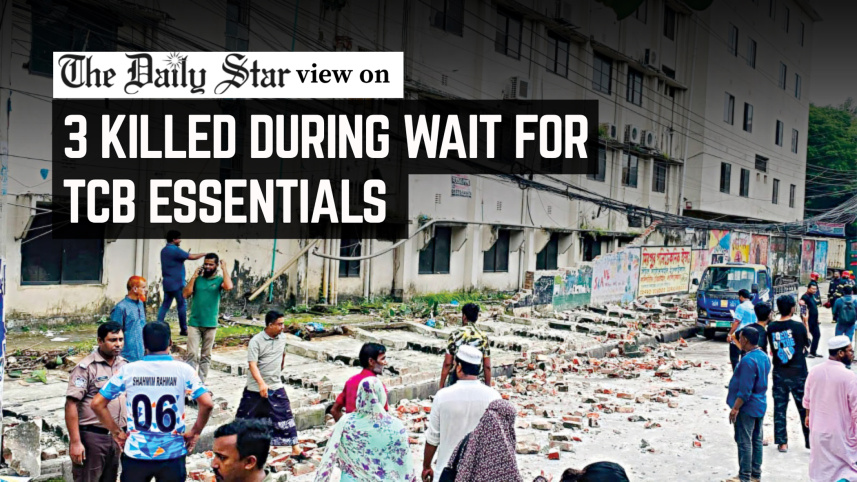
People, especially the poor, die in all sorts of unexpected ways in this city. From pedestrians being killed by falling building parts and other infrastructure failures to workers losing their lives in totally preventable accidents, the perils that ordinary people face are appalling. Nasima Begum, a 44-year-old cleaner, Mohammad Firoz, a 41-year-old rickshaw puller, and Beauty Begum, a 50-year-old local tenant became the latest victims of the multifaceted negligence that plagues our sprawling capital. They were killed on Tuesday when the wall of a university college in Mirpur collapsed while they were standing in a queue to buy subsidised food from a TCB truck.
According to a report in this daily, when a crack first appeared in the wall—more than eight feet high—some people moved away, but many in the queue did not, fearing they would lose their place and have to return home empty-handed. So, when the wall eventually collapsed, it claimed the lives of three people and injured at least seven others, all of whom were forced by poverty to remain beside a hazardous structure, trusting that it would hold. It did not.

Media reports suggest that the wall, built in 2014, lacked RCC (reinforced cement concrete) casting. Proper construction materials were not used to build this boundary wall of an educational institution where thousands of young people study. Locals also told this paper that the wall had tilted towards the street after an earthquake last year and that the collapsed section lacked any beams. Were the university-college authorities unaware of this structural weakness, and what steps, if any, did they take to address it? Did the contractor who built the wall ever consider the lives they were putting at risk by using substandard materials? Or did they assume that maintaining quality was not important because such negligence is rarely penalised?
The uncomfortable truth is that non-compliance with construction rules continues to be widespread in the country, even after the Rana Plaza tragedy that claimed the lives of more than 1,000 workers. While some changes were introduced in the garment industry, compliance with construction rules has seen little improvement in general. This cannot continue in a functioning state that aspires to ensure the safety of its people, whether rich or poor. Only when rules are properly enforced will this change: educational institutions or other building authorities will become more cautious about whom they award construction contracts to; contractors will be compelled to use quality materials; and workers will be encouraged to carry out their tasks properly.
We hope the relevant authorities take note of the latest tragedy and take steps to mend this broken system. At the same time, we hope the probe committee formed to investigate the tragic incident identifies the individuals responsible for the poor construction of the wall and holds them accountable for the untimely deaths of Nasima, Firoz, and Beauty.
 For all latest news, follow The Daily Star's Google News channel.
Comments