


A faster, cheaper path to rural justice
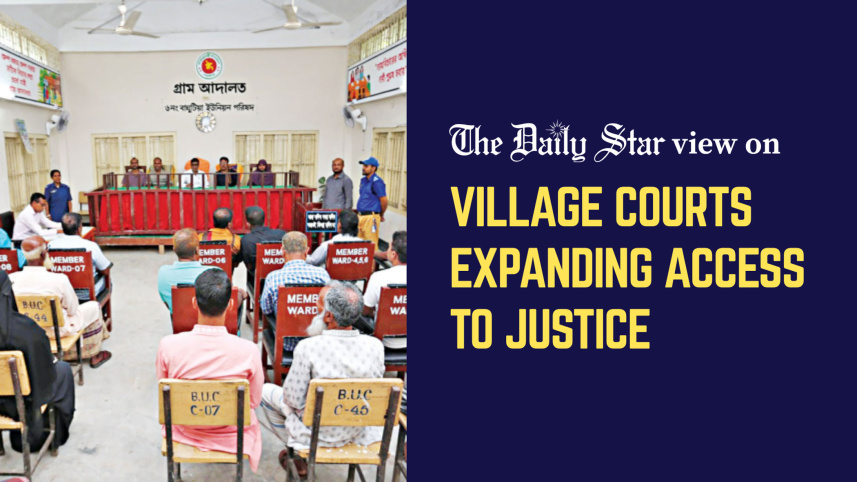
According to a Supreme Court study published in July, more than 46.3 lakh cases were pending with courts across the country as of March 2026. Against this backdrop, it is commendable that village courts have emerged as a source of relief for the rural population seeking to resolve various disputes. These courts, operated through union parishads (UPs) and without a lawyer’s involvement, offer affordable and relatively faster legal remedies for civil and minor dispute complaints. In Bangladesh, where familial or small-scale disputes can often turn violent due to delays in the legal process of resolution, such an alternative is necessary.
Between February 2024 and July 2026, district courts reportedly referred at least 22,698 cases to village courts. According to data from the Activating Village Courts in Bangladesh (AVCB) project, more than 2.6 lakh cases were recorded by village courts nationwide during this period, 74,458 of which were filed by women. The overall resolution rate at village courts is 83.77 percent, and each case is disposed of within 18 days from filing, on average. A criminal complaint must be filed within 30 days of the incident, while a civil dispute must be lodged within 60 days of the incident or within a year in cases of land dispossession. The court is then constituted with a five-member panel, comprising the UP chairman and two representatives nominated by each party. Women’s representation is also mandated on panels handling disputes involving women’s issues or interests.

It is clear that village courts are formal and regulated, unlike traditional village arbitration, and cases are also disposed of faster and at a much lower cost than in judicial courts. With support from the EU and UNDP, the Local Government Division (LGD) is expanding the system to 4,456 UPs—3,048 newly activated—across 61 districts. The village courts also have safeguards in place to address bias, political influence, and non-payment of compensation for a resolved case.
With the term for donor support nearing its end, the LGD is seeking to shift operational, capacity-building, and digital-maintenance costs for running village courts to the government’s revenue budget. We support this plan and believe that this project should be expanded further. These village courts ease citizens’ frustration by shortening the time they have to spend pursuing a legal case while also lowering the amount of money they have to spend on a lawyer. Not only can they help deter rural arbitration, village courts also prevent minor disputes from turning violent due to remaining unresolved for too long. We hope the LGD will be duly supported in sustaining this essential system.
 For all latest news, follow The Daily Star's Google News channel.
Comments