


Dengue, floods and politics: Why do we never learn?

Hegel is often credited with the idea that the only thing we learn from history is that we learn nothing from history. It is one of the more embarrassing observations about our species: we are, individually and collectively, capable of knowing exactly what will go wrong, and doing it anyway. Most of us are not ignorant of the lesson—we are simply unmoved by it, until we are. Cigarette smoking is a mundane example: the evidence linking it to cancer is not contested, and the packet itself carries the warning. Smokers are not misinformed, yet millions light the next one anyway—because the fact and the feeling live in two different parts of the mind, and only one is in the room at the moment of decision.
Behavioural economists call this gap temporal discounting: the tendency to value an immediate reward far more heavily than a higher but delayed cost. A cigarette's pleasure is now; the fatal illness, if it comes, is decades away and only probable. History, when it tries to teach a lesson, is almost always addressing the discounted, distant side of that ledger—which is precisely its structural disadvantage against the present.

There is also good neurological reason to doubt the old “heart versus head” model, in which emotion is cast as reason's adversary. The neuroscientist Antonio Damasio studied a patient, Elliot, whose brain damage left his logic fully intact but destroyed his capacity to feel the weight of consequence. The result was not a superior decision-maker but someone who could no longer decide well, because reasoning without feeling has no compass telling it which conclusion matters. Emotion is not the enemy of learning from history—it is often what makes a lesson stick, which is why statistics alone rarely change behaviour, and why those who lived through a catastrophe guard against it far better than those who only read about it.
There is a plausible evolutionary reading too, though such explanations describe a pattern more reliably than they prove why it exists. For most of human history, survival depended on reading immediate signals, not on modelling slow-moving, civilisation-scale risk. A mind built for the next hour had little occasion to develop a standing alarm for a crisis forty years away—which may be why climate change struggles for political attention in a way an immediate flood never does: the danger is real, but it doesn't look like the danger our attention evolved to notice.
A further complication is motivated reasoning: once a person or institution has committed to a conclusion, intelligence can be redirected from “what is true” to “how do I defend what I have already decided”. And a sharper mind is simply better at constructing plausible justifications for the position it already holds. Layered on top is social identity: abandoning a belief entangled with one's group or self-image rarely feels like a small correction—it can feel like betrayal. So, the historical lesson is often not forgotten so much as quietly outcompeted by the discomfort of admitting one's own side was wrong.
Some of history's most stubborn repetitions are not failures of judgement but structural traps. Biologist Garrett Hardin's 1968 essay on the "tragedy of the commons" described how a shared resource can be destroyed even when every user understands the danger, simply because no one has the incentive to stop first while others continue. The same shape recurs in the everyday habit of dumping waste into a drain everyone knows will flood the neighbourhood next monsoon—nobody involved needs to be foolish; each can be rational while the aggregate outcome is exactly the disaster history predicted.
There is also, less comfortably, the matter of power. Sometimes the lesson is understood perfectly well by those in a position to act on it—but acting would cost them something they value more than the distant consequence. What is unsustainable in the long run can remain highly convenient in the short run for whoever benefits today. Here, the failure to learn from history is not one of knowledge or psychology at all—it is a failure of incentive.
Finally, there is normalcy bias—the tendency to treat a long absence of disaster as proof it is unlikely, rather than the ordinary calm between occurrences. This compounds into a kind of generational amnesia: the generation that survives a catastrophe builds the institution that prevents its recurrence; the next inherits it; the third, never having felt the original fear, starts asking why the restriction is even necessary. Success, in this sense, can quietly erase the memory of the conditions that produced it.
Politics may be the arena where this pattern is most visible, and Bangladesh is no exception. A party in opposition builds its case—often accurately—against the abuses of power: centralised authority, silenced dissent, captured institutions. It wins support partly by promising to be different. Yet once in office, it often drifts towards the very practices it once condemned, each step justified as necessity rather than repetition. This is not really a mystery: the incentives of holding power resemble those of the predecessor far more than they resemble those of the opposition, and noticing one's own hypocrisy is far harder than noticing someone else's.
The same gap between knowing and acting shows up well outside politics, too. Dengue is one of the clearer examples: the country has faced an almost annual outbreak since the disease was first identified here in 2000, and 2023 was the deadliest year on record, with reported infections exceeding 320,000 and roughly 1,700 deaths. The prevention mechanism—clearing standing water where mosquitoes breed—is neither expensive nor mysterious, yet the pattern recurs each monsoon, partly because keeping one's own rooftop free of stagnant water benefits the whole neighbourhood while the cost falls on the individual household—a small, local tragedy of the commons.
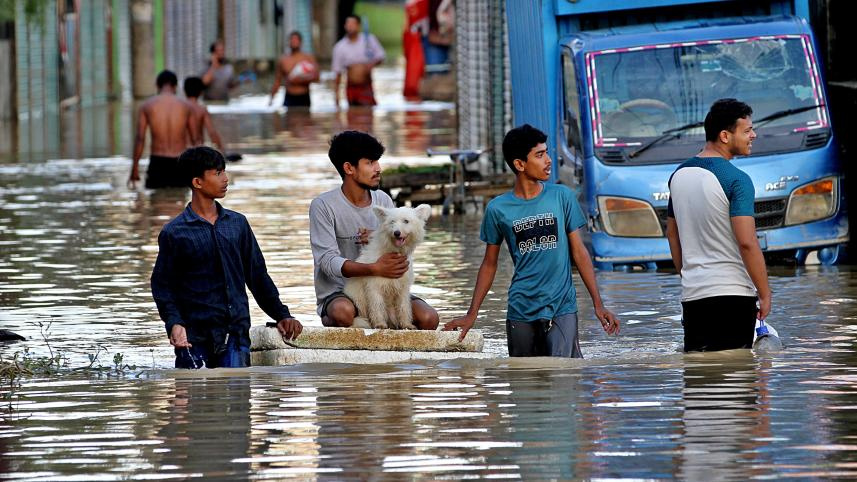
Flood management offers a genuine counter-example to fatalism about history. Flooding recurs almost every year and cannot be eliminated—Bangladesh sits at the base of three of the world's great river systems. But casualties have fallen well below what recent floods would once have produced, aided by the Flood Forecasting and Warning Centre's river-level forecasts, an expanded network of embankments and shelters, and community-level evacuation drills. International disaster-risk-reduction literature has repeatedly held this up as a model worth studying elsewhere. The flood itself has not gone away; what has changed is how much warning people get before it arrives.
Of all these areas, though, politics may be hardest to convert into lasting habit—the incentive to repeat sits with the very people who would have to choose not to. Put together, these strands point to a conclusion more useful than either extreme—"humans never learn" or "humans naturally learn." We are bad at holding an abstract lesson in mind against an immediate reward or a threatened identity—but we learn considerably better when a lesson is converted into something that does not depend on anyone remembering it: a building code, a vaccination schedule, a constitutional check on power.
That reframing carries a practical implication: awareness campaigns that simply repeat the facts—everyone already half-knows stagnant water breeds mosquitoes—run into exactly the psychological limits described above. The more durable response, following that same logic, is to build systems that work even when attention and willpower predictably fail: automatic drainage inspection rather than annual appeals to conscience, enforced regulations rather than seasonal slogans, standing institutions rather than standing hope.
Hegel's aphorism captures something true about the mind in the moment of decision. But it is not the last word on history. Bangladesh's floodplains, less deadly now than they were a generation ago, remind us the lesson can survive—not because people got better at remembering it, but because they were wise enough not to have to.
Hussain A Samad is consultant at the World Bank in Washington, DC and an independent researcher. He can be reached at hsamad2000@yahoo.com.
Views expressed in this article are the author's own.
Follow The Daily Star Opinion on Facebook for the latest opinions, commentaries, and analyses by experts and professionals. To contribute your article or letter to The Daily Star Opinion, see our guidelines for submission.
 For all latest news, follow The Daily Star's Google News channel.
Comments