Bangladesh's education crisis: The future has already begun

Bangladesh's educational crisis is often described as a list of unrelated problems: exam cheating, poor learning outcomes, a curriculum built around memorisation rather than critical thinking, weak technical training, politicised universities and chronic underfunding. It is not a list—it is one failure repeated in different forms. Bangladesh has largely failed to make education the mechanism for building capability and character, and every symptom can be traced back to that larger failure.
When schooling is not education
The distinction matters because Bangladesh has made remarkable progress in access to education, but that progress can mask a deeper failure. Children who once would never have entered a classroom now do; gender gaps have narrowed; years of schooling have risen. Some of that trade-off was probably unavoidable. But schooling is not education, and a country can succeed at the first while failing at the second. The real test is what kind of person and what kind of productive capability emerge at the other end—and on that test, Bangladesh is in crisis.
Cheating is a symptom, not the disease
Start with cheating, a problem that the education minister has repeatedly raised in recent months. CCTV cameras, tighter invigilation, secure question papers and tougher punishment may all be necessary, but none is a magic solution. Surveillance cannot repair a culture that has spent generations treating cheating as regrettable rather than disqualifying. Bangladesh has lived with examination malpractice for so long that allegations of it have become part of the political folklore that even surrounds prominent national figures. Whether every such story can be verified matters less than what its persistence reveals: a society that gossips about cheating rather than recoiling from it has already conceded too much moral ground.
As Wharton psychologist Adam Grant recently argued in The New York Times, the durable defence against cheating is "moral identity"—the internalised conviction that dishonesty is incompatible with the kind of person one wants to be. Surveillance stops a student from cheating while someone is watching; education is meant to produce a person who does not cheat when no one is watching.
So the task is not merely to make cheating harder but to make it shameful—to change the moral expectations surrounding examinations, not merely their mechanics. No camera can do that.

Yet suppose every Bangladeshi student stopped cheating tomorrow; would the crisis end? No, because cheating was never the deepest problem. The deepest problem is that too many students are not learning anything worth cheating for.
By the World Bank's 2024 estimate, 51 percent of Bangladeshi children cannot read and understand an age-appropriate text by the end of primary school—a statistic made more damning, not less, by the fact that Bangladesh enrols almost all its children in school. This is no longer a country failing to reach its children; it is a country reaching them and failing to teach most of them adequately. Access was the first problem, and Bangladesh made progress on it; learning is the harder one.
History should be taught to develop the ability to weigh evidence, distinguish argument from propaganda and entertain competing interpretations—not to conscript children into inherited partisan battles.
What can a student actually do?
The curriculum compounds the failure. Bangladeshi education remains heavily oriented towards examinations, memorisation and textbook learning, while successive governments have spent extraordinary energy rewriting the political interpretation of history when the more urgent task is preparing students for the future. History should be taught to develop the ability to weigh evidence, distinguish argument from propaganda and entertain competing interpretations—not to conscript children into inherited partisan battles.
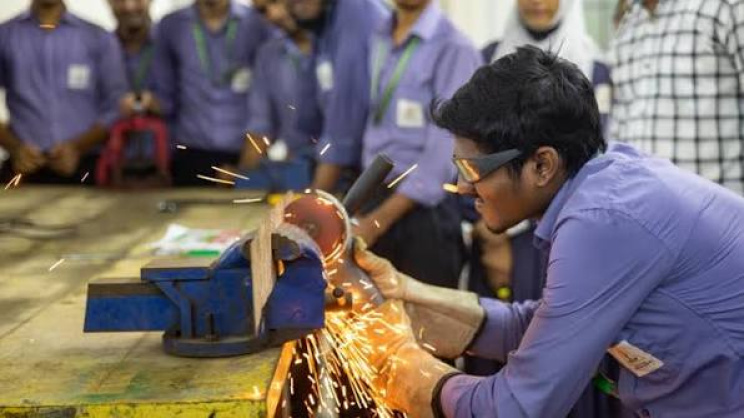
Technical and vocational education suffers from the same disconnect, only more expensively. A student who memorises the description of a machine but never learns to operate, repair or adapt it leaves with a credential and little else. No capability, no productivity, no value to an employer. Closing this gap requires much closer links between educational institutions and industry. Apprenticeships, internships and work-based training should become integral to technical and vocational education, thereby helping curricula keep pace with changing technologies and the skills employers actually demand.
Every curriculum should be forced to answer one blunt question: what can this student actually do when it is over? Can they read critically, write clearly, work with numbers, use modern technology, solve unfamiliar problems, communicate, collaborate and keep learning as technology changes? Those capabilities—not certificates—will determine Bangladesh's productivity, earnings and competitiveness.
Universities without accountability
The rot reaches the universities too. An education system cannot preach merit while distributing its top leadership positions through political patronage—as the Awami League government was rightly criticised for doing. A successor government that simply installs its own aligned academics in the same posts has not reformed the system; it has only changed the beneficiaries. Two wrongs do not make a right, and a relabelled patronage system remains a patronage system. Universities should be led by people selected transparently for scholarship, integrity, intellectual leadership and administrative competence—i.e., merit should be the overriding principle in a resource-constrained economy like Bangladesh. A common refrain in Bangladesh is that the country aspires to become like Singapore. One lesson worth borrowing from Singapore is its unusually strong institutional emphasis on merit and competence.
Recent disciplinary actions against university faculty point to a related and more serious problem: critics say suspensions of academics perceived as sympathetic to the ousted party have bypassed due process. It is a pattern that predates this government and will likely outlast it: university faculty becoming a battleground for whichever party holds power, rather than universities functioning as institutions independent of politics altogether.
Academic freedom, however, does not mean immunity from accountability: a professor who commits demonstrable misconduct should be investigated and, where the evidence warrants it, disciplined. But political affiliation, past sympathy or unpopular opinion cannot substitute for evidence, and a change of government should not become an occasion for political house-cleaning. A university ceases to be intellectually autonomous once academics learn that a political transition may determine who is permitted to teach.
Bangladesh needs rules, not alternating systems of partisan control: misconduct should be investigated through transparent procedures, the accused should be informed of the charges and given a meaningful chance to respond, and punishment should follow evidence rather than political cycles.
Politics is only part of the university problem. Bangladeshi higher education, especially public universities, also suffers from weak internal governance and limited accountability for classroom teaching. Systematic student evaluation of teaching is weak or absent in many institutions; office hours, advising and faculty accessibility are poorly institutionalised; and many academics begin teaching with no formal preparation in pedagogy—how to design a course, communicate difficult material or assess learning. A doctorate establishes domain expertise; it does not automatically make someone an effective teacher.
Research creates another distortion. Bangladesh needs good research—universities should help address the country's economic, technological and social problems—but research should be judged by relevance, quality and originality, not by counting publications as if productivity were a matter of tonnage. A proliferation of papers of uncertain quality, in journals nobody reads, contributes little to scholarship or national development. And the pursuit of publication should not obscure universities' primary responsibility: educating students well.
There is a useful lesson next door: India's Indian Institutes of Technology have become important academic institutions, but their reputation was built above all on the rigour of their education and the quality of the engineers they produced. Bangladesh does not need dozens of institutions pretending to be MIT. It needs a small number of genuinely research-intensive universities and many more institutions that do the less glamorous but indispensable job of teaching undergraduates exceptionally well.
That means changing what universities reward: teaching quality over credentials, real faculty–student contact, pedagogical training, stronger advising and research judged by quality rather than volume. Promotion should follow professional contribution—not political connection or bureaucratic longevity. A university that protects neither its faculty's independence nor their accountability cannot prepare students for a competitive knowledge economy.
Spend more, govern better
None of this is affordable at current spending levels. Public expenditure on education has remained at around 2 percent of GDP or less for years, well below the 4–6 percent benchmark of UNESCO's Education 2030 framework. Money alone will not repair bad governance, weak teaching or a defective curriculum—pouring more into badly governed institutions can simply produce more expensive failure. But the converse is equally true: no country acquires excellent teachers, modern laboratories and competitive universities on bargain-basement financing. Bangladesh has to spend more and spend better—both, not either.
Education policy is industrial policy
All these failures converge on a single economic verdict: Bangladesh is not building human capability fast enough for the economy it says it wants. The old growth model rested on abundant, low-skilled labour, especially in garments—a model that cannot carry Bangladesh indefinitely. The next stage—scaling up electronics, machinery, engineering, pharmaceuticals and biotechnology, and higher-value manufacturing beyond their current small footprint—requires technicians, engineers, managers and workers who can absorb and adapt technology, not simply perform repetitive tasks.
Tax holidays and one-stop investment services may lure a factory but cannot manufacture the skilled workforce it requires. That capability has to develop rapidly before the investor arrives. Education policy, in that sense, is industrial policy. And no version of Bangladesh's growth story can outrun its people's capabilities.
Growing old before growing skilled
The demographic clock is already ticking. Writing in Foreign Affairs, demographer Nicholas Eberstadt notes that by 2050, more than 13 percent of Bangladesh's population will be elderly (65+), supported largely by the children the country is educating today; yet, by the skill measures he cites, roughly five in six Bangladeshi youth fail to meet even the lowest threshold for participating in a modern economy.
Bangladesh is ageing without the human-capital base that allowed richer societies to absorb the same transition. That is an unforgiving trap.
His comparison with Ireland is stark: Bangladesh's projected elderly share in 2050 is one that Ireland had already reached by the mid-2010s—yet only one in six Irish youth fell below those minimum skill standards, versus roughly five in six in Bangladesh. The larger point is that Bangladesh is ageing without the human-capital base that allowed richer societies to absorb the same transition. That is an unforgiving trap.
The demographic dividend from a young workforce will not last forever. Automation and AI are already reducing the value of the routine tasks on which low-skilled workers depend, while an ageing population will need more healthcare, income support and social services. These will need to be financed by the productivity and taxes of a working-age population that, on current trends, may be insufficiently skilled to shoulder the burden. Put plainly, Bangladesh risks growing old before it grows skilled.
That is why cheating, curriculum, university appointments, academic freedom, teacher quality and education budgets should not be treated as six separate stories. They are one story, and at its centre lies the real question: not whether Bangladesh will change in the next twenty-five years, but whether its people's capabilities will keep pace with the country's changing demands.
The future has already begun
A badly educated child in 2026 will be in the prime of their working life in 2050. Today's struggling primary-school student, tomorrow's underqualified technician; today's rote-taught vocational student, tomorrow's productivity ceiling; today's politicised university, tomorrow's hollow research base; today's poorly taught undergraduate, tomorrow's poorly prepared teacher; and today's underfunded classroom, tomorrow's skills shortage.
And skills shortages, unlike factories, cannot be repaired quickly. Factories can go up in a few years; investment regulations can be rewritten in months. Human capability takes a generation, and Bangladesh does not have a spare one.
That is why Bangladesh's education crisis is urgent. Honest examinations matter, but they are only part of the solution; the larger challenge is building an education system that develops integrity, practical skills and independent thought, and prepares today's children to sustain a more productive, technologically capable and considerably older Bangladesh in 2050. That horizon may appear distant on a calendar. In education, it is already here. The future has already begun.
M.G. Quibria is an economist who began his academic career at the University of Dhaka and has since held faculty positions across Asia, Europe and North America. He has also held senior policy positions at the Asian Development Bank and the Asian Development Bank Institute. He can be reached at: mgquibria.morgan@gmail.com
Send your articles for Slow Reads to slowreads@thedailystar.net. Check out our submission guidelines for details.

The global injustice behind Bangladesh’s shipbreaking industry

How to make essential medicines affordable and accessible in Bangladesh
Can Bangladesh make its plastic waste policy work?
Dhaka accidentally built the city planners now want. Can we make it liveable?

Can Bangladesh produce its own knowledge?
How we are killing Dhaka

Can Bangladesh afford not to invest in Bhola’s gas?
Bangladesh’s renewable policy: Still too little but not too late
Prabhat Patnaik speaks / Why the Global South must rethink export-led growth