


Fertiliser shortages demand urgent action
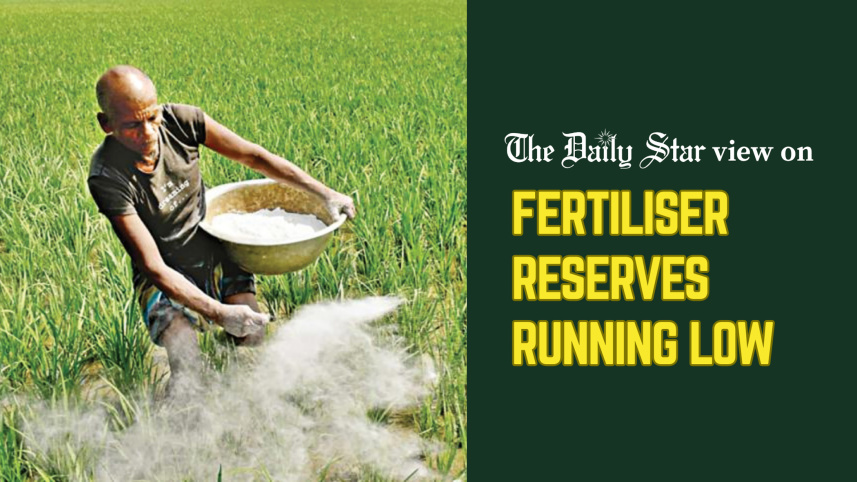
It is quite alarming that reserves of some key fertilisers have fallen below safe levels, raising concerns about shortages during the upcoming Aman season. The protracted US-Israel war on Iran and China’s fertiliser export ban have only heightened the risks. Such concerns, however, have been looming over us for some time now, with fertiliser production hit by acute gas shortages just before the Boro season earlier this year. So, the question is why the government has still not taken adequate steps to address the problem.
According to a recent report by this daily, reserves of several non-urea fertilisers have fallen below the required safe levels. These include diammonium phosphate (DAP), triple super phosphate (TSP), and muriate of potash (MOP), whose stocks currently stand at 3.90 lakh tonnes, 3.53 lakh tonnes, and 1.96 lakh tonnes, respectively—all below safe levels. The shortages are already forcing farmers to pay Tk 5-7 more per kilogram than the government-fixed prices. Meanwhile, urea stocks remain above safe levels for now, but much of its supply is typically sourced from West Asian countries now caught up in the Iran conflict, meaning potential trouble down the line.

The government, however, continues to maintain that there is no immediate fertiliser crisis, apparently to avoid public panic or supply disruptions. This stance has done little to boost confidence or address the crisis. The government has yet to issue any procurement circular for non-urea fertilisers, and orders usually take at least two to three months to be shipped once placed. This leaves little room for complacency as any disruption could have considerable implications for our food security.
We, therefore, urge the government to demonstrate foresight in addressing the fertiliser shortage, particularly amid the volatile situation in West Asia. The Strait of Hormuz handles roughly one-third of internationally traded fertilisers, but traffic has remained heavily restricted amid the ongoing conflict. What is baffling is that, even after months of uncertainty, our government has yet to formulate and implement a robust fertiliser strategy. It is imperative that the government act proactively now. It must strengthen domestic production, try to secure more stable routes for raw materials, and explore diplomatic channels to ensure that fertiliser reaches farmers without interruption.
If the government fails to act decisively, farmers will have to bear the immediate cost while consumers could ultimately suffer through higher food prices and greater insecurity. We cannot afford to wait for a crisis before taking proper action.
 For all latest news, follow The Daily Star's Google News channel.
Comments