


How long will the National Public Library stay closed to the public?
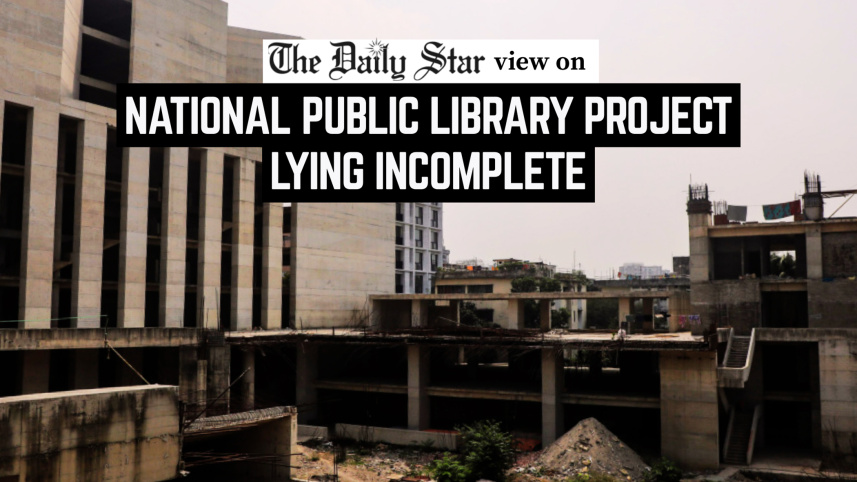
It is unacceptable that the Sufia Kamal National Public Library in Dhaka’s Shahbagh has been inaccessible to the public for nearly four years. Under a modernisation project, the library building was demolished in 2022 and the new building was set to be completed in December 2024. However, the work is reportedly only 65 percent complete. During this time, the project cost, initially estimated at Tk 524 crore, has gone up to Tk 561 crore due to the addition of new components and an increase in the US dollar exchange rate. Now, a revised proposal to extend the project timeline till December 2027 and to increase the total cost to a staggering Tk 620 crore is waiting to be placed in the next Executive Committee of the National Economic Council.
While piling costs and ever-extending timelines of public projects have become quite common, what is concerning about this library project is how such an essential public place has been closed off from people for so long. The library, when operational, was one of the few places in the capital where an average citizen could access a wide collection of books, magazines, and news publications. The library premises served as a vibrant space for civic engagement through various cultural events and seminars. For young people, spaces such as libraries offer a social environment separate from the home and the workplace or classroom where they can gather to build knowledge, exercise their creativity, socialise, and expand their community. With both physical and digital spaces for free thought and speech shrinking, building more of these institutions is essential so that people can freely engage with culture and practise open-mindedness in their societal view.

Unfortunately, the opposite is happening in Bangladesh. While privately-built food courts, shopping malls, and pricey entertainment venues mushroom, the renovation of necessary public spaces such as parks and libraries remains shrouded in bureaucratic stupor for years on end. Instead of being held accountable, those responsible for the delays are granted endless free passes, deadline extensions, and increased budgets. Meanwhile, children and young people experience unrestrained exposure to digital spaces filled with unverified information and distorted sociopolitical narratives.
We urge the Public Works Department and other relevant authorities to expedite the reconstruction of the Sufia Kamal National Public Library and make it fully accessible to the public. It should serve as a space for not just traditional learning, but also for cultural activities. To build a well-informed nation that can think critically, it is crucial to make knowledge accessible to people. Without this, we may soon find ourselves in a dark age where opinions are only formed based on dominant social media discourse and conspiracies.
 For all latest news, follow The Daily Star's Google News channel.
Comments