


The moral calculus of footpath evictions in Dhaka

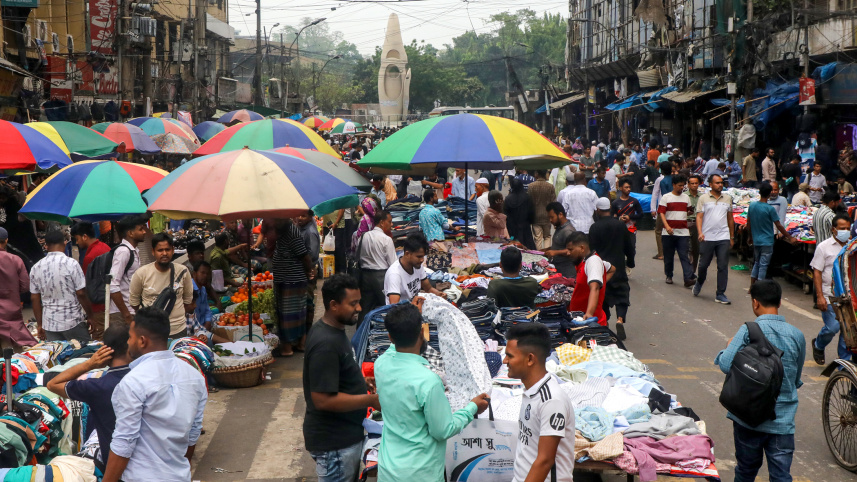
The footpaths of Dhaka have again become a political flashpoint of late. Amid an eviction drive that started earlier this month and subsequent re-occupation attempts by aggrieved hawkers, we have seen calls for a proletarian revolution: shara Banglar hawker ek hao, lorai koro … bhat de, kaj de, noile hawker boshte de (“Hawkers of the country, unite—fight on… give us food, give us work, or at least let us sit on the footpath and sell”). Marx would have agreed with them.
How should we respond to this crisis?

The reality is that there is simply no just solution to the so-called “illegal occupation” of footpaths by vendors. Of course, footpaths are for pedestrians. However, this assumption is reasonable so long as we are content to take a sanitised view of the street—namely, that it should be neatly divided into paths for vehicles and paths for pedestrians. This is the standardised position of the planner and the urban administrator, one that ignores the complex urban ecology of what we experience as a “street” in the developing world. Streets, in our socioeconomic context, are battlegrounds of daily life, featuring myriad urban activities: moving, walking, selling, shopping, eating from street vendors, socialising, protesting authorities, demanding rights, begging, and, most importantly, claiming space for livelihoods.
In our prevailing pattern of urbanisation, wherever the lower-income population finds even a square inch of street space, they will create opportunities for livelihood there. This fluid arrangement cannot be undone by force. A week or a month after eviction, footpath vendors invariably return. For better or worse, this is how the informal, grassroots economy functions in the cities of the developing world. Eviction here is not just bad optics; this elitist project is antithetical to the humanity of the city and to citizenship. Any attempt to cleanse the streets must therefore begin with an understanding of how they function in our urban context.
This is not to say that vendors have a natural right to occupy footpaths, nor can streets be simply reduced to a vehicle-pedestrian binary. Consider the issue from another angle for a moment. When law enforcement officials justify their eviction drive on legal grounds, what exactly is the law regarding footpaths? What law are the authorities enforcing? There is none. There is no codified footpath policy. What the authorities are enforcing is a bureaucratically agreed-upon arrangement of urban street use. But that is not law. I would argue that the footpath eviction drive constitutes a misuse of power, one rooted in a bourgeois view of urban life that seeks to render invisible a pervasive grassroots economy because it is perceived as an aberration in the smooth functioning of the city in favour of the elite.
The crucial question before us is: how do we do justice to pedestrians while remaining empathetic to footpath hawkers? Is it possible to dispense justice to competing stakeholders simultaneously?
To solve the problem of footpaths, we must think beyond immediate eviction and address broader structural issues: how to educate the urban population about land-use regulations so that hawkers are incentivised to relocate to designated marketplaces; how to redesign footpaths as multifunctional urban ecosystems; how to ratify a national footpath policy; and how to decentralise cities so that the grassroots economy does not need to occupy every square inch of street space.
Let us now zoom in on the footpath problem from the perspective of moral economy. If we accept British historian E. P. Thompson’s conception of moral economy as grounded in obligations of care and fairness, we may find that the footpath problem requires a broader philosophical deliberation on justice.
A few months ago, I was passing through Manik Mia Avenue in Dhaka. The silent commercialisation of the footpaths along this beautiful road has unfolded right before our eyes. In this city of excessive noise pollution, traffic congestion, and crowds, there is a severe lack of open, peaceful spaces. That is why people gather there in the afternoons to stroll and enjoy the open footpaths in front of the parliament. A park-like environment spontaneously emerges there in the evenings. For small-scale vendors such as fuchka sellers, this becomes an ideal market—a simple matter of supply and demand.
Not only fuchka sellers but also sketch artists, toy sellers, balloon sellers, tea vendors, clothing sellers, and jewellery sellers arrive with their small businesses. This is grassroots survival. It is difficult to eliminate such practices. If removed forcibly, such action may be perceived—within our social context—as an aggressive cleansing of poverty by the elite, ruling classes. The roots of this informal economy run deep in our moral soil, generating a quiet public sympathy for these “street warriors.”
However, there is also a counterargument. Should grassroots markets—or any market—be allowed uncontrolled access to every corner of the urban body? The parliament building is the constitutional centre of the state. Ideally, as laws are made there, should the surrounding area not maintain a certain market-free sanctity? Even if people hold negative attitudes toward politics, is there any reason not to regard the parliament area as nationally significant? Why should it be subjected to market “pollution”?
So, the question becomes: should grassroots markets be allowed to remain on Manik Mia Avenue, or should the area be kept market-free so that citizens can enjoy it peacefully? Is this binary framing of rights even fair? Can justice be ensured for competing parties at the same time? Clearly, there are no simple answers. We are thus confronted with a philosophical dilemma: the concept of justice is relative and largely dependent on our moral, political, and social viewpoints. Justice is never an unquestionable ideal. One group’s justice may be another’s injustice.
Since ancient times, justice has been a subject of debate. Plato and Aristotle associated justice with human virtue and moral responsibility within the Greek polis. The Latin term justitia implies treating everyone equally. In democratic systems, the rule of law forms the institutional core of justice. However, in recent times, discussions of justice have expanded beyond legal frameworks and judicial boundaries. As Amartya Sen argues, justice is an ongoing process with no revolutionary endpoint; it must extend beyond legal definitions into everyday moral imagination. Its primary goal, he suggests, should be to empower the broader population in decision-making. Until the concepts of justice and injustice are deeply embedded in people’s daily lives and moral imagination, social instability and self-serving behaviour will persist, and the greater good will remain secondary.
Let me offer an example. Suppose students block a highway demanding that their college be upgraded to a university. The public is stranded in traffic all day. Patients cannot reach hospitals. Students cannot reach their school. Small traders lose their capital. But do the protesting students ever consider the damage they have caused? In pursuing their own demands, are they not being unjust to others?
Consider another example: in developing countries, the informal economy plays a major role. Research shows that in Bangladesh, the informal economy contributes 40-43 percent of GDP and accounts for 85 percent of employment. Yet mainstream economists in the country rarely address it; their policy reports focus almost exclusively on the formal economy. According to the United Nations’ 2025 World Population Report, Dhaka is currently the world’s second-largest city by population, with approximately 37 million residents, behind Jakarta at 42 million. More than 80 percent of Dhaka’s population is engaged in the grassroots economy. Is it not unjust to exclude them from macroeconomic policymaking?
American political philosopher Judith Shklar offers a useful framework for understanding such situations. She argues that while we often theorise justice as an ideal condition—for example, upgrading a college to a university or including informal economy into macroeconomic policies—we rarely consider how injustice operates in everyday life, such as through the harm caused by road blockades or the exclusion of large populations from policy frameworks. Ideal justice is rare, but injustice is abundant all around us. Until we develop the habit of viewing society through the eyes of those who suffer injustice, the dream of a good society will remain unattainable.
In the end, evicting footpath vendors is a gross simplification of a complex social problem—one that demands a long view of how injustice is enacted under official mandate and, paradoxically, in the name of law.
Adnan Zillur Morshed is a professor, architect, historian, and public thinker. He can be reached at morshed@cua.edu.
Views expressed in this article are the author's own.
Follow The Daily Star Opinion on Facebook for the latest opinions, commentaries, and analyses by experts and professionals. To contribute your article or letter to The Daily Star Opinion, see our guidelines for submission.
 For all latest news, follow The Daily Star's Google News channel.
Comments