


How David Attenborough changed how we see nature

I want you to sit with a picture. A mother pilot whale circling the surface of the Pacific Ocean holding her dead calf above the water, refusing to let go. The camera lingers and in the background was David Attenborough's calm, unhurried voice suggesting that the calf may have died because of toxins passed through its mother's milk. Toxins that came from our plastic. Millions paused during that moment shifting in their seats witnessing a whale carrying her grief through the vast emptiness of ocean. And that, turning sorrow into something impossible to look away from, is Sir David Attenborough’s gift.
David Attenborough started working at the BBC in 1952. Since then, he has never paused in his journey toward wildlife conservation. On May 8, 2026, he crossed 100 years milestone. Prince Harry, writing in Time magazine, described him as “an institutional pillar as essential to the national fabric as a cup of tea." Scientists marked the milestone by naming a newly discovered parasitic wasp Attenboroughnculus tau in his honour. When scientists choose to name a species after someone, it is among the highest honours in the natural world. David Attenborough has been honoured in similar ways more than 40 times.

Prior to Attenborough, wildlife films were rigid affairs, recorded from safe distances, narrated like encyclopaedia articles, and targeted more at a classroom than a family room. He revolutionised that completely. With Zoo Quest, a multipart nature documentary series in the 1950s, he was the one who first introduced wildlife television outside of the traditional studio. Later, everything changed in 1979, When Life on Earth first aired. Not only did it explain evolution, it made audiences feel attached to it. What he understood, instinctively, was that people don't care about abstractions, but characters with unique traits and quirks. So, he gave them a crow who uses tools to solve puzzles, a chimpanzee consoling a grieving companion, and a pair of albatrosses reuniting after years apart at sea. These were more than just wildlife footnotes, they were stories. People don't forget such stories and once you can't forget, you start to worry about them. That's ecology.
He understood something else too, a truth industrial civilisation had long preferred to overlook. Humanity is not nature's master but one thread in a vast web of life. Destroying that web is, in many ways, destroying ourselves. As he said in A Life on Our Planet, “The living world is a unique and spectacular marvel. Yet the way we humans live on earth is sending it into decline.” This wasn't about abstract conservationism, instead was a witness statement from someone who had spent decades meticulously watching the deterioration happening in real time.
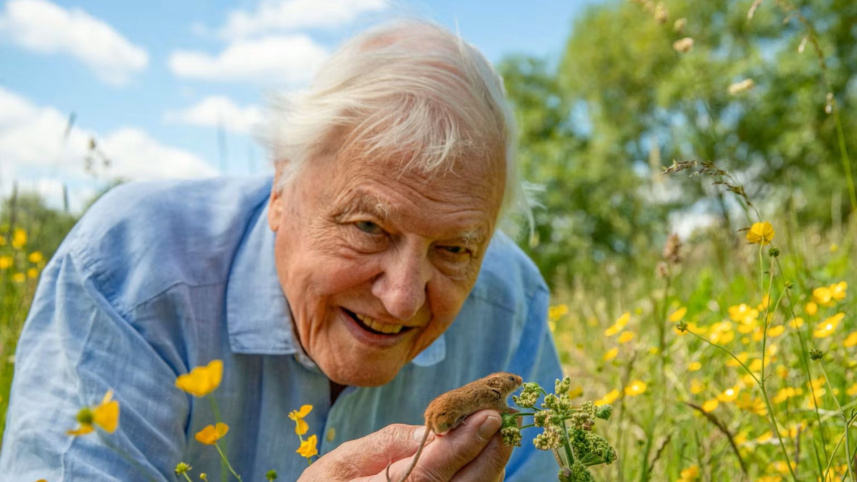
In the world of documentaries, where many are enjoyable but only a handful leave a lasting impact, Life on Earth accomplished both brilliantly. A famous encounter in Rwanda, where a baby gorilla climbed over David Attenborough as he rested in the woods, helped boost global support for wildlife conservation. At that time, only about 250 mountain gorillas remained in the world, but today the population has grown to over 1,000. Attenborough later called the experience “one of the most privileged moments of my life” at age 100.
Blue Planet II (2017) marked the moment he became something closer to an activist though he'd never have called himself one. In plastic-clogged oceans, seabirds feeding bottle caps to their chicks was an image so haunting and heart-wrenching that it etched itself to our collective memory. And, not only that, around 88 percent of viewers who watched Blue Planet II changed their behaviour afterwards. The UK banned plastic straws, stirrers, and cotton buds. The EU passed a single-use plastics directive. Major corporations including Coca-Cola, Unilever, and McDonald's, pledged to reduce plastic waste. Blue Planet II was explicitly referenced in the speech introducing the UK's 25-year environment plan.
Before David Attenborough, the dominant Western view of nature was largely extractive and his documentaries challenged that idea. For generations raised far from rainforests or coral reefs, his programmes became a first encounter with worlds they had never seen, ecosystems they learned to love long before they understood them scientifically. For much of his career, Attenborough let the images speak for themselves. That changed at COP26 in Glasgow, the most consequential climate summit since the Paris Agreement, when he was appointed as the official “People's Advocate” and stood before the world leaders and said, “If working apart, we are a force powerful enough to destabilise our planet, surely, working together, we are powerful enough to save it.”
In 2022, the UN Environment Programme awarded him the “Champions of the Earth Lifetime Achievement Award”. He recalled, upon receiving it, that 50 years ago whales were on the edge of extinction and said, “People got together and now there are more whales in the sea than any living human being has ever seen. If we act together, we can solve these problems.”
Three enduring lessons can be extracted from David Attenborough's century-long life, that it is never too late to save the planet, truth can inspire without alienating, and attentiveness is an act of love. The planet is a one interconnected system. What happens to the coral reefs off Australia matters to the fisheries of the Bay of Bengal. What happens to the Amazon changes monsoon patterns across South Asia. He understood that interconnection before most of the world caught up. His philosophy, distilled from a lifetime of watching, was simple. “Humanity flourishes only when earth flourishes. Civilisation is not separate from nature’s fate, it is bound to it.” He also believed that nature possesses an extraordinary ability to recover, if humanity is willing to give it space.
Rupayan Dhruba is executive engineer in Bangladesh Small and Cottage Industries Corporation (BSCIC). He can be reached at rupayandhruba@gmail.com.
Views expressed in this article are the author's own.
Follow The Daily Star Opinion on Facebook for the latest opinions, commentaries, and analyses by experts and professionals. To contribute your article or letter to The Daily Star Opinion, see our guidelines for submission.
 For all latest news, follow The Daily Star's Google News channel.
Comments