


Padma Barrage: Reviving one region, risking another?

The Padma Barrage is one of Bangladesh’s major planned water infrastructure projects, intended to address water scarcity in the southwest during the dry season. It proposes the construction of a 2.1 km-long barrage across the Padma River (Lower Ganga) at Pangsha, Rajbari, with a reservoir with about 2.9 billion cubic metres of storage capacity and two hydropower plants with a total capacity to generate 113 MW of electricity. The project will help restore dry-season flows, reduce saline intrusion, improve irrigation and navigation, and assist biological recovery in the Gorai–Madhumati system and the Sundarbans. If constructed as envisaged, the proposed barrage might bring significant benefits to southwest Bangladesh, including increased freshwater availability, reduced salinity in Khulna, Satkhira, and Bagerhat, and the restoration of freshwater-dependent ecosystems and nearby wetlands.

The project specifically targets the Gorai–Madhumati, Ichhamati, Chandana–Barasia, Baral, and Hisna–Mathabhanga river systems to provide a minimum dry-season flow of about 570 cubic metres per second (cusec). Thus, it increases channel connectivity, reduces siltation, restores navigability and reduces waterlogging in regions like Bhabadah in Jashore. From an agricultural perspective, the project will ensure irrigation of almost 2.88 million hectares of cropland, thereby improving crop yields and food security. The socio-economic feasibility assessment anticipates annual economic gains of about Tk 8,000 crore. These benefits, however, depend on sufficient water availability and the environmental sustainability of the barrage’s operation.
One particular concern is that the barrage can pose unforeseen dangers to downstream areas, particularly the south-central region in the lower Padma system. The main problem is hydro-geomorphological. Barrages disrupt the normal water-sediment balance. Sediment upstream is confined, leaving the downstream flows typically “sediment-starved.” which the downstream flows compensate by eroding riverbeds and banks. For example, about 93 percent of the sediment trapped by the Sanmenxia Reservoir on the Yellow River in China has reduced sediment supply downstream, leading to channel incision, bank instability, and morphological changes. Similar fluvial changes have been observed in many regulated rivers worldwide.
This applies to Bangladesh as well, where the Ganga–Padma is one of the most sediment-laden river systems in the world. A study reveals that the Padma River carries an estimated 316 million tonnes of suspended sediment every year, at Hardinge Bridge, upstream of the Padma Barrage’s site. Sediment trapped in the barrage reservoir would reduce the amount of sediment available downstream, leading to sediment-starved flows that could destroy riverbeds and banks. Available research indicates that the lower Padma is already severely unstable, shedding over 1,472 hectares of land each year due to bank erosion. The most vulnerable stretch is from Shibchar to Sureswar in Madaripur and Shariatpur, where bankline retreat of 64-153 metres per year has been recorded at some places. These circumstances show how the lower Padma is vulnerable to changes in sediment supply and river flow.
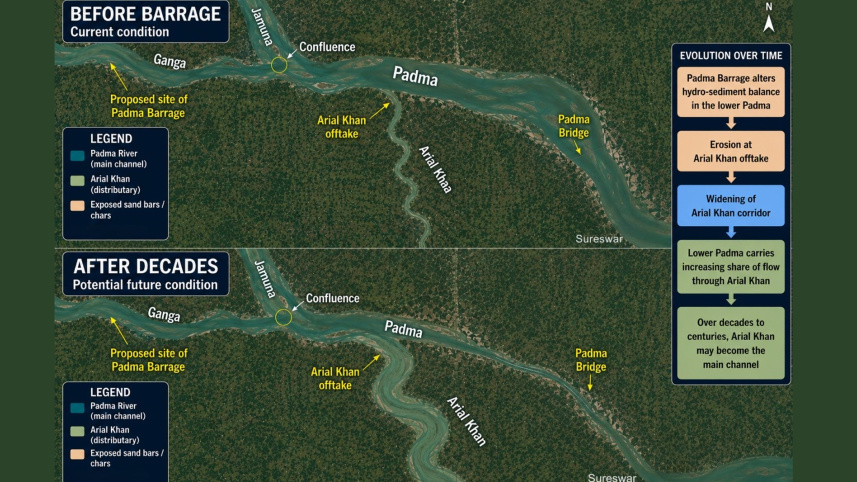
A major geomorphic change could occur in the lower Padma region. The Arial Khan is the first major distributary on the left bank of the lower Padma. Once the barrage is in place, the altered hydro-sediment balance in the lower Padma could promote erosion at the Arial Khan’s offtake, slowly widening the Arial Khan corridor, as well as narrowing the Shibchar–Sureswar reach of the Padma. If this trend continues for decades, it could lead to a far more important geomorphological transformation. The lower Padma may carry an increasing share of its flow through the Arial Khan, becoming the main channel. This may lead to serious erosion along the Arial Khan riverbanks and significant land loss, forcing people out of long-settled areas. History provides a remarkable precedent: the avulsion of the Brahmaputra into the present-day Jamuna. If a similar process evolves, future generations may ask whether the narrowing of the Padma from its confluence with the Arial Khan River was an inevitable consequence of the Padma Barrage or the Padma Bridge at Mawa point.
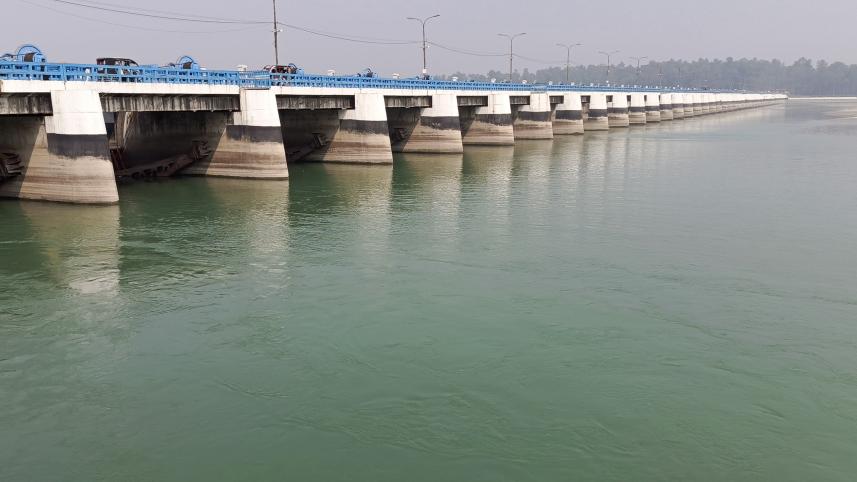
If Bangladesh is serious about a long-term solution to the water situation in the southwest, the discussion should not be confined to the proposed Padma Barrage. The Farakka Barrage could help mitigate the impact of the dry season by increasing river flows, but it should not supplant Bangladesh’s legal rights under international water-sharing rules. The better approach is to update and renegotiate the 1996 Ganges Water Sharing Treaty, which is due to expire in December this year. Bangladesh can follow certain international legal frameworks, such as the UN Convention on the Law of the Non-Navigational Uses of International Watercourses (1997) and the Helsinki Rules. The principles include the equitable and reasonable utilisation and the obligation not to cause major harm to downstream countries. These principles offer Bangladesh a strong legal basis to negotiate a more adaptive and fair treaty.
Apart from treaty revision, Bangladesh could take several supplementary steps to improve freshwater availability in the southwest. Surpluses from the monsoon can be stored in strategic off-channel storage systems, including floodplain reservoirs, modified beels, and off-river storage basins, for release during the dry season. The Menindee Lakes in Australia demonstrate how off-channel storage can support environmental flows, irrigation, and regional water security without relying primarily on large in-channel barrages. A low-head regulating structure may be a sustainable option for improving dry-season flows, especially by diverting water into the Gorai and other southwest distributaries with minimal sediment entrapment and downstream geomorphic disturbance. Similar river flow management systems on the Rhine River in Europe and the Murray River in Australia show that water may be redistributed efficiently without the need to build enormous storage barrages.
Most importantly, the Padma Barrage must not serve as a substitute for a new and fair Ganges Water Sharing Treaty. Similarly, future geomorphic changes in the lower Padma should be assessed in relation to barrage operations rather than other structures, such as the Padma Bridge.
Dr Md. Abdullah Al Baky a GIS and remote sensing professional with expertise in fluvial geomorphology, is director of Geospatial Intellect in Melbourne, Australia. He can be reached at abdullah@geospatialintellect.com.au.
Views expressed in this article are the author's own.
Follow The Daily Star Opinion on Facebook for the latest opinions, commentaries, and analyses by experts and professionals. To contribute your article or letter to The Daily Star Opinion, see our guidelines for submission.
 For all latest news, follow The Daily Star's Google News channel.
Comments