


The auto-rickshaw dilemma: Last-mile lifeline or grid-draining liability?

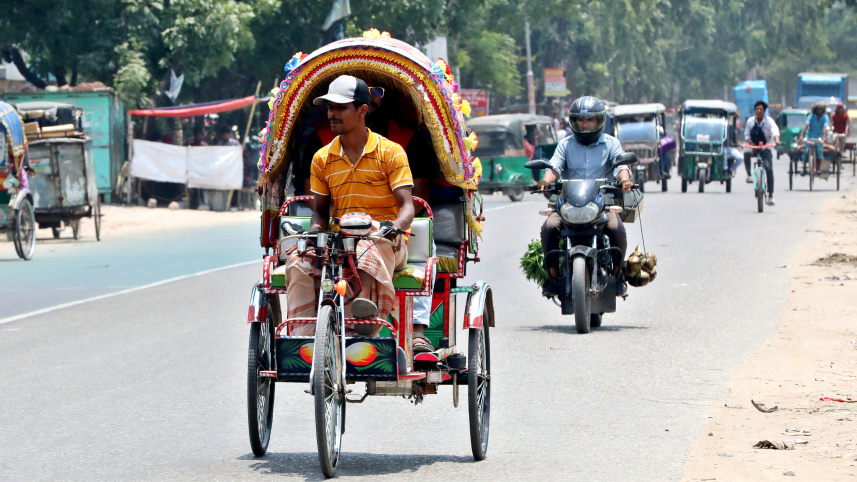
A few days ago, I took the metro rail from Uttara to Agargaon simply to enjoy the experience. The ride was smooth, on time, lasting 19 minutes that would have taken an hour or so by road. For a few minutes, I could imagine a Dhaka free of gridlock. Then, stepping off the platform brought me back to reality. There was no interlinking transport service, only a swarm of battery-run three-wheelers clustered around the exit. The drivers were calling out destinations with confidence, knowing they were the only practical option. That moment captures the central paradox of urban transport in Bangladesh. We have invested billions in world-class mass transit. MRT Line-6 now carries about 350,000 passengers daily between Uttara and Motijheel. The Kamalapur extension is on track to open January next year, and more lines are under construction. Yet for a vast majority of a city of 3.6 crore, these lines remain functionally out-of-reach or inadequate since the connection between station and destination has never been properly planned.
This is the “last mile” dilemma of transit planning, the final stretch between a transit hub and a passenger’s destination, the most critical link in the chain. A 2025 study of MRT users in Dhaka found that around 43 percent of passengers rely on informal rickshaws as their primary transport to stations.

Traffic congestion in Dhaka drains approximately Tk 650 crore annually (according to a 2020 figure) in lost productivity, fuel waste, accidents and health costs equivalent to six to 10 percent of GDP. Average vehicle speed in the city has fallen to 4.8 km/h from the 25 km/h in the late 1990s. The Revised Strategic Transport Plan prepared by Asian Development Bank (ADB) and Japan International Cooperation Agency (JICA) in 2025 identified the core structural problem as a siloed agency architecture in which roads, metro, urban planning and public transport operate independently, with no coordinating authority and no shared accountability for outcomes.
In this vacuum, battery-powered three-wheelers have emerged as an improvised answer. CPD estimates, 60 lakh of them, popularly known as “easy bikes” or “Banglar Tesla,” now operate nationwide serving around 11.2 crore passenger trips daily, with over 10 lakh in Dhaka alone. They navigate narrow neighbourhoods lanes connecting commuters to metro stations or bus terminals at fairly reasonable fares. The existence of these three-wheelers is not an issue, but their operation outside any regulatory framework is. Even though a draft “Electric Three-Wheeler Management Policy 2025” has been prepared by the Road Transport and Bridges Ministry, it has not been approved yet. In the absence of a concrete policy and implementation strategy, it has been difficult to bring the three-wheeler drivers under a unform registration structure that works all over the country. Furthermore, the vehicles are assembled without standardised safety specifications and most do not have rear-signals, speed-governors or crash protection. This results into the three-wheelers accounting for a considerable number of recorded road accidents across the country.
Beyond road safety, the sector bleeds the national power grid. Over 48,000 illegal charging points identified by DMP across the capital drain an estimated Tk 4,000 crore in annual power theft. Regularising charging infrastructure at commercial tariffs through licensed stations is therefore a must for transport reform and revenue recovery. It is also important for those whose livelihood depend on the sector. Over 10 lakh drivers rely on this sector for their livelihoods and for countless neighbourhoods these vehicles are the only option. Attempts to clear arterial roads in 2024 and 2025 triggered protests and blockades and these vehicles returned within days as a systemic consequence. Until we bridge the last-mile gap, the demand fuelling the three-wheelers will largely remain.
There is a counterintuitive dimension worth acknowledging during Bangladesh's current fuel crisis, triggered by the Middle East supply disruptions. These three-wheelers consume no fossil fuel. In a city where every commute competes for the same rationed fuel, some 10-lakh battery-powered three-wheelers absorbing last-mile demand represent a buffer. Regulated solar-powered hubs would convert an illegal grid burden into a clean, fuel-free mobility that contributes to, rather than steals from, the system it depends on. The government has at least recognised this. The draft “Electric Three-Wheeler Management Guidelines 2025” proposes mandatory BRTA registration, BSTI-approved component standards, compulsory driver licensing, and a zoning framework confining these vehicles to designated feeder routes while prohibiting them from arterial roads and national highways. Over 20,000 drivers have already been trained by DNCC pilot scheme and BUET has designed a standardised, safer vehicle.
If we look at examples from our neighbouring countries, the Philippines, Thailand, and Sri-Lanka has shifted from informal to integrated systems through cooperative licensing and targeted financial support treating these “drivers” as “partners”, protecting passenger without bankrupting provider. Bangladesh has the need, the vehicles, and the drivers, but lacks the institutional backbone to turn plans into action.
Dhaka needs an integrated multimodal mobility framework that treats metro, bus, and the last-mile feeder as a single connected network with defined and complementary roles. That starts with the MRT itself. Line-6 currently runs trains every eight to 12 minutes against a designed peak headway of 3.5 minutes, and revenue falls well short of the Tk 3,700 crore repayment due between 2026 and 2031. Extending operating hours and frequency, integrating ticketing with feeder services are essential for the metro’s Tk280 crore investment to deliver the intended return.
Virginia’s micro-transit model shows how decentralised travel can be regulated through smaller, flexible, on-demand vehicles. Designated rickshaw stands, drop-off zones at every MRT station in Dhaka would serve the same purpose. A franchise-based, app-integrated feeder model, metered fares, mandatory certification, fixed routes address driver income and road safety simultaneously. This is how regulated informal transits have moved from chaos to integration. Until a unified transport authority with a proper mandate resolves the fragmentation, every individual improvement will continue to underperform.
Bangladesh has demonstrated that it can build world-class transit like metro rail. The next test is whether it can build simple, lane-by-lane, mohalla-by-mohalla links for people to reach it. The rickshaw drivers at the Agargaon exit were not a local workaround, they serve as a bridge over a gap the state failed to close. Instead of pushing them out, they should be brought into a coordinated system. That benefits both the drivers, commuters, and taxpayers in a city, choked by the high price of inaction. Before laying the next metro-track, we must ensure the first and last miles are accounted for.
Dr Sabbir Ahmad is a researcher, mentor, and a leader in project delivery and engineering. He can be reached at sabbir@ieee.org.
Views expressed in this article are the author's own.
Follow The Daily Star Opinion on Facebook for the latest opinions, commentaries, and analyses by experts and professionals. To contribute your article or letter to The Daily Star Opinion, see our guidelines for submission.
 For all latest news, follow The Daily Star's Google News channel.
Comments