


Loan defaults and a world championship we did not need

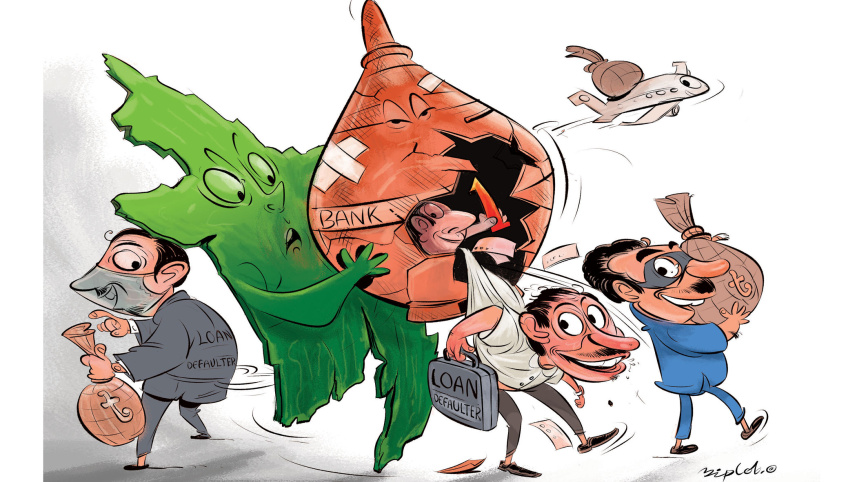
Scooping up the global championship in defaulted loans is no mean feat. The political culture of assisting business tycoons to become lawmakers, dating back to the early 1980s, is at the root of this catastrophe. This culture soared during the 15-plus years of Awami League (AL) regime, and unfortunately the disease is still in place. It weakened the banking sector, which was further aggravated by the inept handling of the Yunus-led interim regime. And sadly, there is no light at the end of the tunnel to correct the political indulgence of defaulters under the BNP regime either. At this time, BNP really needed an Ekushey Padak-winning economist and leader like M Saifur Rahman in this regard.
A recent report in Prothom Alo showed that Bangladesh’s defaulted loans now occupy 32.78 percent or roughly one-third of the total loans disbursed. The amount has peaked at Tk 606,555 crore, or roughly $49.31 billion when converted at Bangladesh Bank’s rate of Tk 123 per US dollar. This defaulted amount is enough to make underground rail for all of Dhaka, 18 metro rail lines, or at least 12 Padma bridges.

The share of defaulted loans in Bangladesh has earned global championship by surpassing the 31.5 percent mark of the Central African nation Chad, a country that has historically navigated significant economic and developmental challenges. A World Bank (WB) estimate released in 2025 found that 44.8 percent of Chad’s population lived under the international poverty line in 2022, when Bangladesh’s poverty rate was 18.7 percent by data tracked by the Asian Development Bank. Bangladesh’s GDP growth became negative only thrice: in 1971, 1972, and 1975. But the corresponding figures for Chad went negative 16 times during the 1971-2025 period, as the WB figures confirm.
The interim government led by Dr Muhammad Yunus, who once championed the rhetoric of sending poverty to a museum, added another 30 lakh people to poverty, as various sources confirmed. Despite this “magical” contribution to poverty, Bangladesh’s poverty rate remains comparatively lower than Chad’s. Seeing Bangladesh’s defaulted loans and financial metrics reach levels comparable to nations navigating much steeper historical hurdles is a stark wake-up call for the country. The amount of Bangladesh’s defaulted loans, which is close to $50 billion, is almost double the size of Chad’s GDP, which was $21.5 billion in 2025. Chad’s per capita GDP was $1,022 in 2025, while Bangladesh’s was $2,597, according to the WB estimates.
If we compare Bangladesh’s situation with its South Asian peers, it becomes obvious that the way defaulted loans have skyrocketed only in Bangladesh is nothing but a unique political syndrome that has moved from bad to worse under all regimes in turn. While the country earned the second highest growth rate of 5.5 percent in South Asia just after India (6.2 percent) during the 1991-2025 period, its performance in banking funds does not conform to any economic laws. Its non-performing loan (NPL) ratio has surprisingly exceeded its peers’ experience by far.
Another Prothom Alo report presents the loan default rates of South Asian nations, where Sri Lanka’s figure is 9.4 percent, Pakistan’s 5.8 percent, and Nepal’s 5.7 percent. The corresponding number for India is as low as 1.8 percent, suggesting that the defaulted loan pandemic in Bangladesh is a politico-financial cancer by default, and it must be overcome through drastic reforms at the top level of government. How did India make this magic happen? First, India did not use big loans for political pampering. Second, India’s bankruptcy laws are more effective than Bangladesh’s. Third, Indian banking laws allow the banks to seize and sell collateral or property once defaulters fail to meet a timeline, implying that Bangladesh’s banking laws warrant corrections in favour of the banks, not in favour of the looters—a fashion that the country can no longer afford if the government really wants to make its banking sector survive and function.
The news of Bangladesh’s championship in defaulted loans has come at a time when the government is getting ready to implement the Ninth Pay Scale for government employees, private sector credit growth being less than 5 percent is the lowest in almost three decades, the tax-to-GDP ratio being around 7 percent is also the lowest in recent history, and the government is preparing to buy 14 aircraft from the US’s Boeing Company and 20-24 fighter jets from China. These affairs are contradictory, sending conflicting signals to investors and foreign stakeholders. That is why both domestic and foreign investments have reached new lows since the new government took office nearly seven months ago.
That rescheduling of bad loans does not work in Bangladesh has remained true since the early 1990s. The AL regime gave indirect legitimacy to bank looting in the name of rescheduling. The current government, which is expected to be tough on defaulters, has followed in the AL regime’s footsteps. The big defaulters over Tk 1,000 crore have been allowed 15 years’ rescheduling instead of the previous limit of 10 years approved during the Yunus regime. This dilution of law is nothing more than a signal of lifelong impunity for the big plunderers of funds.
Long-term waivers for big loan defaulters go against the economic philosophy of banks, which are supposed to provide short-term working capital mainly to medium and small enterprises, while big entrepreneurs are supposed to draw their funds from the capital market. The central bank has become a scapegoat covering the wrongdoings of tycoons who finance politicians in power in exchange for illicit gains. Unless the government brings effective reforms to correct the cancer of defaulted loans in the banking industry, no glimmer of hope is in sight.
Dr Birupaksha Paul is professor of economics at the State University of New York at Cortland in the US.
Views expressed in this article are the author's own.
Follow The Daily Star Opinion on Facebook for the latest opinions, commentaries, and analyses by experts and professionals. To contribute your article or letter to The Daily Star Opinion, see our guidelines for submission.
 For all latest news, follow The Daily Star's Google News channel.
Comments