


Bangladesh's young mathematicians shine at WMI 2026
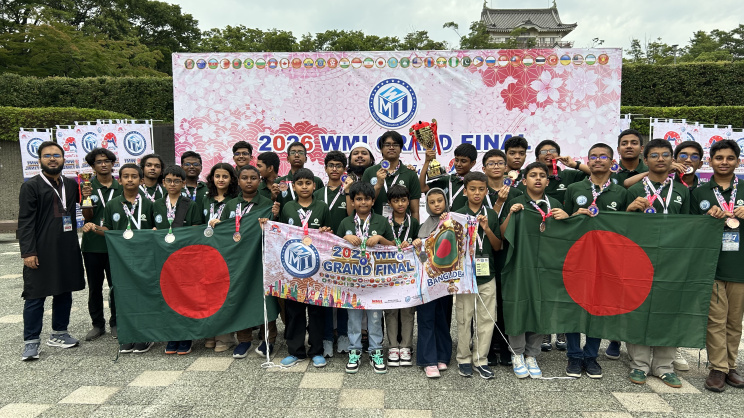
Bangladesh returned from the World Mathematics Invitational (WMI) 2026, held in Chiba, Japan, with an achievement matched by few nations at the competition: every single member of its 27-member national team won an award. Competing against roughly 2,300 students from more than 30 countries, the Bangladeshi contingent secured two diamond awards, two gold medals, six silver medals, 14 bronze medals, and three merit Awards, achieved under the management, training and international coordination of Banglar Math.

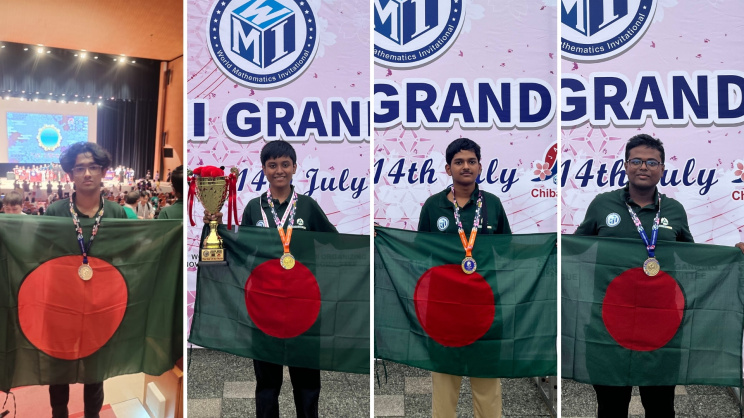
Among the many young mathematicians who represented the country four names stand out: Ahbab Zulkifal Zahin of Rajshahi Collegiate School, who won a diamond award; Jeet Bala of Swarnakali High School in Gopalganj, also a diamond medallist and the country's top-3 second-place finisher; Sajidul Haq of St Joseph International School, a sixth grade student who won gold and was named “Star of the World” for posting the highest score among all Bangladeshi participants; and Rahid Azad Ahan, a ninth grader from Khulna Public College, gold medallist. Their accounts, gathered after the competition, trace a common thread of confidence, discipline, mentorship, and tenacity that carried Bangladesh's flag to Chiba and back.
A shared pull toward numbers
For many of the medallists, the pull toward mathematics began long before the WMI ever entered the picture, and the invitation to compete in Japan simply became the natural next step in a much longer relationship with the subject.
“Ever since my childhood, I have been deeply attracted to numerical problems and mathematics, and due to my parents' support, it has only been enhanced further. Bangladesh Math Olympiad (BdMO), Banglar Math Excellency Championship (BMEC), and Banglar Math appeared to me as an opportunity to showcase my love and interest through the various problems that were introduced in this olympiad, so I was highly motivated to take part,” says Zahin, who recently passed his SSC examination.
Jeet Bala, competing among the strongest performers in the entire contingent, described a similarly deep-rooted attachment to the subject, sharpened further by the chance to test himself against peers from around the world. He says, “My deep-seated passion for mathematical problem-solving, abstract thinking, and exploring core disciplines, like number theory, Euclidean geometry, combinatorics, and inequalities, pushed me to enter the olympiad scene. I have always derived immense joy from testing my analytical limits against complex, non-routine problems that stretch far beyond the standard school curricula.”
For Bala, beyond the personal intellectual thrill, the drive to represent Bangladesh on an international platform and benchmark his skills against the brightest young mathematical minds around the world was a massive motivation.
Months of methodical preparation
Behind the medals lay months, and in some cases years, of structured preparation. Zahin drew on lessons from his earlier appearance at WMI Thailand 2025, building a study routine around his own strengths and weaknesses, and credited the organisation's trainers with helping the wider Bangladeshi contingent cut a figure on the international stage. Bala's route was more formal and academic. He immersed himself in advanced problem-solving techniques, functional equations, and rigorous proof-writing, trained alongside other hopefuls at national BdMO camps and selection tests, and supplemented that structured work with independent study of classical contest literature.
For Ahan, the step up from national to international competition initially felt disorienting. His BdMO preparation had already given him a strong foundation, which meant BMEC felt like a natural progression, but WMI level left him unsure whether his existing methods would be enough. Banglar Math's problem-solving classes, he said, became a reliable space to verify his reasoning and catch the subtle errors that slip past a solitary solver. He also worked through the organisation's practice book and built in time to reflect on a problem's shape before diving into calculations.
Haq's route to the podium began earlier still, through the BMEC advertised at his school, which led to his selection for the WMI 2026 team trial. His preparation included independent practice on previous years' papers – a formula that, by his own account, was less about elaborate strategy than sustained effort.
Carrying the flag under pressure
Representing a country at an international competition carries a weight that differs from student to student, and the two youngest medallists among the group described handling it in markedly different registers.
For Haq, the youngest of the four grade six Bangladeshi participants, earlier experience on the international stage had already taken the edge off any nerves.
“I already participated in several competitions, including international competitions, and received awards there, so there was not much pressure for me, as I was confident enough to get an award from here. I was also confident to keep my country's honour in front of the whole world,” he says.
Ahan answered the same question framing years of relentless preparation as having already settled the outcome long before he sat down to compete in Chiba. He expands, “I knew I would win. Pressure is for people who are unsure. I wasn't. I had already seen every problem the country could design. WMI was already finished while BdMO was still just my warm-up. The international arena wasn't a mystery. It was just a bigger board with the same rules.”
Building an ecosystem, not just a medal count
Ahmed Shahriar, coach of the Bangladesh Mathematics Team at WMI and co-founder of Banglar Math, views the results as validation of a broader project rather than the product of individual brilliance alone. Looking beyond the next olympiad cycle, he outlined a calendar built around two flagship national competitions: the Banglar Math Team Championship (BMTC), held between August and September, and the Bangladeshi Math Excellence Championship (BMEC), held between March and April, both open to students from grades 3-12.
 For all latest news, follow The Daily Star's Google News channel.
 “Through these competitions, we aim not only to identify talented students but also to nurture their problem-solving abilities, teamwork, confidence, and competitive mindset,” he states, noting that Bangladeshi students have now collected more than 150 international medals and recognitions across competitions including the World Mathematics Team Championship, the International Mathematics Competition, WMI, and the American Regions Mathematics League.
Asked what they would tell the next generation of hopeful Olympiad participants, each of the four medallists offered a version of the same underlying message, even as their tone ranged from gentle encouragement to something closer to a full-throated rallying call.
“If you have a good understanding of the topic of the olympiad or any competition and try hard enough, Inshallah you can easily get an award,” says Haq.
“Cultivate a genuine curiosity for understanding mathematical concepts from first principles rather than relying on rote memorisation or shortcuts. Never be intimidated by difficult problems or initial failures. Resilience in mathematics is forged precisely by wrestling with complex proofs, making mistakes, and rigorously analysing where you went wrong. Stay consistent with your daily practice, embrace the intrinsic elegance of problem-solving,” added Bala.
“Can't solve math in 10 minutes? Try an hour. Still, no? Try two. Still, no? Try three,” says Ahan, before tempering the intensity of his own advice. “And before you grind, take a moment to reflect. Reflection isn't hesitation. It's reconnaissance. Look at the battlefield before you charge.”
“Participating in the olympiad would help them to work with their fear of mathematics and develop their problem-solving skills to a very high level. We should remember that at the end it is not over when they lose; it is only over when they give up,” says Zahin.
For Shahriar, that spirit of persistence is precisely the point: “We want to build a nation of problem solvers. We dream that one day, the students who are solving mathematical problems today will grow up to solve the big problems for Bangladesh”
Comments