


The delta paradox

In the seventeenth century, the southeast portion of the Ganga-Brahmaputra-Meghna (GBM) delta underwent environmental pressures of crisis proportions. Social breakdown was evident from vicious slave raids and subsequent slave trading. Paradoxically, this was a period of renewed agricultural growth for the southeast, as the newly active delta generated fresh rice-producing lands. Therefore, although conventional history-writing tends to equate economic growth with social and political stability, this may not hold true for late medieval Bengal.
The argument
 For all latest news, follow The Daily Star's Google News channel.
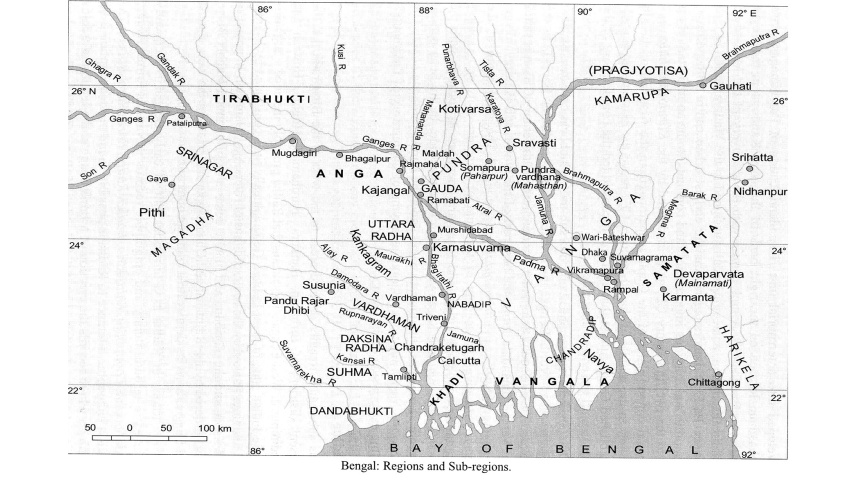
 According to historian Richard Eaton, west-to-east riverine shifts from the sixteenth century onward rendered Bengal’s western delta moribund and made the southeast delta very active. This enormously enhanced the revenue-paying capacity of southeast Bengal.
New rivers like the Bhairab, Mathabhanga, Garai-Madhumati, and Arialkhan created fertile valleys. Agricultural yields jumped exponentially. Per Mughal statistics, between 1595 and 1659, revenue demand for the southeast saw a +117% jump, whereas the northwest saw a change of –13%.
In Eaton’s words, ‘A distinguishing feature of East Bengal during the Mughal period… was its far greater agricultural productivity and population growth relative to contemporary West Bengal. Ultimately, this arose from the long-term eastward movement of Bengal’s major river systems, which deposited the rich silt that made the cultivation of wet rice possible’.
The notorious slave raids occurred in this peculiar situation of agrarian growth amidst physical destruction.
Fickle rivers
Before studying the effects of the riverine shifts, let us see how the southeast’s chief rivers fared at this time. The Tripura Vamsavali mentions the sixteenth-century southeast’s fluvial network: the Gomati, Jamuna, Brahmaputra, Dhaleswari, Kirtinasa, and the Meghna.
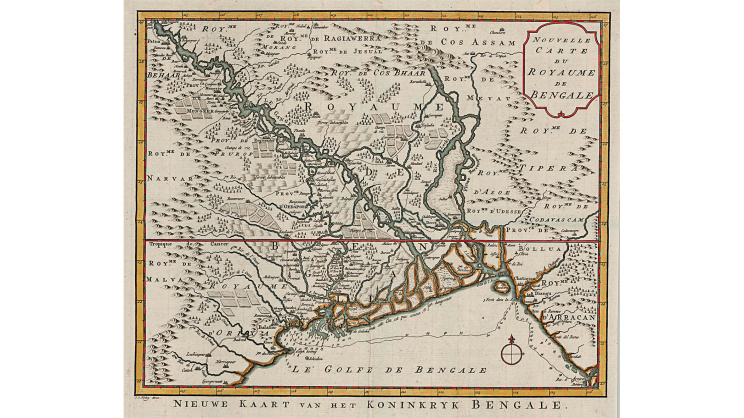
In Giovanni Antonio Magini’s map (1597), the Meghna is clearly the chief river, but in Linschoten (1596), it is ‘Cosmin Flu’, not the Meghna, that waters the southeast. Sometimes the Lakhiya or Laquia (see Guillaume Delisle, 1740, and Nicholas Bellin, 1747–61) is noted as the principal river. A mysterious river called ‘Caor’ appeared in maps for over two hundred years. Scholars agree that both Caor and Lakhiya are surrogates for the Brahmaputra, and ‘Caor’ was likely to be a diminutive form of ‘Karatoya’.
Karatoya was an old river. Karatoya Mahatmya, composed sometime before the second half of the twelfth century, states that the land along its course was wealthy with tanks and wells; its people were wise and pure; and its banks were fertile, elevated, and free of snakes. Spanning the Bhutan-Tibet route, this land—filled with citadels, monasteries, and temples—was twice blessed, since the Karatoya washed its shores.
The mighty Karatoya, which Bakhtiyar Khilji had described as immense as the sea while sailing on it during his Assam campaign at the start of the thirteenth century, declined in favour of the Lakhiya and the Brahmaputra when the latter changed its course in 1787.
As these rivers received more water, the Karatoya’s banks turned moribund, its flow reduced to a stream, and a flood in 1820 effectively ended its course. It appears as a major river in Rennell’s map of 1776; even in 1810, Francis Buchanan-Hamilton described it as ‘a very considerable river’. By the start of the twentieth century, the Imperial Gazetteer of India reported that the Karatoya was a ‘trickle’.
The Meghna, down which Ibn Battuta had sailed in the fourteenth century, also underwent drastic changes in its course. English traveller Ralph Fitch’s sketch, c. 1585, showed the Ganges and Meghna joined at Sripur, south of Sonargaon. Two hundred years later, English surveyor James Rennell’s maps (1764–72) show the confluence shifting to Dakhin Shahbazpur (Bhola) Island. The Padma and the present Brahmaputra (Jamuna) became more prominent.
The west-east shift created new ports, but it also destroyed older channels and made the southeast an area of environmentally disrupted human settlement, marked by ‘lost’ rivers, ‘lost’ civilisations, and ‘lost’ cities.
The Ganges’ southward stretch from Jafarganj to Dakhin Shahbazpur is called Kirtinasha, or the Great Destroyer, and Sripur, the capital port-city of the Baro Bhuiyans Chand and Kedar Rai, was a casualty. Bakla was destroyed by a cyclone and storm-wave in 1584. The Ichhamati, along which Jean-Baptiste Tavernier travelled from Jafarganj to Dhaka in 1666, now contains hardly any water during the dry season. Between 1811 and 1867, Sagor Island at the Hugli’s mouth was swept by six major cyclones; those of 1833 and 1864 took thousands of lives.
In 1774–75, the Scottish colonial official and trader Robert Lindsay travelled down ‘the Dacca river for twenty miles; we stopped at Feringee-bazar. At this place the Dacca river, which is a branch of the Ganges, joins the great Brahmaputra; when both united, they are known by the name of Meghna, and form one of the largest rivers in the world.’
Twelve years later, in 1787, when it changed course a hundred miles south, the Brahmaputra crossed Mymensingh and emptied into the Meghna at Bhairab Bazaar, from which point a vast freshwater sea covered the land for half the year across large waterbodies (haors) spanning Netrokona and Sylhet from west to east. This inland sea deterred settlers from the west, but the term ‘bazaar’ indicates a thriving local economy. In the first half of the twentieth century, the Brahmaputra’s main channel ran due south from below Chilmari, instead of around Mymensingh and Bhairab Bazaar as in Rennell’s day. The two courses were nearly 70 miles apart at one point.
Delta imaginaries
The delta’s unique hydrology meant that its rulers lay outside the main circles of power. This allowed them to build networks to stabilise their rule, protect themselves from neighbouring polities, and preserve access to the sea. Deltas are autarchic and self-sufficient, but unlike islands, they are amorphous, marked by ambiguity, lack of definition, and fluid boundaries—a zone where land and sea intertwine and merge, demonstrating the fungibility or interchangeability of land and sea. Delta imaginaries provide fertile ground for perspectives in which porous frontiers act as filters, through which the salt of the sea is gradually replaced by the silt of the land.
The British civil servant Francis Bradley Bradley-Birt wrote in 1906: ‘Memories still cling thick around these lower reaches of the Lakhiya, close by where the great rivers meet. But just below, the Meghna, the Ganges, the Brahmaputra, the Dullasery, and the Ishamutty all unite, and this meeting-place of the giant watercourses is the most historic spot in all Eastern Bengal. The many tides that have ebbed and flowed this way have seen strange scenes… It has seen great principalities and kingdoms rise and fall, the fleeting glories of a fickle world. On its broad bosom it has borne brave fleets and armies to victory and defeat… Only the great river… flows onwards…’.
A new urbanisation
Early European maps of the period show that riverine shifts created new lands dotted with market towns and ports in the southeast. However, Bellin’s maps from 1747 to 1761, issued in Abbé Prévost’s Histoire Générale des Voyages (1770), designated the Bengal coast as ‘Toute cette côte est peu connue et fort dangereuse’ (translation: ‘this coast is little known and very dangerous’), alluding to its dangerous tides and shifting sandbanks.
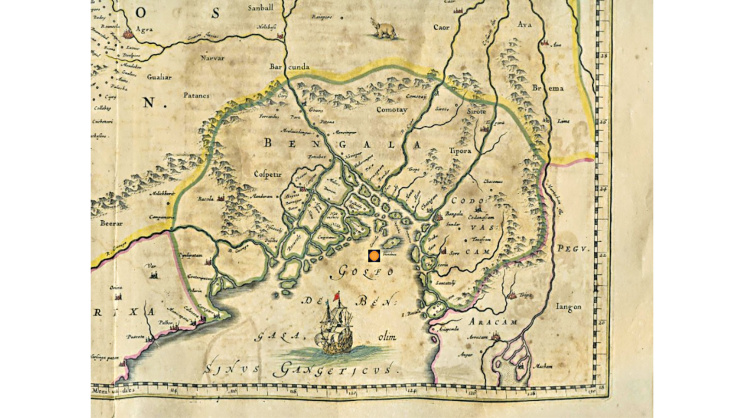
For the Portuguese, their bases in ‘Bengala’ were simply represented as being sited in Maluco (mulk or territory) and Nao Maluco/Nao Moluco (naya mulk). Willem Blaeu’s 1638 map inscribes them with place names: ‘Noldy’ for Nao Maluco and ‘Buram’ for Maluco.
Let us now see what this newly urbanised southeast looked like.
João de Barros’ Quatra Decada da Asia (1552, 1553, and 1563, edited by Lavanha in 1615) marks political divisions, towns, fortified ports (bandar), bazaars, and citadels in the newly emergent islands: Jugudia, Sundiva, Merculij (Meherkul), Guacala, Bulnei, Bicaram, Angara, Belhaldy, Cuipitavaz (the Husain Shahi mint town of Khalifatabad, Bagerhat, on the Bhairab’s bank), Tipuria, and the eponymous Maluco and Naomoluco.
Overflowing saltwater from the sea destroyed settlements and promoted migration. Escalating global demand for cheap labour exploited this migratory trend and facilitated a slave-raiding culture in Arakan.
Blaeu’s map of 1638, clearly derived from the Barros map, marks Pacuculy, Cuipitavaz, Tipuria, Dipuria, Bicaram, Guacala, Angara, Balbaldy, Jugudia, and Sundiva. Catrabo (Katrabuh, near Dhaka) and Khizrpur, both under Isa Khan, were sixteenth-century port towns supplementing Sonargaon, Isa’s capital port city. Fathabad (modern Faridpur, situated on the bank of an old channel of the Padma) was a mint town. Bakla (British Backergunge) was an ancient capital and a medieval port town, and under the British, a grain mart.
The fortified sixteenth-century Yashohara-Ishwaripur and Dhumghat were, respectively, the capital and shipyard of the Baro Bhuiya Pratapaditya. Sripur and Sonargaon were port-based capitals and grain and cotton marts belonging to Kedar Rai and Isa Khan. Sandwip, belonging to no one, was a salt-producing centre and port. Loricoel on the Meghna, also called Norcoel, Meherkul, or Merculij, became a fortified bridgehead but functioned as a strategic maritime gateway for upstream polities. As a defensive outpost, salt-trading centre, and site of a Portuguese Augustinian settlement, Loricoel was under Isa Khan’s rule. Because of its access to the sea, it was contested by Tripura, Bengal, Arakan, and the Portuguese.
In the period from 1433 to 1538, the southeastern delta contained four mint towns, as opposed to one in the western delta. In the period 1538–1760, this number grew to fourteen, compared to seven in the west. Many of these appeared on newly formed lands.
A similar predominance is seen in Bengal’s inscription sites: between 1538 and 1760, the southeast had thirteen sites, compared to eight in the west. Clearly, the southeast retained its economic momentum despite the environmental ravages it underwent in the seventeenth century. At the same time, operating within a commercial boom but constrained by an emerging political and social crisis, these towns could not become stable urban centres, and their milieu remained predominantly rural.
A land destroyed
This distinctive hydrography facilitated slave raiding. The rivers were capricious and the drainage system was unique; brackish water flowed inward rather than outward. Overflowing saltwater from the sea destroyed settlements and promoted migration. Escalating global demand for cheap labour exploited this migratory trend and facilitated a slave-raiding culture in Arakan. The southeast, with its larger rivers and with creeks and inlets extending far inland, underwent terrible Magh raids by Portuguese-Arakanese bands. The Mughals were unable to defend the eastern frontier.
In 1772, Scottish official and merchant Robert Lindsay wrote: ‘This navigation [of the Sunderbans] is part of the Delta of the Ganges, extending more than 200 miles along the coast, through thick forests, inhabited only by tigers, alligators, and wild animals peculiar to a tropical climate; the human population is very scanty, the country being overflowed every spring-tide by salt water. It is a dreary waste of great extent, but beautiful in the extreme, the lofty trees growing down to the water’s edge with little or no brush or underwood. The innumerable rivers and creeks which intersect this country in every direction form a passage so intricate as to require the assistance of a pilot; its windings are like the mazes of a labyrinth…’.
Surveyor James Rennell wrote soon after: ‘That part of the Delta bordering on the sea is composed of a labyrinth of rivers and creeks, all of which are salt, except those that immediately communicate with the principal arm of the Ganges. This tract, known by the name of the Woods, or Sunderbunds, is in extent equal to the principality of Wales; and is so completely enveloped in woods, and infested with Tygers, that if any attempts have ever been made to clear it (as is reported) they have hitherto miscarried. Its numerous canals are so disposed as to form a complete inland navigation throughout and across the lower part of the Delta, without either the delay of going round the head of it, or the hazard of putting to sea.’
But navigation was not easy: the creeks dried up, and ships could run aground. During 1782–83, Lindsay’s 400-ton Augusta sailed from Sylhet to Macau via Kolkata ‘through a most intricate and hitherto unexplored navigation, to the vicinity of the sea’.
He anchored ‘at a place called Luckypore, near the confluence of the Ganges and Brahmaputra, two of the largest rivers in the world… and crossed and recrossed this great river, at this place full twenty miles broad’, but then ran aground. He searched for ‘a passage to sea through the narrow channels, or creeks, with which this wide delta abounds; and we succeeded in finding deeper water in the river called Harringotta, a smaller branch of the Ganges.’ Only the small, fast Magh boats could navigate this unique landscape.
Rila Mukherjee is a historian and the author of India in the Indian Ocean World: From the Earliest Times to 1800 (Springer Nature, 2022) and Europe in the World from 1350 to 1650 (Springer Nature, 2025).
Comments