The painted cosmology of Tikoil village
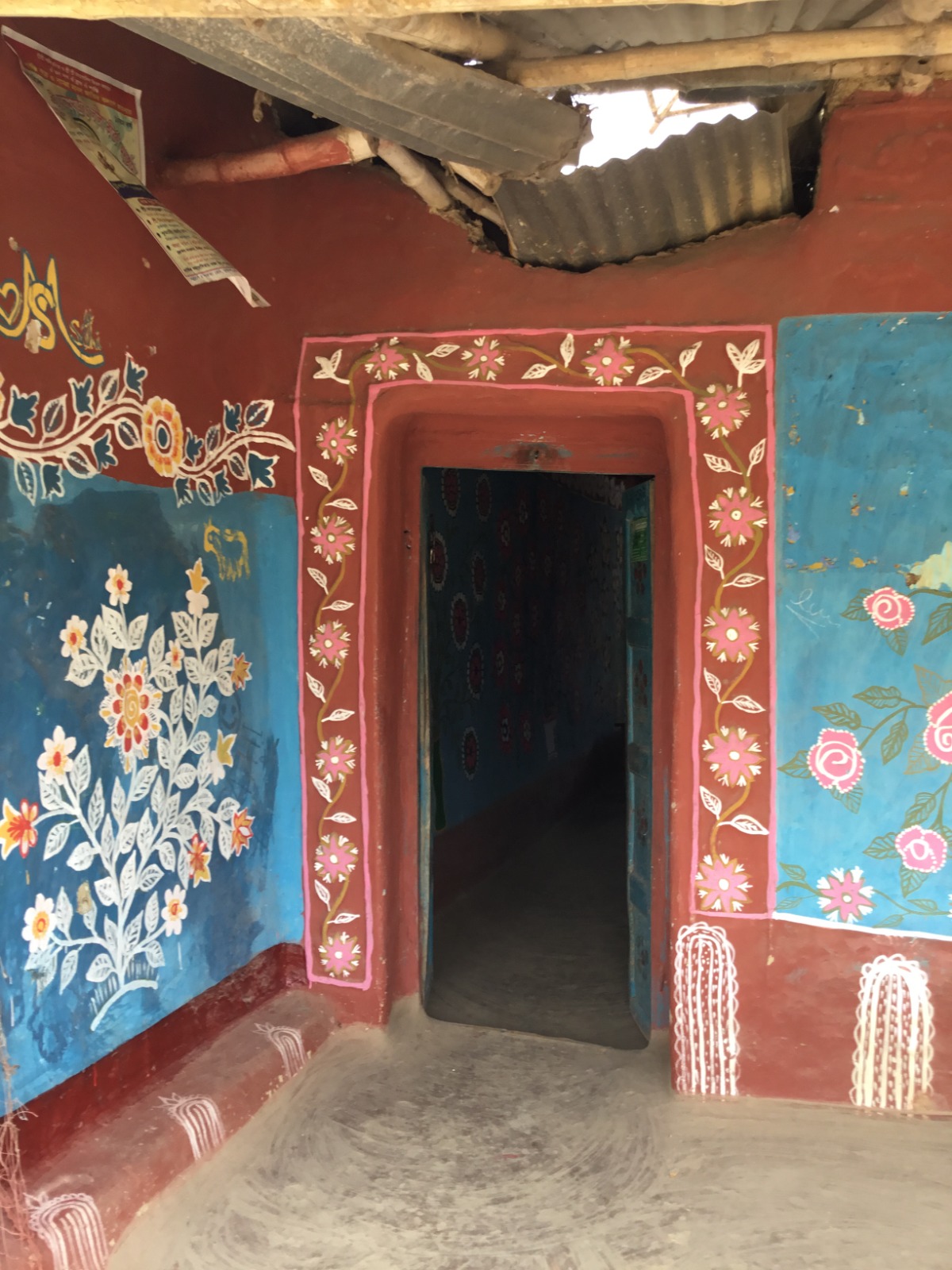
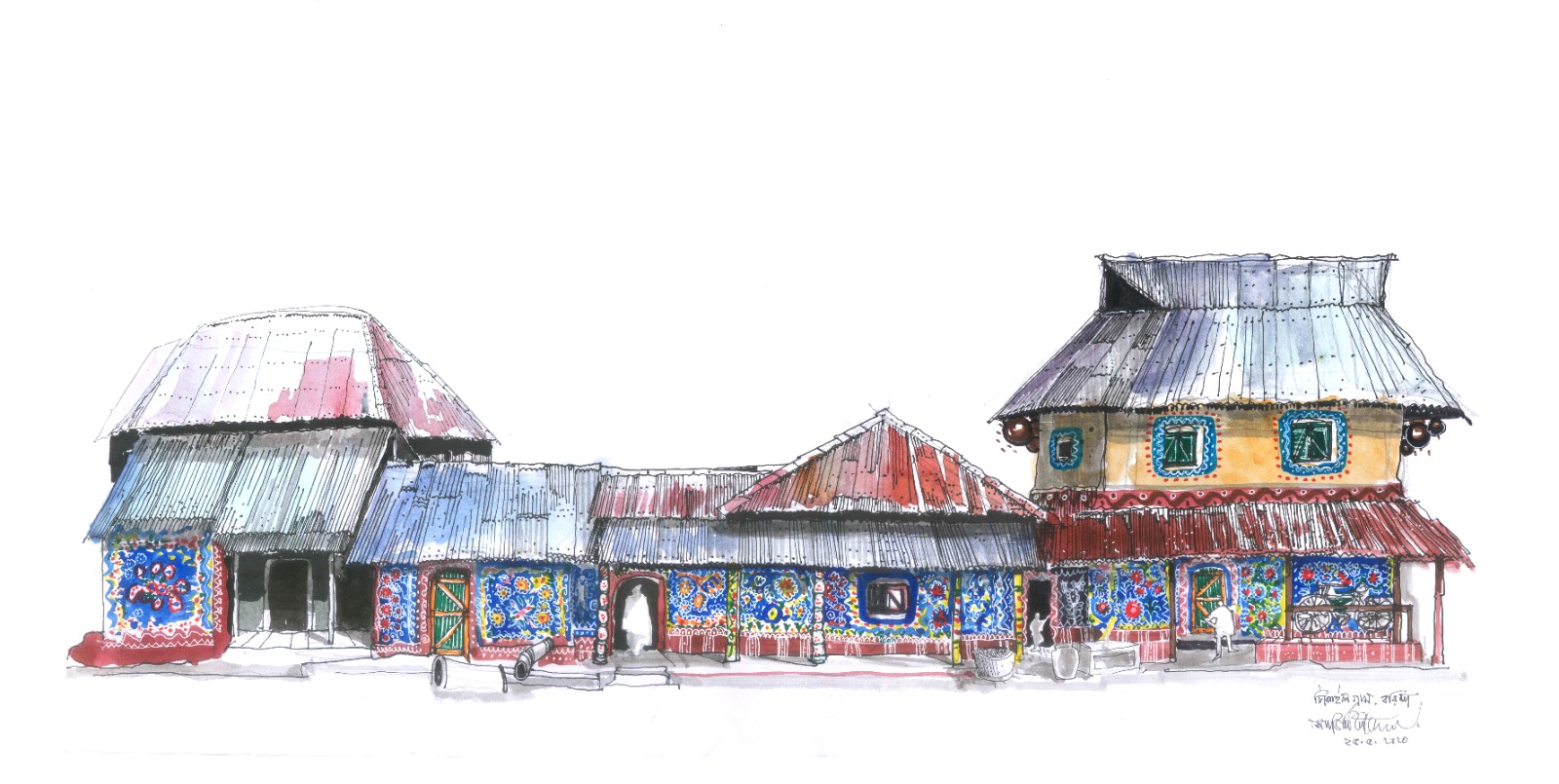
In the quiet, clay-laden expanse of northwestern Bangladesh, in a village called Tikoil, life unfolds not just in time, but in colour—layered, renewed, and remembered upon the fragile yet enduring surfaces of earthen homes. Known locally as Alpona Gram, this settlement stands as a rare and poetic testament to a living tradition where architecture becomes canvas, and everyday life transforms into an act of continuous artistic devotion. Here, walls are not inert boundaries; they are expressive skins of memory, inscribed by the hands of women whose knowledge flows through generations without written record, yet with remarkable precision and depth. The village does not simply exist, it performs itself through pigment, ritual, and rhythm. Every courtyard, every façade, every threshold participates in a choreography of colour that reflects not only aesthetic intent but also a profound cosmological understanding of the world.
When homes become living canvases
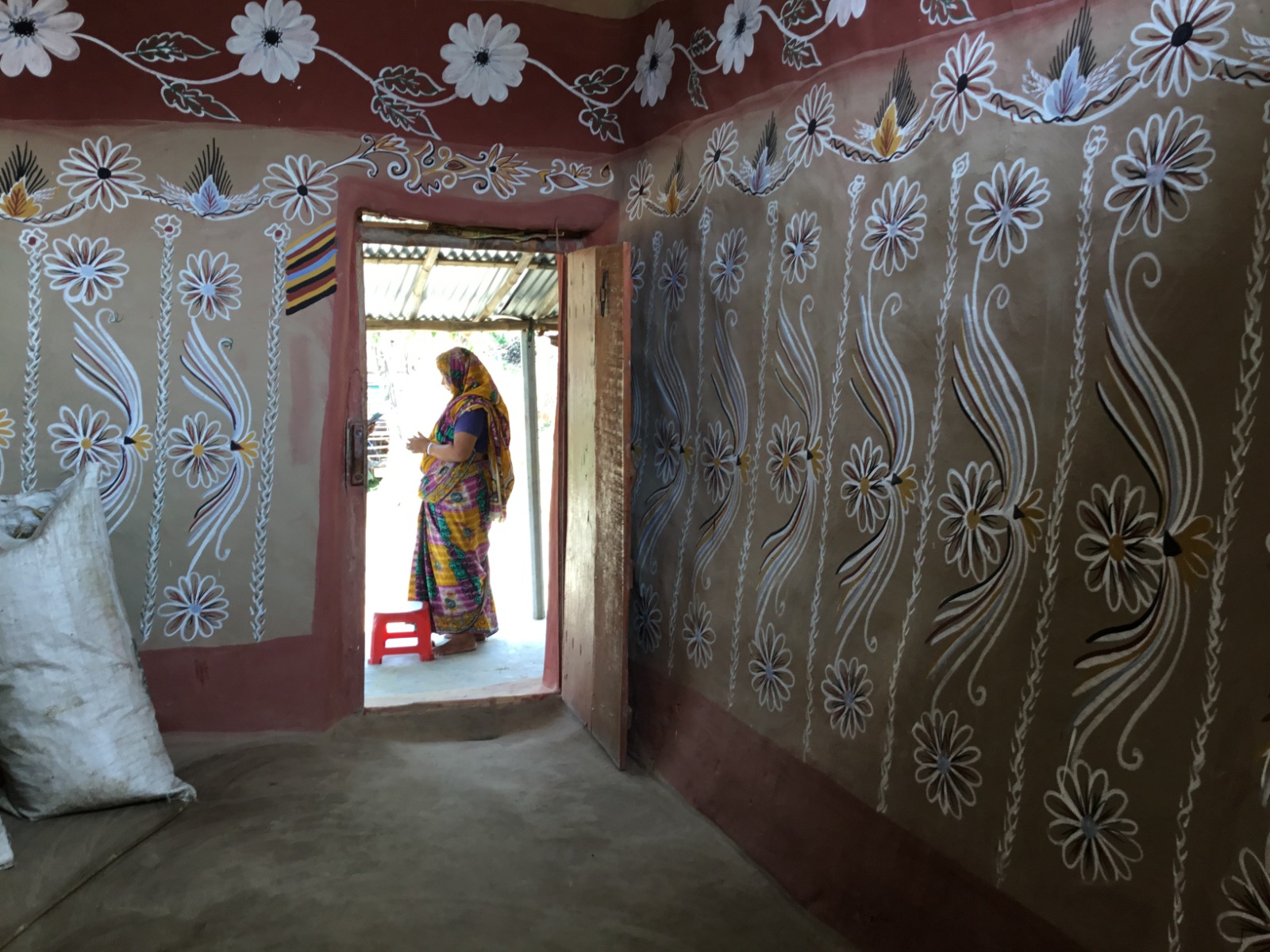
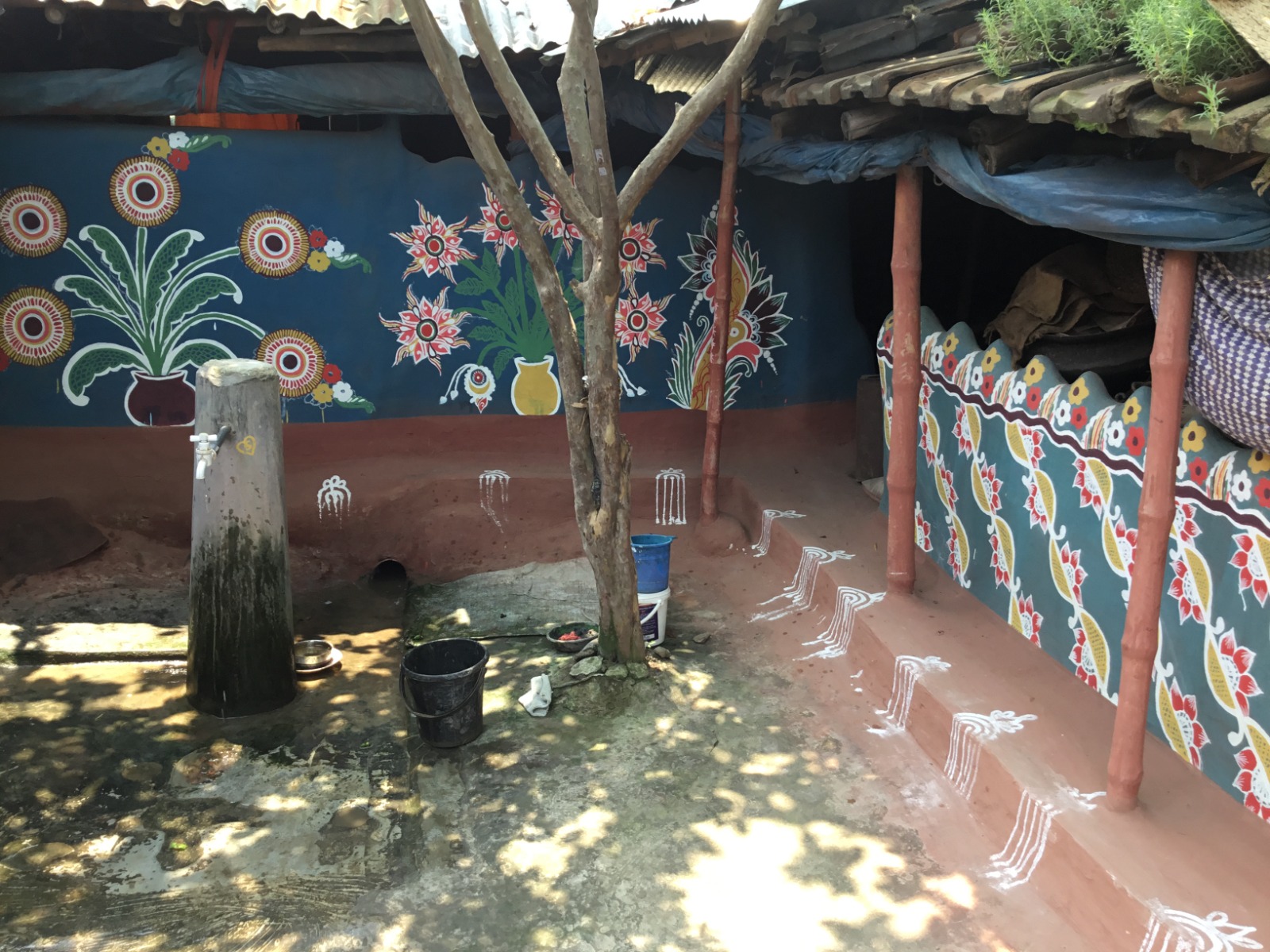
To enter Tikoil is to step into a landscape where art is inseparable from habitation. The homes, constructed from the very earth beneath them, carry within their surfaces the story of their making. Clay walls, smoothed with layers of etel mati, become receptive grounds upon which motifs bloom floral patterns, birds in motion, fish gliding across dry surfaces, geometric spirals echoing cosmic continuity. These are not random embellishments; they are symbols encoded with meaning such as fertility, protection, harmony, and connection to the unseen. As documented in the research on painted homesteads, such motifs are deeply embedded within ritual cycles and seasonal rhythms, suggesting that the act of painting is not decorative but performative, an act that aligns the household with both social and celestial orders. The house becomes more than shelter, it becomes a living cosmogram.
The silent artists: Women as custodians of memory
At the heart of Tikoil’s painted world lies a form of authorship that is both invisible and immense, the quiet, enduring agency of women whose creativity sustains not only an art form, but an entire cultural cosmos. Their work does not seek recognition, yet it defines the identity of the village. In Tikoil, artistic knowledge is not institutionalised; it is inherited. It flows through generations in a matrilineal rhythm, carried in gestures, habits, and shared moments rather than written texts. Mothers do not “teach” in the conventional sense. They demonstrate, repeat, and invite participation. Daughters watch, imitate, and gradually internalise. In this process, creativity becomes a lived inheritance, and memory is transmitted through the body.
This form of transmission is what we understand as intangible cultural heritage- a living archive of practices, expressions, skills, and meanings that exist not in objects, but in people. Unlike tangible heritage, which can be preserved in museums or documented in archives, intangible heritage survives only through continuity of practice.
In Tikoil, the painted wall is not the heritage itself; rather, it is the outcome of a deeper cultural system rooted in feminine knowledge, ritual participation, and collective memory. The real heritage resides in the hands that paint, the rhythms that guide them, and the meanings they carry forward.
Women in Tikoil are not merely decorators of space; they are interpreters of a cultural language that binds the domestic sphere to broader cosmological and social orders. Their creative initiative operates within the intimate domain of the household, yet its implications extend far beyond it. Each motif whether a lotus, a bird, or a spiral is chosen not only for its visual appeal but for its symbolic resonance. Through these forms, women articulate ideas of fertility, protection, continuity, and harmony. In doing so, they embed belief into architecture, transforming the home into a site of both aesthetic expression and spiritual alignment.
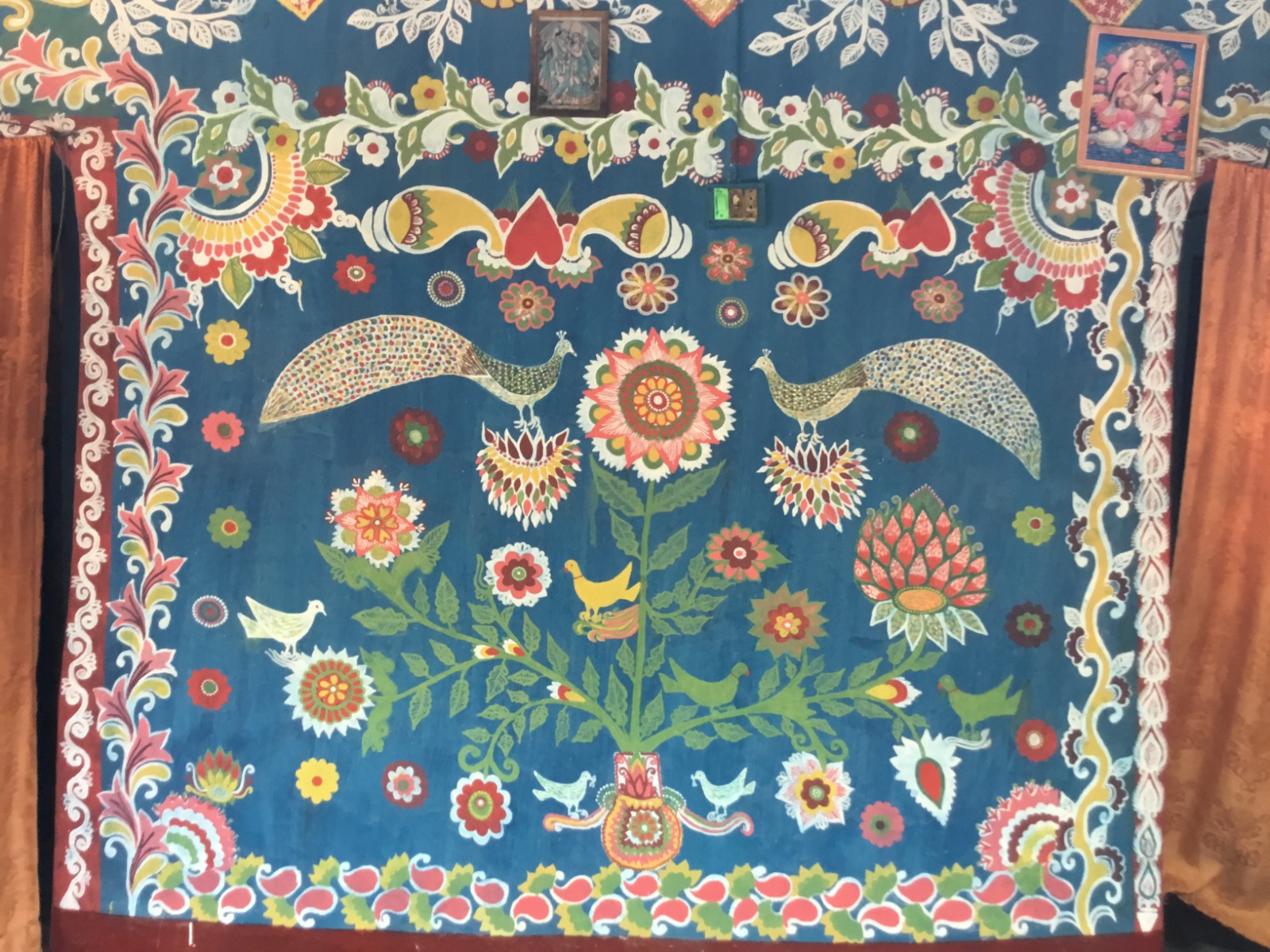
The courtyard becomes the primary stage of this creative practice- a space where labour, conversation, and artistry merge seamlessly. Women gather not in isolation but in collectivity, sharing tools, pigments, and stories. The act of painting unfolds as a social event, where laughter, memory, and technique intermingle. This communal dimension is essential to the survival of the tradition. It ensures that knowledge is not confined to individuals but distributed across the community, making it resilient and adaptive. The repetition of motifs across generations is not mechanical; it is interpretive. Each woman brings subtle variations, responding to her own experience, environment, and time. In this way, the tradition remains dynamic, evolving while retaining its core identity.
Importantly, the absence of formal documentation does not indicate a lack of structure. On the contrary, the system is deeply organised, guided by seasonal cycles, ritual occasions, and social contexts. Certain motifs appear during harvest festivals, others during weddings or religious observances. The timing, placement, and composition of paintings follow an internal logic that is understood collectively, even if never explicitly codified. This is the essence of intangible heritage: a knowledge system that is shared, embodied, and continuously enacted.
Yet, this heritage is also fragile. As social structures shift and younger generations move towards different forms of livelihood, the continuity of such practices becomes uncertain. The introduction of new materials and changing lifestyles may alter the rhythm of transmission. What is at risk is not only a visual tradition, but a mode of learning, a way of being together, of creating together, of remembering together. The feminine creative initiative that sustains Tikoil is therefore not just an artistic contribution; it is a cultural foundation that requires recognition and care.
To acknowledge these women as custodians of intangible heritage is to recognise the depth of their knowledge and the significance of their labour. It is to understand that heritage is not only found in monuments or artefacts, but in everyday acts of making, in the quiet persistence of tradition, and in the creative resilience of communities. In Tikoil, the painted wall stands as a testament to this truth—a document not of ink, but of touch, where every line carries memory, and every colour holds the presence of those who came before.
Earth as palette: The material poetry of pigment
Traditionally, the colours that animate these surfaces were drawn directly from the environment. Red from iron-rich soil, white from refined clay, black from soot, and subtle hues from leaves, bark, and organic matter—each pigment carried the essence of its origin. The preparation of these colours was itself a ritual, involving soaking, grinding, mixing, and waiting. This process embedded value into the act of painting, connecting the artist not only to the wall but to the land itself. The material and the meaning were inseparable. As the research highlights, this integration of local resources with artistic expression created a unique ecological aesthetic, where architecture, environment, and culture converged seamlessly. The wall was not merely a surface; it was an extension of the earth, and the pigment was its voice.
The house as cosmos
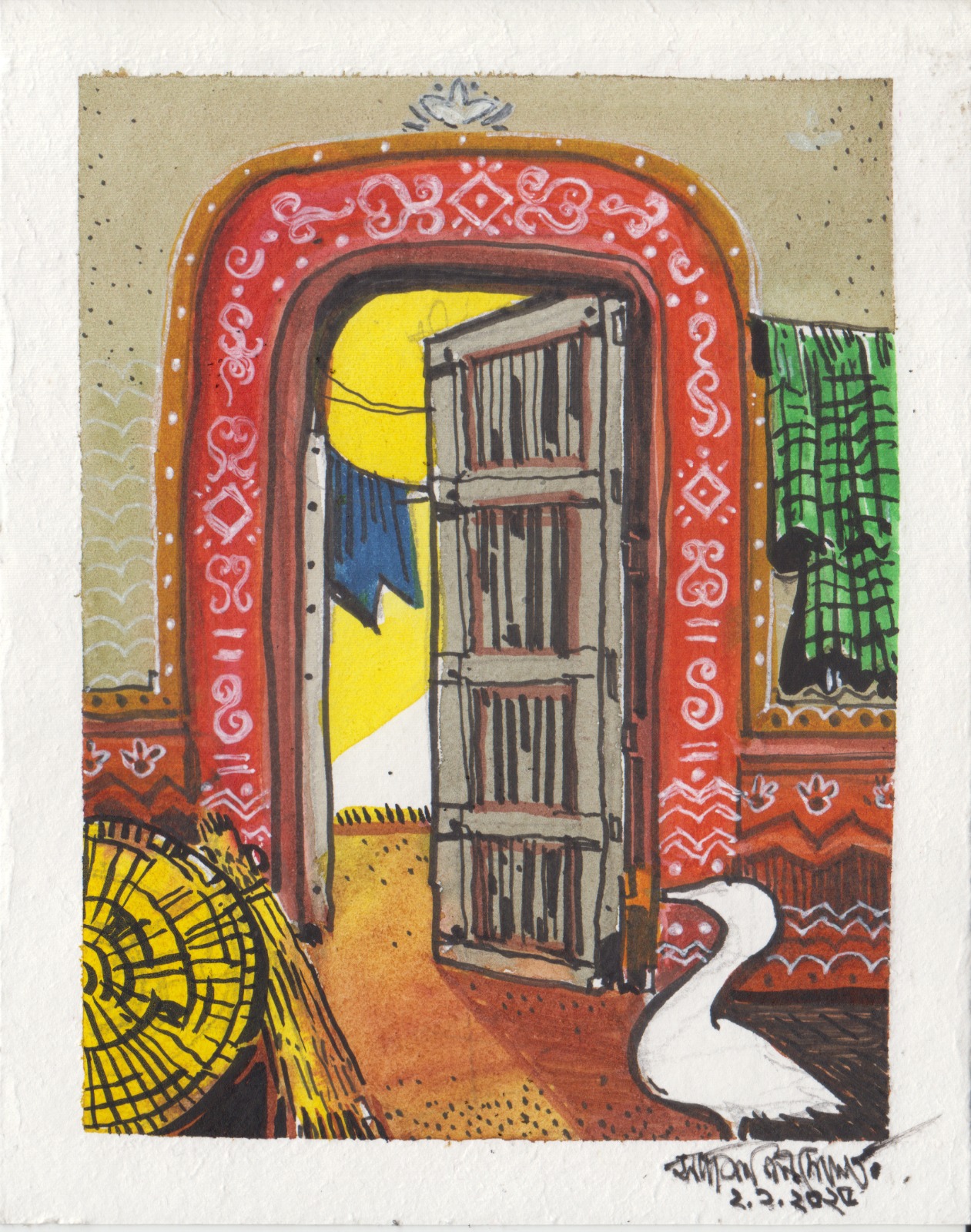
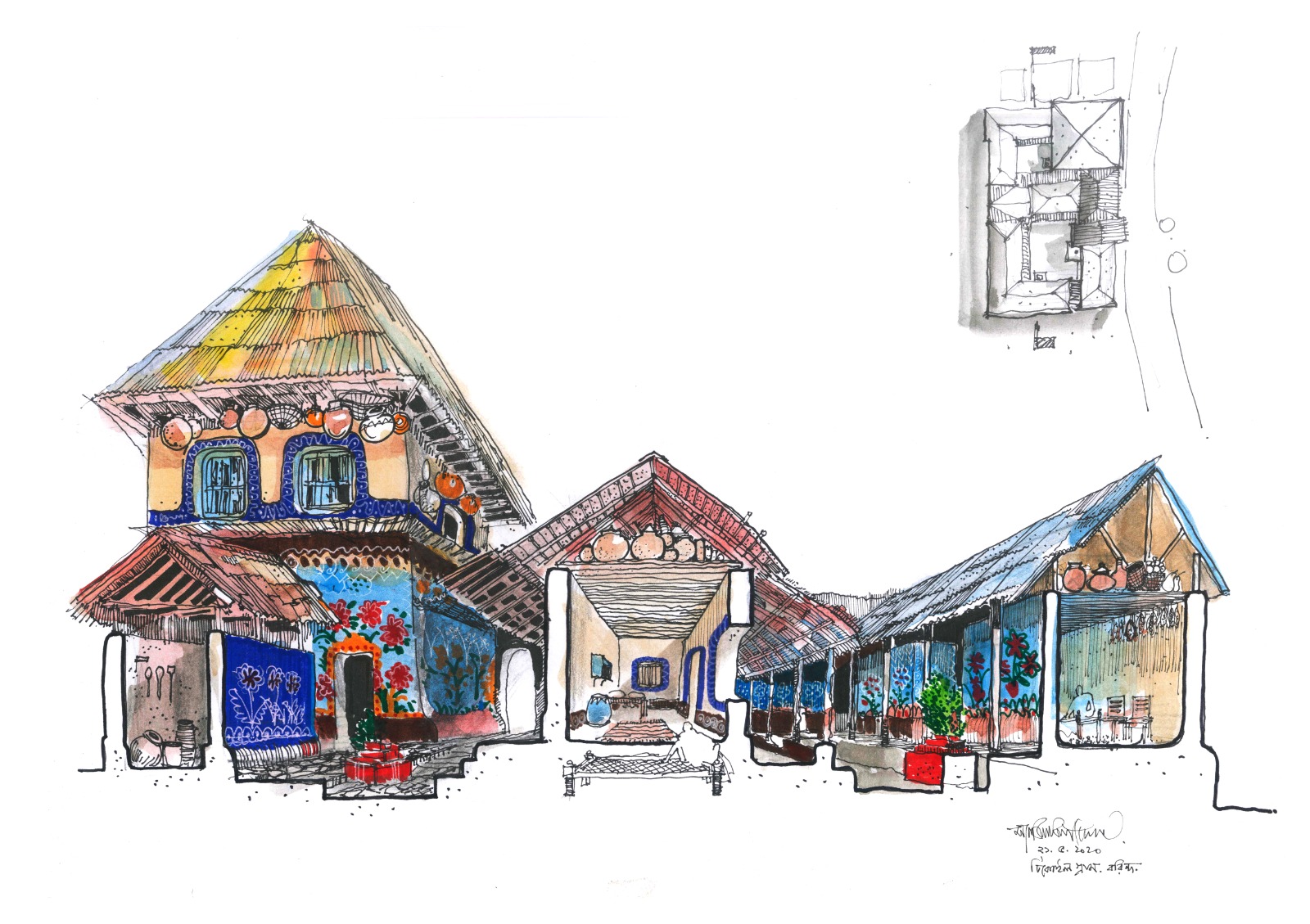
Beyond its visible beauty, the painted homestead of Tikoil carries an invisible architecture of belief. Every motif, every placement, every repetition reflects a cosmological understanding that binds the household to the universe. The doorway becomes a threshold between worlds; the courtyard transforms into a ritual centre where sky meets earth; the walls themselves act as mediators between the material and the spiritual. As explored in the study, the painted house operates as a microcosm—an ordered universe where elements of nature, cycles of time, and symbols of protection coexist in visual harmony. In this sense, painting is not merely an act of creativity; it is an act of alignment, ensuring that the home resonates with both earthly and celestial rhythms.
The beauty of fading: Impermanence as renewal
Perhaps the most profound aspect of this tradition lies in its embrace of impermanence. Unlike modern constructions that seek durability and resistance, Tikoil’s painted homes accept and even celebrate change. The monsoon rains, which wash away colours and soften walls, are not seen as destructive forces but as agents of renewal. Each year, as the rains fade the motifs into memory, the village prepares to repaint, to begin again. This cyclical process mirrors the rhythms of agrarian life, where seasons dictate activity, and renewal is inherent to survival. The fading of colour is not loss; it is transformation. It ensures that the act of painting remains alive, dynamic, and meaningful. The tradition persists not because the images endure, but because the act continues.
Modern colours, shifting meanings
In recent decades, a quiet transformation has entered Tikoil through the introduction of synthetic, industrial paints. These colours, brighter and more durable, offer practical advantages—less labour, longer-lasting surfaces, and a broader palette. For many women, this shift brings convenience in the face of changing social and economic demands. Yet, it also introduces a subtle disconnection. When pigments are purchased rather than prepared, the intimate relationship between artist and environment weakens. The ritual of making colour fades, replaced by efficiency. As discussed in the research, this transition challenges traditional notions of authenticity, raising questions about what is preserved and what is transformed when materials change but practices continue.
Authenticity in transition
What defines authenticity in a living tradition? Is it fidelity to original materials, or the continuity of meaning and participation? In Tikoil, the answers resist simplicity. The walls are still painted, the motifs still carry symbolic weight, and the community remains engaged. Yet, the ecological and ritual dimensions have shifted. The seasonal rhythm of renewal is altered, and the tactile knowledge of pigment preparation is gradually diminishing. The tradition is not disappearing; it is evolving. The challenge lies in ensuring that this evolution does not erode the deeper cultural and cosmological essence that gives the practice its significance.
Between visibility and vulnerability
As interest in folk traditions grows, Tikoil has begun to attract attention beyond its immediate geography. Visitors arrive, cameras capture, and stories circulate. Media platforms such as The Daily Star have played a role in highlighting the beauty and cultural importance of such villages, bringing them into national and global conversations. Yet, with visibility comes vulnerability. There is a risk that living traditions may be simplified into visual spectacles, detached from their deeper meanings. Preservation must therefore move beyond admiration, engaging with the community in ways that respect their knowledge, agency, and evolving realities.
Towards a living future
The future of Tikoil lies not in resisting change, but in shaping it thoughtfully. Efforts to sustain the tradition must prioritise the voices and practices of the community itself. Hybrid approaches to materials, community-led repainting festivals, documentation of motifs, and educational initiatives can help bridge past and present. The goal is not to freeze the village in time, but to allow it to grow without losing its roots. Tikoil’s strength lies in its ability to adapt while maintaining continuity—a quality that must be nurtured rather than constrained.
When walls whisper stories
Ultimately, Tikoil is more than a village; it is a philosophy inscribed in clay and colour. It teaches us that architecture can be intimate, that art can be collective, and that beauty can emerge from everyday acts of care. In a world increasingly defined by speed and standardisation, Tikoil offers a slower, deeper way of being—one where making is meaningful, where surfaces carry stories, and where the boundary between life and art dissolves.
And somewhere, in the spotlight of a Bengal evening, as shadows stretch across painted walls, a woman lifts her hand, touches the earth, and redraws the universe—one quiet, enduring line at a time.
Sajid Bin Doza, PhD, is an art and architectural historian, heritage illustrator, and cultural cartoonist. He is an Associate Professor in the Department of Architecture, School of Architecture and Design (SoAD), BRAC University. He can be reached at sajid.bindoza@bracu.ac.bd
Send your articles for Slow Reads to slowreads@thedailystar.net. Check out our submission guidelines for details.
Tajuddin Ahmad: A life for Bangladesh
Interactive / The haor crisis explained
Interactive: Bangladesh Labour History · 1881 - 2026 / Fight for Justice
Justice at work for all
The Price of Labour
Interactive / How many more lives before workplaces become safe?

The expansion of wage labour and the message of May Day
In conversation with Richard Wolff / Can workers seize the opportunity as Western capitalism declines?