The reality of vocational training for Bangladeshi women

At 19, Rima has already begun thinking about the difference between learning a skill and making a living from it. She enrolled in a driving course at a technical training centre in Dhaka because she wanted a skill that could lead to paid work. Driving appeared to offer several possibilities: employment in Bangladesh, self-employment and, potentially, work abroad.
The certificate matters to her. But it is not the destination. “I want to finish the course and actually use what I learned,” she says. “Otherwise, what is the point of having the certificate?”
For women entering Bangladesh’s technical and vocational education and training (TVET) system, that question is increasingly important.
Women represented around 29.5 per cent of TVET enrolment in 2023, according to official BANBEIS data. The figure indicates gradual progress. But enrolment is only the beginning of a much longer journey: choosing a trade, acquiring practical competence, completing training, finding work, remaining employed and, ultimately, turning skills into sustainable income.
At each stage, women can encounter a different barrier.
The trades women enter matter
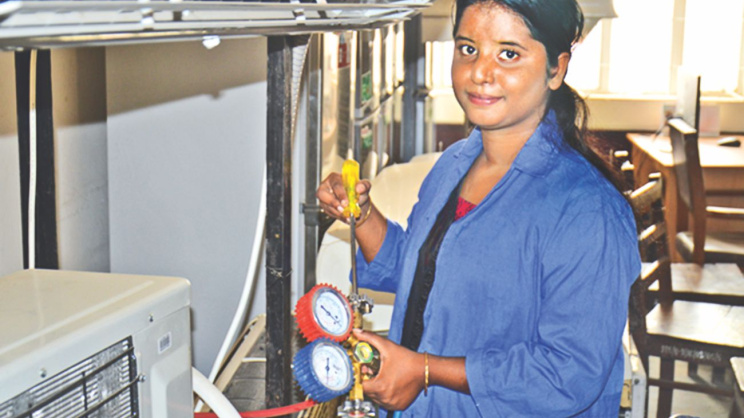
For 21-year-old Nusrat, choosing electrical work was itself a challenge. She was interested in technical equipment and wanted to enter a field where she believed there would be long-term demand. Her family was less enthusiastic. “They asked me why I wanted to do a man’s job,” she says.
Her experience reflects a less visible dimension of women’s participation in TVET: the trade a woman enters can matter as much as whether she enters training at all.
According to Gunjan Dallakoti, SME Development Specialist and Officer-in-Charge of ILO Bangladesh, women remain concentrated in service-oriented trades such as caregiving, tailoring, food and beverage, and bakery. These occupations have genuine labour-market demand in Bangladesh and overseas and can provide routes into employment, self-employment and entrepreneurship.
The concern is the narrowness of women’s occupational choices. They remain underrepresented in engineering, manufacturing, industrial occupations, digital technologies and emerging green sectors.
Career guidance is therefore important. A young woman making her first occupational decision may not know which sectors are expanding, which qualifications employers recognise or what opportunities exist beyond the occupations she sees women around her performing. Her choice may be shaped less by labour-market information than by what appears socially acceptable.
The issue is not whether women should abandon traditionally female occupations. It is whether they have a genuine choice.
A certificate is not the same as competence
For Rima, learning to drive inside the training area was relatively straightforward. Real traffic was different. “I needed more practice,” she says.
That distinction is central to vocational education. Completing a course does not necessarily demonstrate that a graduate has developed the practical competence employers require.
Driving requires judgement, confidence and the ability to respond to unpredictable traffic. Electrical work requires repeated practice with equipment and workplace procedures. Automotive repair, electronics and machinery-related occupations similarly depend on practical experience.
The ILO’s experience points to a gap at this stage. Independent competency assessments have found women more likely than men to be assessed as “Not Yet Competent”. This does not mean women are less capable of acquiring technical skills. Rather, it raises questions about the conditions under which competence is developed.
Practical training requires functioning equipment, qualified instructors, adequate workshop time and exposure to real workplaces. Industry attachments and apprenticeships can help bridge the distance between classroom instruction and employment. A training place has little value if the institution cannot provide meaningful practical education.
What happens after training?
Nusrat completed her electrical course expecting to find work in the trade. One workshop told her it preferred male workers. Another job required long shifts that her family was reluctant to accept.
Eventually, she began assisting a relative with electrical repair work. “I am using what I learned,” she says. “But it is not the kind of job I imagined after finishing the course.”
Her experience illustrates another distinction: training does not necessarily determine occupation. A graduate may find work but not in the field in which she qualified. She may earn an income without fully using her technical skills, or remain unemployed despite completing the course.
Bangladesh lacks a comprehensive national tracer system that follows TVET graduates into the labour market using sex-disaggregated data. This leaves important questions unanswered. How many women work in the occupations for which they trained? How many move into other sectors? How many become entrepreneurs? How many leave the workforce? And how many are still using their skills a year after graduation?
Bangladesh lacks a comprehensive national tracer system that follows TVET graduates into the labour market using sex-disaggregated data. This leaves important questions unanswered. How many women work in the occupations for which they trained? How many move into other sectors? How many become entrepreneurs? How many leave the workforce? And how many are still using their skills a year after graduation?
Without such measurements, success can easily become synonymous with enrolment and certification.
Yet getting a job is not the end of the journey either. Women can face unequal pay, limited career progression, workplace harassment, unsafe transport and the burden of unpaid care work.
This creates two different questions: Can a woman get the job? And can she remain in it?
A woman who leaves employment after six months and one who remains employed for five years may both appear as successful graduates in a short-term employment survey. Their economic trajectories are very different.
When home-based work becomes the outcome
Shila, 32, followed another path. She completed a food-processing course but did not enter a factory or restaurant. Instead, she began making snacks and bakery products from home.
“I could not work outside for the whole day,” she says. “At home, I can work and still manage my family.”
Her experience complicates the idea that formal employment is the only measure of successful training. Home-based entrepreneurship can create income, flexibility and independence. But it can also reflect constrained choices.
If a woman chooses entrepreneurship because she sees an opportunity and has access to finance and markets, it can represent economic empowerment. If she works from home because formal employment is inaccessible due to mobility restrictions, care responsibilities or discrimination, the same outcome reflects structural barriers.
When vocational training works
There are also examples of successful transitions. Under the ILO’s EU-funded Skills 21 project, around 70 per cent of graduates secured wage or self-employment, while more than 60 per cent of entrepreneurship graduates had started or were in the process of establishing a business. Women transitioned into employment at least as successfully as men within the project.
The significance lies not simply in the employment figures but in the pathway connecting training to work.
Outcomes can improve when curricula are connected to labour-market demand and trainees receive practical experience, career counselling and assistance entering employment.
Beyond the certificate
For some women, those circumstances extend beyond Bangladesh. Rima is considering overseas employment because she has heard that skilled workers can find better opportunities abroad. But migration introduces additional risks.
Technical competence is only one part of preparation. Information about legitimate recruitment channels, contracts, costs, wages and working conditions can determine whether an overseas opportunity becomes decent employment or a source of vulnerability. Skills training therefore needs to connect potential migrants with reliable employment information.
Ultimately, the success of women’s participation in TVET cannot be measured by enrolment alone.
Dallakoti identifies continued use of acquired skills one year after graduation, alongside decent employment, opportunities for growth and control over income, as a more meaningful indicator. Bangladesh therefore needs to follow graduates beyond certification.
For Bangladesh, the next challenge in women’s vocational education is therefore not simply bringing more women into training.
It is ensuring that what they learn can become a job, a business or a career.
Musrat Hossain Mithila works at Slow Reads, The Daily Star. She can be reached at mmusrat30@gmail.com
Send your articles for Slow Reads to slowreads@thedailystar.net. Check out our submission guidelines for details.

Can we save young Bangladeshis from deadly Mediterranean crossings?

Breastfeeding in Bangladesh: What is holding mothers back?

Fidel Castro at 100 / Why Fidel Castro’s legacy still haunts Washington

Thirst in the Sundarbans: The water crisis facing Munda women

Which female-dominated jobs are actually the most exposed to AI?

What remains of Bangladesh's fading ethnic traditions

Good intentions are not enough: Why Bangladesh should rethink orphanages

Are we eating microplastics with our fish?

The invisible Mintis of Karwan Bazar