Who recycles Bangladesh’s garment waste?

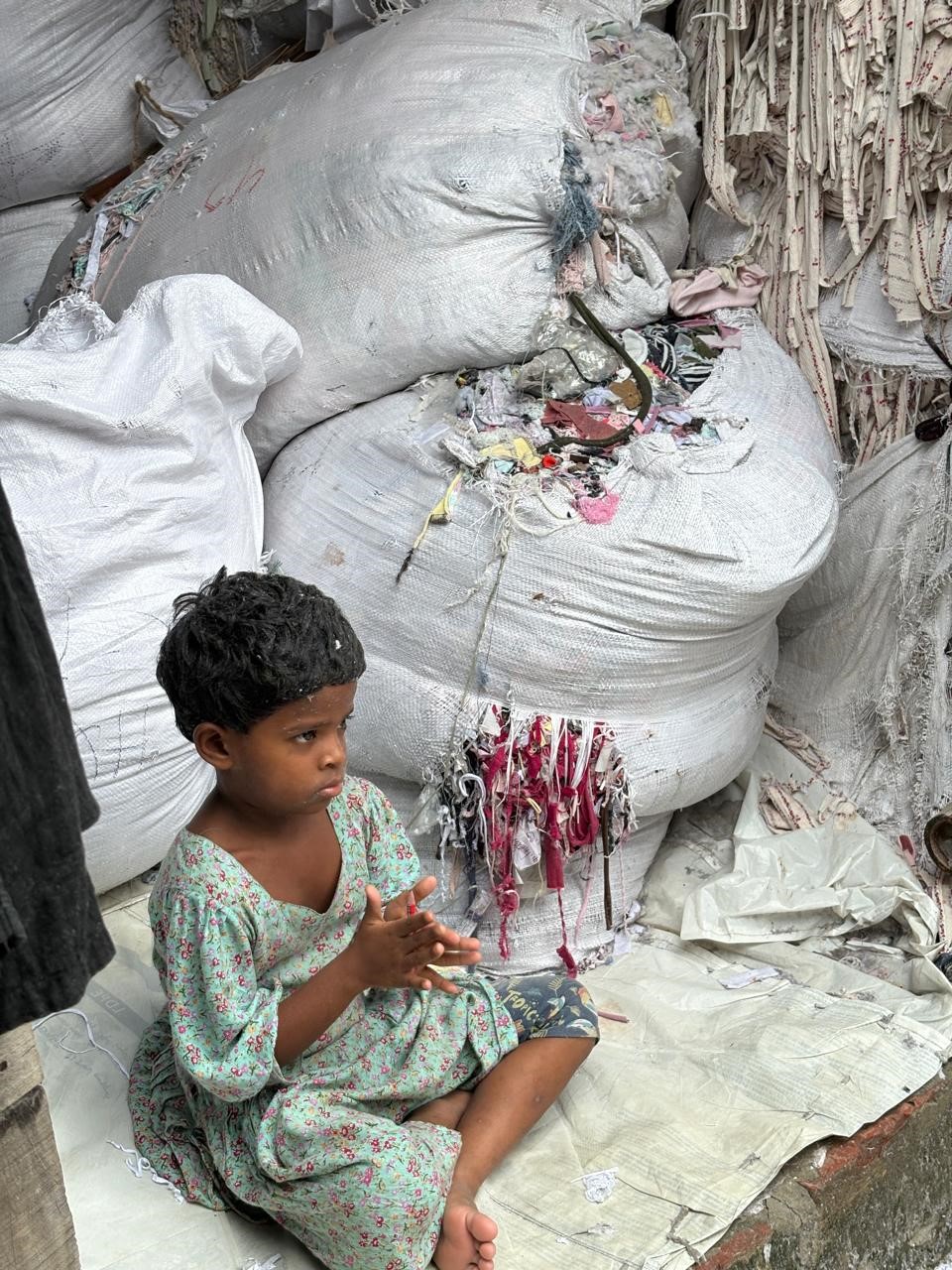
Six-year-old Ayesha (name changed) sits cross-legged on a torn plastic sheet, her hair covered with white dust, her small hands holding a broken pencil. Her mother is somewhere inside the maze of fabric, sorting cloth for a living. A few metres away, two men, their heads and faces covered with towels, feed scraps into a machine inside a dim shed. The air smells of dust. Closer to the yard’s entrance, three women sit in a loose circle on a stained tarp, their hands moving quickly as they sort a rainbow of fabric scraps into separate piles: white here, black there.
This is ‘jhut’, the leftover cloth from Bangladesh’s garment industry: offcuts too small to become the shirts and dresses sold in stores abroad. What happens to it next is largely invisible. It is sorted by hand, shredded by machine, and sold back into a supply chain that rarely asks who did the sorting or what it cost them. Ayesha will likely grow up to do this work too.
Behind Bangladesh’s garment export industry lies a second, informal economy that recycles its waste. In Gazipur and Narayanganj alone, there are 500–700 small to medium-sized factories. Jhut factories in Gazipur generate and process nearly 10,000 to 12,000 tonnes of fabric waste daily, while Narayanganj generates 120 to 150 tonnes of garment waste per day. Yet this workforce remains almost entirely beyond the reach of labour laws and safety regulations, and largely outside public view.
The sorting factories have tin roofs supported by bamboo poles, giving them the appearance of temporary structures. Light enters through gaps in the roofs, yet the interiors remain dim and dusty. The floors are bare concrete, covered with dirt and scraps, with torn plastic and rubbish scattered around. Tall jute or plastic sacks filled with sorted materials leave only narrow walkways between them.
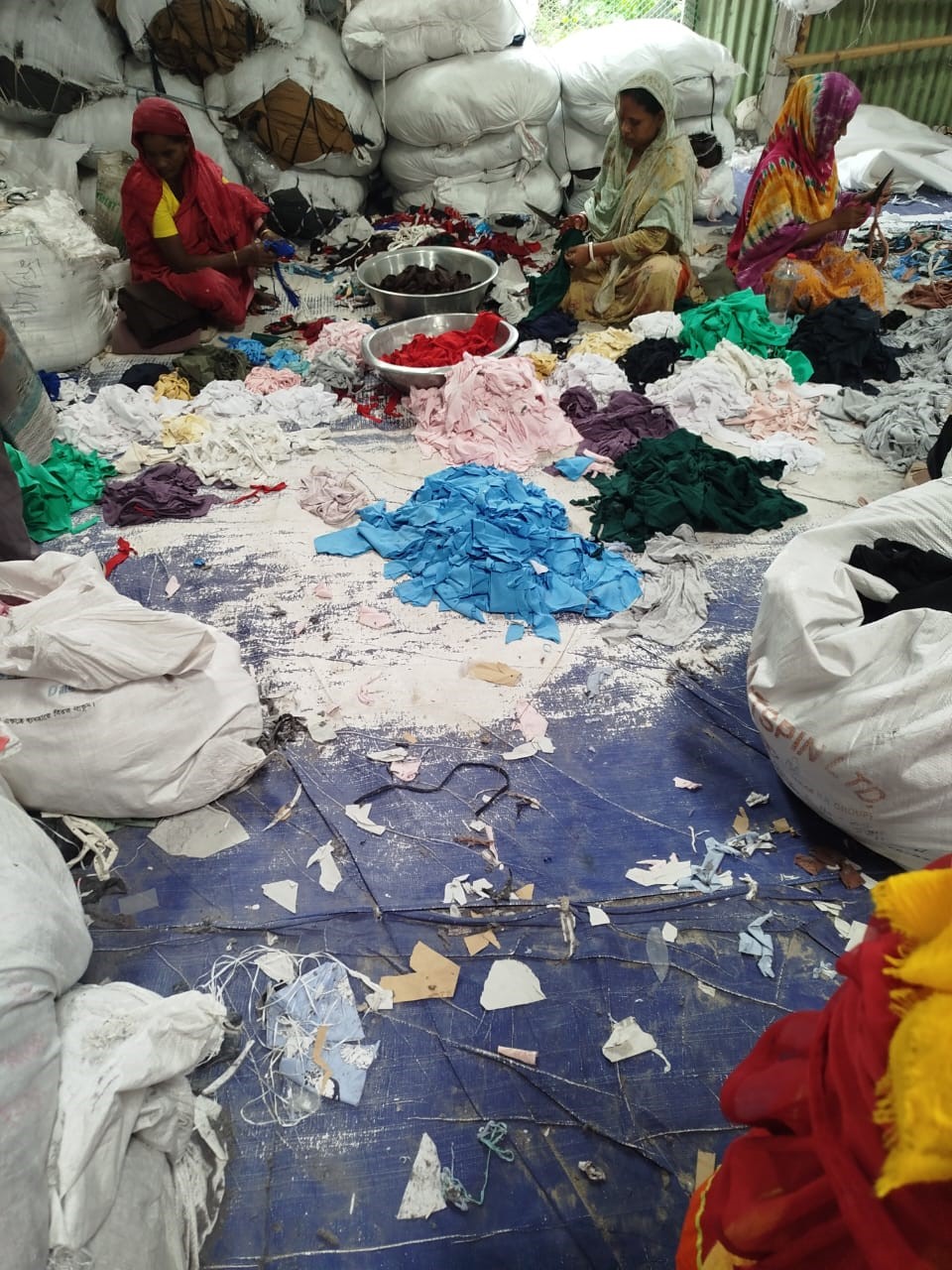
Of the 120 workers observed at the site, 65% were women, most between the ages of 20 and 50. The majority are local residents, and many of them entered this line of work to support their families. Workers typically remain in this trade for 5 to 20 years, often leaving only when their health declines or they find better work.
“I never thought I’d end up doing this kind of job,” said a woman in her mid-40s who sorts materials. Two years ago, her husband passed away. She feels there is no one else she can depend on. With no other source of income, she had to find work, and this was the only option available. She described the job as physically demanding, taking a toll on her hands and back as she sits on the ground all day sorting scraps. She sees no safety net to fall back on if she were to face a serious health issue.
She earns BDT 260 per day for a full day of sorting, or roughly BDT 8,000 per month, though the amount fluctuates depending on her attendance. Her workplace is not permanent. She may arrive the next morning to find no work at the same factory, forcing her to search for work at another. Her shift runs for 10 hours, typically from 7 am to 5 pm, seven days a week. Taking a day off is a financial decision for her: if she doesn’t work, she doesn’t earn. She gets a 90-minute break during the day. There is no paid leave or sick leave; if they cannot work because of a national holiday, they receive no pay for that day.
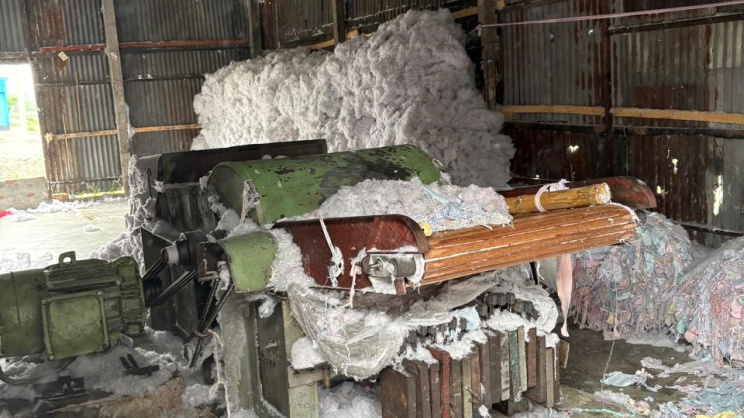
After walking for a few minutes, I heard the roar of a machine. I came across a factory where a large metal machine occupies one-third of the space, its grinding roar so loud that any conversation requires shouting. There are no gloves to protect the workers’ hands and no ventilation system to draw the dust out of the air. Some men and women cover their noses and mouths with pieces of cloth, but these are not supplied by the employer. The shredding process produces fine particles that, when inhaled over the years, can enter the lungs and cause damage. There is no barrier or protective cover around the shredding machine itself, and this is not unique to one factory. It is the same across the shredding factories I observed; the machinery is simply not designed with workers’ safety in mind. Losing a hand means losing their livelihood. “If the machine takes off one of your hands, the owner will give you some compensation for medical treatment, but you will lose your job as well as your hand.”
The workers’ skills make the material sellable, but their earnings remain below the living wage benchmark. The system was not built deliberately to escape regulation; it simply grew around buyer demand, with safety and worker protection never designed into it.
I still think about Ayesha. She was still there when I left, sitting by the sacks. If nothing changes, what will happen to her? In a few years, those same hands, now holding the broken pencil, will know exactly what this place asks of them. No one will have to teach her. No one will have to teach her. By then, she will have spent her childhood watching this work become a way of life, one sack at a time.
Chowdhury Lamia Tarik is a research officer at Research and Policy Integration for Development (RAPID), focusing on informal labour and marginalised communities in Bangladesh.
Send your articles for Slow Reads to slowreads@thedailystar.net. Check out our submission guidelines for details.
The lead crisis we cannot see
Bangladesh running out of options on Rohingya crisis: Is there a way out?
Construction of the Sugandha-Kalatoli beach road / A grave threat to Cox’s Bazar’s sand dunes
Why have Nihar Koli and Samrat been sent back to their alleged abusers?
The reality of vocational training for Bangladeshi women

Can we save young Bangladeshis from deadly Mediterranean crossings?
Breastfeeding in Bangladesh: What is holding mothers back?
Fidel Castro at 100 / Why Fidel Castro’s legacy still haunts Washington
Thirst in the Sundarbans: The water crisis facing Munda women