


How the shoe factory found its feet
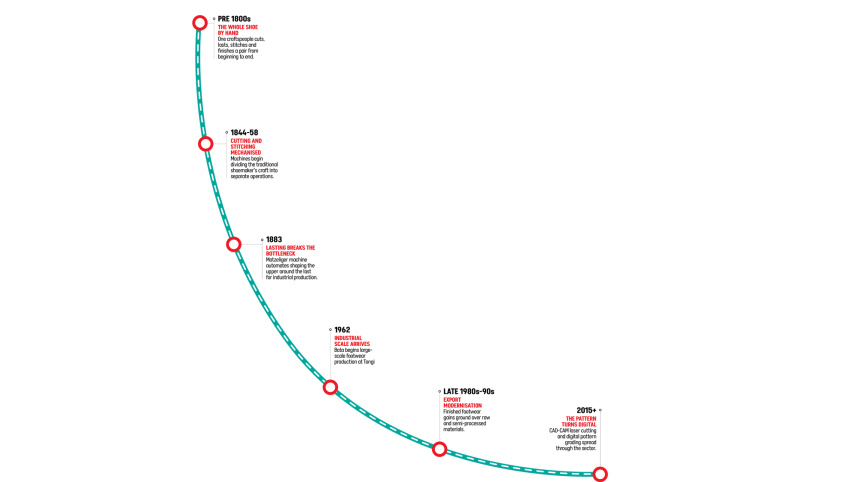
A shoe may appear simple, but its construction reflects centuries of craft, invention and industrial change. Once made entirely by individual shoemakers, footwear gradually became the product of specialised machines, assembly lines and new materials. Vulcanised rubber, synthetic polymers, adhesives and injection moulding transformed both the shoe and the factory producing it. Today, computer-aided design, automated cutting and digital sampling are reshaping the process again. Bangladesh, which entered large-scale footwear production in the 1960s, now faces its next transition: moving beyond production volume towards greater capability in design, engineering, precision, traceability and environmentally responsible manufacturing for increasingly demanding global markets.
Inside a modern footwear factory, a shoe may begin without any leather, fabric or rubber being touched. It first exists as a digital design: its proportions adjusted on a computer, its pattern graded into different sizes and its components arranged to minimise wasted material.

Only then does physical production begin. Machines cut the upper into precisely shaped pieces. Operators stitch them together. The unfinished upper is pulled over a foot-shaped last, the sole is attached, and the shoe passes through finishing and inspection before being packed.
The equipment has changed dramatically, but much of the underlying sequence would still be familiar to a shoemaker from centuries ago. A shoe must be designed around the foot, shaped, joined and finished. The evolution of footwear manufacturing is therefore not a story of one invention replacing human craftsmanship. It is the story of an intricate craft being divided, mechanised and increasingly digitised—one operation at a time.
When one craftsperson made the whole shoe
For most of history, shoemaking was a small-scale trade. A craftsperson measured the wearer’s foot, prepared a wooden last, cut the upper and sole, stitched the components and shaped the finished shoe. Differences between two pairs were inevitable because judgement, rather than standardised machinery, governed nearly every operation.
The last was central to the process. It determined the shoe’s shape, fit and proportions. The upper had to be stretched and secured around it by hand in a demanding process known as lasting. Even when individual components could be prepared more quickly, lasting remained a bottleneck that depended heavily on skilled labour.
This model was capable of producing durable and repairable footwear, but output was limited. Shoes were relatively expensive, sizes were inconsistent, and increasing production meant finding and training more craftspeople.
Machines divide the craft
Mechanisation arrived in stages during the nineteenth century. A patented sole-cutting machine appeared in the United States in 1844, while the Blake-McKay machine of the following decade mechanised the stitching of soles to uppers. Machinery developed for welted construction later allowed soles to be stitched more rapidly while retaining the strength and repairability associated with traditional shoes.
One of the decisive advances came from Jan Ernst Matzeliger, whose lasting machine was patented in 1883. According to the Smithsonian’s National Postal Museum, the machine could produce as many as 700 pairs in the time an expert hand laster produced 50. Lasting, once one of the slowest and most specialised operations, could now become part of an industrial production system.
Mechanisation also changed the organisation of labour. Instead of one person making an entire shoe, production was divided into cutting, stitching, lasting, sole attachment and finishing. Workers specialised in particular operations, while machines helped deliver consistent sizing and repeatable output.
The shoe factory had begun to resemble an assembly line. Yet it never became quite as straightforward as the production of a single moulded object. A conventional shoe can contain numerous components made from materials that stretch, compress and react differently to heat and adhesives. Aligning and joining these flexible pieces has kept footwear manufacturing unusually dependent on human hands.
New materials, new methods
Leather was no longer the only material transforming the industry. The development of vulcanised rubber in the nineteenth century made durable rubber soles and waterproof footwear practical. During the twentieth century, synthetic rubber, PVC, polyurethane and later EVA foam opened further possibilities.
These materials changed how factories worked. Cemented construction allowed an outsole to be bonded to a lasted upper with adhesive, producing shoes that could be lighter and more flexible than many traditionally stitched designs. Vulcanisation used heat and pressure to cure rubber and bond it to the upper. Injection moulding went further by forming a polymer sole directly against the upper inside a mould. These processes made it possible to manufacture sandals, trainers, school shoes, safety footwear and inexpensive everyday products at very large scales.
Bangladesh enters the factory age
In what is now Bangladesh, footwear production remained largely a cottage-based activity through the colonial period. Shoes were commonly made by small workshops or imported from Calcutta. Large-scale production began in 1962, when Bata established its factory at Tongi. Eastern Progressive Shoe Industries followed in 1967 and began exporting to the Soviet Union, Czechoslovakia and England.
Those factories introduced industrial production to a market still served substantially by craftspeople and small manufacturers. The broader modernisation of the sector, however, gathered pace from the late 1980s. Policy changes encouraged the leather industry to move beyond exporting raw and semi-processed material. The 1990 ban on wet-blue leather exports contributed to investment in crust and finished leather, followed by greater investment in leather goods and footwear manufacturing.
Export-oriented factories subsequently brought in production lines, specialised machinery and manufacturing knowledge from established footwear-producing economies. Cutting presses replaced much manual cutting; dedicated machines handled skiving, stitching, toe lasting, heel-seat lasting, sole pressing and finishing. Direct injection and cemented construction allowed factories to serve both leather and non-leather markets.
 For all latest news, follow The Daily Star's Google News channel.
 Bangladesh consequently moved from supplying hides and semi-processed leather towards making finished products for international buyers. But the transition has been uneven. Large export factories can operate automated or semi-automated cutting systems, product-development laboratories and modern lasting lines, while many smaller manufacturers continue to depend on basic machinery and manually controlled processes.
The factory learns to think in pixels
Digital technology is now changing the work that happens before a shoe reaches the production line.
Computer-aided design allows a designer or pattern engineer to alter proportions, create technical specifications and grade a pattern across multiple sizes. Computer-controlled cutters can then turn those digital patterns into physical components with greater precision. By arranging pattern pieces efficiently across a hide or sheet of synthetic material, software can also reduce costly offcuts.
Bangladesh began building some of this supporting capacity when the Leather Goods and Footwear Manufacturers and Exporters Association opened its CAD-CAM facility in 2015. It offers pattern-making, grading, laser cutting and design training to factories and smaller enterprises. The facility has since added updated design software, digitising equipment, cutting plotters and computerised stitching machines.
Three-dimensional design and digital sampling extend the process further. Brands and factories can review colours, proportions and material combinations on virtual models before producing repeated physical samples. This can shorten product-development cycles, reduce sample waste and make communication between buyers and manufacturers more precise.
Automation meets the stubborn shoe
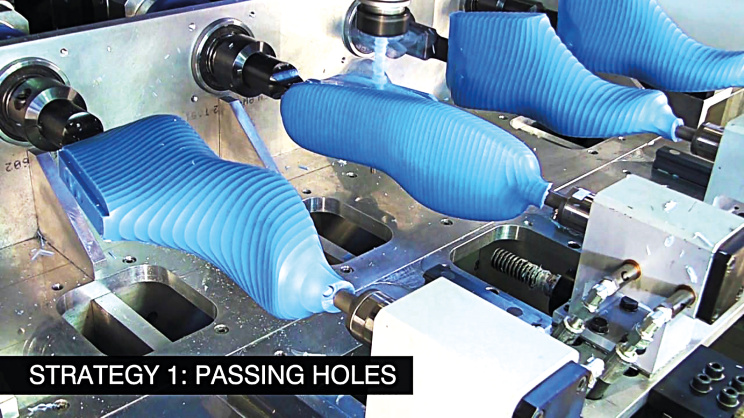
The fully automated shoe factory remains more exception than rule. Automated cutting, sole moulding, adhesive application and some forms of pattern stitching are already viable. But flexible materials and frequently changing designs make many stitching and assembly operations difficult to automate economically.
An International Labour Organization study found that automation remained limited across apparel and footwear despite the apparent repetitiveness of many tasks. More recent research has found growing use of automated cutting and semi-automated footwear sewing, but workers are frequently reassigned rather than removed from the factory altogether.
Bangladesh’s own skills research points in the same direction. A government-backed sector study identified advanced CAD and pattern-making, quality control, injection-machine operation, lasting and production supervision as areas requiring additional training. The surveyed enterprises expected automation to affect some occupations, but anticipated relatively limited overall displacement.
The emerging factory therefore looks less like an empty hall of robots and more like a collaboration between specialised workers and increasingly precise machines.
The next step is value
At the technological frontier, footwear is beginning to bypass familiar production stages. Computerised knitting can form an upper with fewer separate pieces. Three-dimensional printing can produce intricate midsoles or customised forms. Robotic systems can apply material directly around a last, reducing the need for cutting, stitching and adhesive-based assembly.
For Bangladesh, the immediate opportunity is not to pursue automation for its own sake. It is to use technology to improve consistency, conserve material, develop products faster and meet increasingly demanding requirements for quality, labour conditions and environmental traceability.
That will require investment in machinery, but also in designers, pattern engineers, technicians, production planners and quality specialists. It will require factories to progress from following buyers’ specifications to contributing to product development and, eventually, creating more original designs of their own.
The shoemaker’s last has survived every industrial revolution because the fundamental challenge remains unchanged: turning flat and flexible materials into something that fits the complex shape of a moving human foot. The factory of the future will perform that task faster and more precisely. But Bangladesh’s place in that future will depend less on how many hands it can place along a production line than on how much knowledge it can add to every pair.
What comes next?
The next footwear factory will combine skilled hands with smarter machines. Digital design, automated cutting, 3D sampling and better traceability can reduce waste and shorten development cycles. For Bangladesh, the opportunity lies in moving from low-cost production towards original design, technical expertise, cleaner manufacturing and higher-value products for global markets.
Comments