


China-US relations sour
Relations between China and the United States soured yesterday as Beijing fumed over US arms sales to Taiwan and US sanctions against a Chinese bank linked to North Korea.
The sudden US actions and China's angry response mark a break from the friendlier tone that had emerged after US President Donald Trump hosted Chinese counterpart Xi Jinping at his Florida resort in April.

Chinese foreign ministry spokesman Lu Kang said the US moves "go against the important spirit" of the meeting at Mar-a-Lago and are "inconsistent with the general direction of US-China relations".
"We hope that the US administration can correct their wrongdoings so the US-China relations can go back to the correct track of sound and steady development, so that our important cooperation in other fields will not be affected negatively," he told a regular press briefing.
Lu urged Washington to "stop their wrongful actions" after the US Treasury Department said the Bank of Dandong would be severed from the US financial system for allegedly laundering North Korean cash.
He voiced "firm" opposition to the US administration's approval of a $1.3 billion arms sale to Taiwan, which China considers a rebel province awaiting reunification.
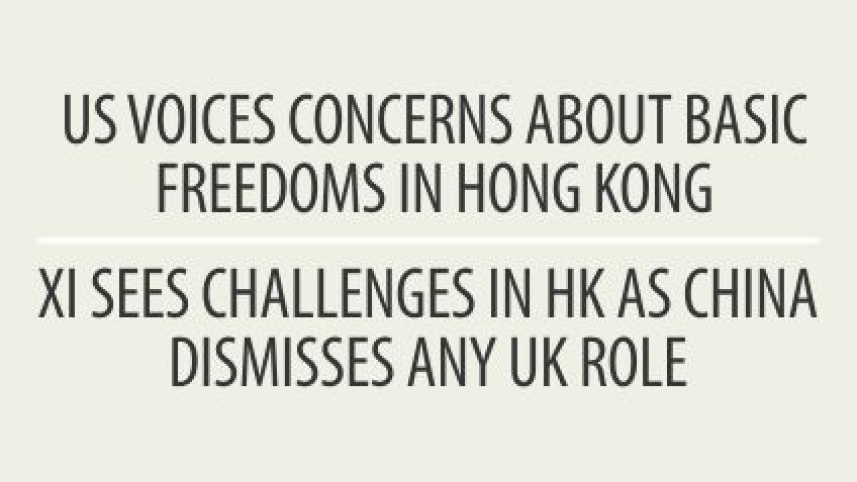
And Lu pushed back against "irresponsible" remarks after the US State Department voiced concerns about basic freedoms in Hong Kong, just as Xi was paying a landmark visit to the semi-autonomous city to mark 20 years since Britain returned the former colony to China.
Xi said yesterday the city's "one country, two systems" formula faces "new challenges" as pro-democracy campaigners ramped up their protests.
"In the 20 years since Hong Kong was returned to the motherland, the success of 'one country, two systems' is recognized by the whole world," Xi said in a speech.
"Of course, during the implementation, we've met some new situations, new issues and new challenges. On these issues, they need to be regarded correctly and analyzed rationally... Issues are not scary. The key is to think of ways to solve these issues."
Without giving specifics, Xi said these needed to be corrected and not handled with an "emotional attitude".
But in a stark and surprising announcement, the Chinese Foreign Ministry said the 1984 Sino-British Joint Declaration on Hong Kong, which laid the blueprint over how the city would be ruled after 1997, no longer had any practical significance, reported Reuters.
"The UK has no sovereignty, no power to rule and no power to supervise Hong Kong after the handover," ministry spokesman Lu Kang said.
It wasn't immediately clear if Lu was attacking just the idea of continued British involvement in Hong Kong, or the principles in the document itself.
 For all latest news, follow The Daily Star's Google News channel.
Comments