


US's diplomatic priorities
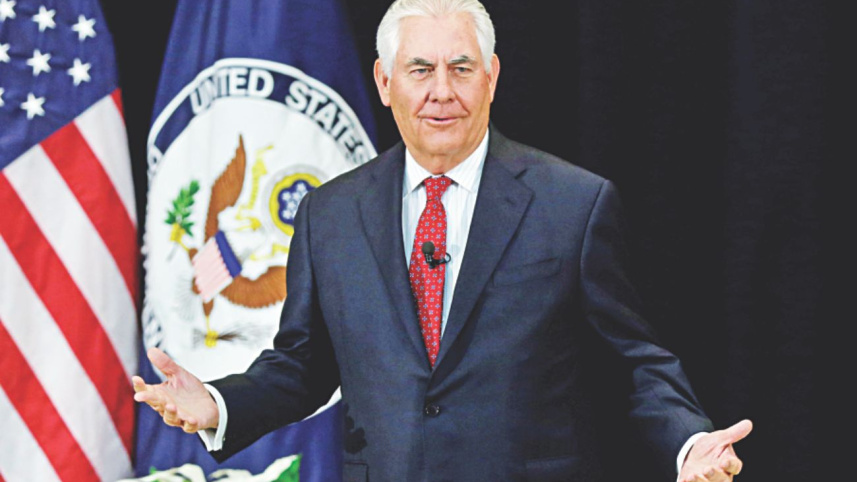
Secretary of State Rex Tillerson laid out his plans Wednesday for tackling world issues including the standoff with North Korea, which he called the most urgent challenge the United States has to deal with." Three months after taking over the State Department, Washington's top diplomat gave a wide-ranging pep talk to his staff around the globe on the work ahead. Tillerson's address didn't address that.
North Korea: Tillerson told the diplomats that he had advised Trump to "test" China's commitment to reining in its neighbor by "leaning in hard" on leader Xi Jinping. If Beijing fails to enforce existing UN sanctions, he warned, then Washington could take action against Chinese banks or companies that deal with Pyongyang. "So it's a pressure campaign that has a knob on it. I'd say we're at about dial setting 5 or 6 right now," he said, without saying how high the dial goes.

China: China's role in North Korea may be the most pressing issue, but Tillerson senses an opening to reset the basis of China-US ties for the next 50 years. Tillerson wants the bilateral dialogue to intensify. Differences remain over freedom of navigation in waters claimed by China in the South China Sea and the trans-Pacific trade imbalance. But Tillerson said ties were at a "point of inflection" and ripe for review. "Let's kind of revisit this relationship, and what is it going to be over the next half century. "I think it's a tremendous opportunity we have to define that, and there seems to be a great interest on the part of the Chinese leadership to do that as well."
The Islamic State: Before North Korea's latest weapons tests, Trump had made the battle to eradicate "radical Islamic terrorism the focus of his foreign policy. It remains a key goal, and Tillerson said the State Department would be part of the effort. He described the threat as emanating in "concentric circles" from the battlefields of Iraq and Syria through the Middle East to Africa and Central Asia.
Russia: Russia clearly hoped that Trump's election victory and Tillerson's appointment would lead to warmer ties with Washington -- that has not happened. Tillerson told his colleagues that, on a visit to Moscow last month, he had told Putin that relations are as bad as they have been since the Cold War. Washington hopes to work with Russia to develop ceasefire zones in Syria, but the former foes are still divided over Russia's intervention in Ukraine. So the secretary, who meets Russia's Foreign Minister Sergei Lavrov in Alaska next week, said he would work on "some small things" to build a level of trust.
The Rest: Tillerson cited work in Africa to alleviate health crises and disrupt terror networks, and in Latin America to combat trafficking and extremist finance. But his list of priorities included no reference to Europe, beyond repeating Trump's call for Nato members to spend more on collective defense.
 For all latest news, follow The Daily Star's Google News channel.
Comments