


A ceaseless stream of being: Fosse’s prose flows like a restless rosary
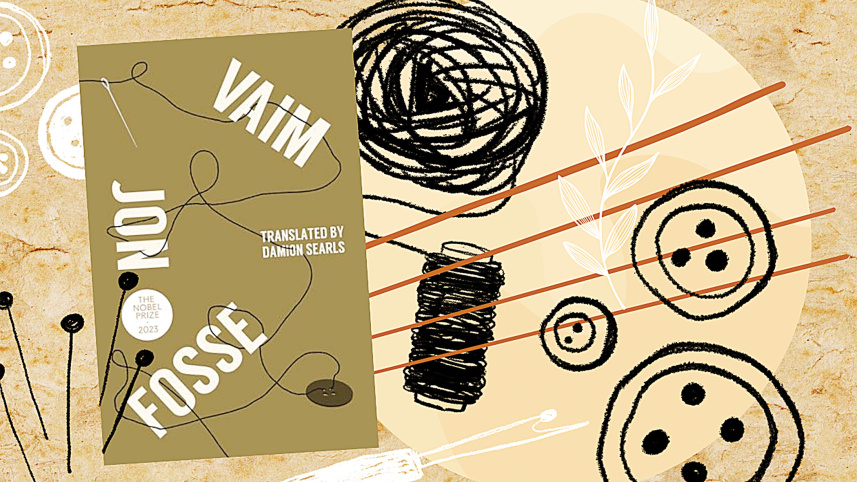
The novel, as a form, for a long time, has been concerned with the representation of consciousness. From the intricate psychological portraits of Henry James to the stream-of-consciousness experiments of Joyce and Woolf, the great novelists have sought to capture the texture of thought. Jon Fosse, in his quiet and unassuming way, is a worthy heir to this tradition. His slow prose, with its long, unpunctuated sentences and subtle shifts in perspective, is a remarkable instrument for the rendering of inner life. In Vaim, his first novel since the Nobel anointing, he narrates the lives of three, no, four ordinary people in a remote Norwegian fishing village, and in doing so, his hypnotic prose exacts the utmost attention from the reader.
Far from being an act of authorial vanity, this demand for attention is the primary tool of Fosse’s metaphysical probing. The effect is achieved through a deliberate, almost monastic, set of stylistic choices. Incantatory repetition, for instance, does not serve to advance a plot but to create a sort of liturgical rhythm, turning a character’s simple internal monologue into a kind of prayer or chant. The recursive syntax, where phrases circle back and qualify themselves with a constant stream of “I think,” “yes,” “or maybe,” mirrors the anxious, non-linear flow of actual memory and doubt.

The novel unfolds as a triptych, a three-part structure that refracts a connected set of events through the lives of its narrators. It begins with Jatgeir, the aging solitary whose life was irrevocably altered when Eline, his great unrequited love, suddenly left her husband to live with him. The second part shifts to Elias, Jatgeir’s only friend, a pensive and isolated observer whose own lonely existence provides a quiet counterpoint to Jatgeir’s drama.
By dissolving traditional punctuation and paragraph breaks, Fosse blurs the distinction between speech, thought, and narration, locking the reader into a single, continuous stream of being. The result is that the reader is hypnotically submerged into the life of the protagonist. In the novel’s long opening section, a trip to the city to buy a needle and thread becomes a vessel for a lifetime of regret, loneliness, and unspoken love. The reader is made to inhabit the narrator, Jatgeir’s state of mind, its rhythm and cadence, experiencing the past as a persistent and palpable presence.
The novel unfolds as a triptych, a three-part structure that refracts a connected set of events through the lives of its narrators. It begins with Jatgeir, the aging solitary whose life was irrevocably altered when Eline, his great unrequited love, suddenly left her husband to live with him. The second part shifts to Elias, Jatgeir’s only friend, a pensive and isolated observer whose own lonely existence provides a quiet counterpoint to Jatgeir’s drama. Finally, the novel circles back in time to give us the voice of Frank, the husband Eline abandoned, completing the Moebius strip. At the novel’s centre is Eline—a character we never hear from directly, but whose life and choices determine the shape of all three narratives. The novel seems less like a three sequential stories, and more like one story told in triplicate, an exploration of how a single life, that of Eline, leaves deep and divergent echoes in the consciousness of others, and how identity itself is a fragile construct, perpetually rewritten by love and the relentless haunting of loneliness.
The plot of Vaim is very thin and simple: a woman leaves her husband for an old love, lives with him until his death, and then returns to the husband she first abandoned. And unlike most novels, plot is not of significance in Fosse’s world, it barely provides the skeleton of the story. The purpose of the plot, here, is to provide a shape, however faint, around which the vast, nebulous clouds of consciousness can gather.
By eschewing narrative complication, Fosse clears a space for his true subject: the texture of being. The reward of reading Vaim is, therefore, not the discovery of what happens next, but the sustained, unbroken immersion in a continuous present—a present, for Jatgeir, Elias, and Frank, that is always saturated with the past. There are no authorial intrusions or narrative signposts to offer respite; the reader is held captive within each man’s mind, adrift on the endless, circling currents of his thought. This is literature as a meditative practice, where the story is but a quiet room in which to inhabit the rambling and often painful music of another’s soul.
This quiet room is, it turns out, a place Fosse intends to revisit. Vaim is the first of three planned works set in the same fictional village. In a recent interview with The New Yorker, Fosse clarifies that he views them as “three separate novels,” whose primary connection will be this shared imaginary place. He describes Vaim, the setting of the novel, as an amalgam of “various places in the western part of Norway,” and also reveals a deeper and more personal connection. As he states, “The language, the landscape, the moods derive from that place”—the village of his own formative years.
Søren Kierkegaard, the founding father of Christian melancholia, insisted that faith required a leap into the absurd, an objective uncertainty held fast with the most passionate inwardness. It is difficult to read the fiction of Jon Fosse, and particularly his newest novel, without seeing it as a long, sustained literary enactment of this leap. The narrative, shorn of full stops and conventional plot, flows like a rosary, its repetitions and refrains mimicking the act of prayer.
Najmus Sakib studies Linguistics at the University of Dhaka. Reach him at kazis713@gmail.com.
 For all latest news, follow The Daily Star's Google News channel.
Comments