


BB identifies risks to economic stability
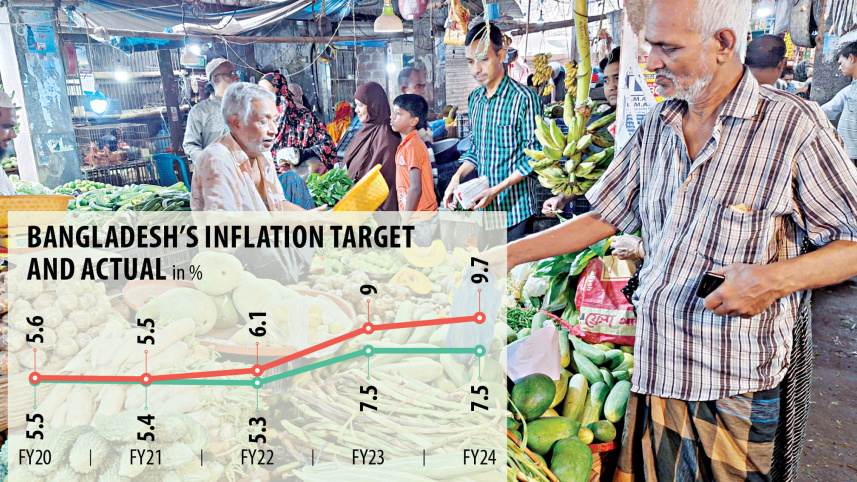
The Bangladesh Bank has identified several macroeconomic challenges that are hurting the economy such as higher inflation and widening income inequality.
"Bangladesh faces several immediate macroeconomic issues that threaten its economic stability and growth," it said.

In its monetary policy statement released yesterday for the first half of the current fiscal year, the central bank said these challenges arise from domestic and international factors, creating a complex policy environment.
"Persistently high inflation erodes purchasing power and real incomes, exacerbating income inequalities."
The BB pinpointed some other challenges confronting the country, including the exchange rate volatility, fiscal constraints, and the financial sector instability.
In order to address these issues, the country requires a multifaceted approach involving a prudent monetary policy, effective fiscal management, and structural reforms, it said.
"By navigating these challenges carefully, Bangladesh can sustain economic growth and enhance resilience against external shocks."
Geopolitical tensions, such as the Russia-Ukraine conflict and the unrest in the Middle East, have disrupted global supply chains and driven up the prices for essential commodities like food and energy, hitting import-dependent nations like Bangladesh hard as foreign currency reserves have witnessed a significant depletion.
The BB has adopted a contractionary monetary policy to manage inflation, but balancing this with economic growth remains delicate.
The global economic outlook is positive, but uncertainties persist due to ongoing geopolitical tensions. Policy rate cuts in advanced economies could affect reverse capital flows and exchange rates.
Bangladesh's forex reserves fell from $41.7 billion in August 2021 to $21.79 billion on June 30. The taka has lost its value by about 35 percent against the US dollar in the past two years.
"Fluctuations in global commodity prices, especially for food and energy, pose risks due to Bangladesh's import dependence," the BB said.
According to the central bank, high non-performing loans (NPLs) undermine financial stability and limit credit availability for productive investments.
Default loans in the banking sector hit an all-time high of Tk 182,295 crore in March, central bank figures showed. However, experts say the figure would be much higher owing to under-reporting.
The BB is implementing measures to reduce NPLs and improve governance within banks, emphasising transparency, governance, and operational efficiency.
About the roadmap to manage NPLs, the central bank said it is dedicated to addressing the challenge of bad loans to stabilise the banking sector and bolster economic resilience.
By 2026, the BB aims to reduce the NPL ratio for state-owned commercial banks to 10 percent and private commercial banks to 5 percent, targeting an overall gross NPL ratio of 8 percent.
The strategy includes legislative reforms, rigorous identification of willful defaulters, revised loan write-off policies, and enhanced recovery processes.
The BB said the Bank Company (Amendment) Act 2023 signifies a stringent approach towards willful defaulters, defining clear penalties and establishing "willful defaulter identification units" within banks for systematic identification.
Revised loan write-off policies, effective from February 18, streamline operations while maintaining full provisions for bad and loss loans up to Tk 5 lakh without court cases.
 For all latest news, follow The Daily Star's Google News channel.
 "Enhanced recovery efforts through dedicated units and incentives will drive proactive loan recovery," the BB said.
Aligning with global standards, the central bank cut the grace period for overdue fixed-term loans from six to three months, effective 30 September 2024.
Starting March 31 next year, any unpaid instalment will be considered past due immediately after its due date. This will promote credit discipline, according to the BB.
It said the introduction of alternative dispute resolution (ADR) guidelines prioritises mediation over lengthy legal processes for swifter settlements.
The upcoming private asset management company (AMC) will manage non-performing assets, improving bank balance sheets and overall sector health.
"This comprehensive strategy, backed by continuous monitoring and transparent reporting, aims to enhance asset quality, revenue, profits, and liquidity."
The BB's proactive measures are aimed at ensuring a resilient financial system and fostering sustained economic growth and stability, it added.
Comments