


Marketing is about to change more than it has in 20 years

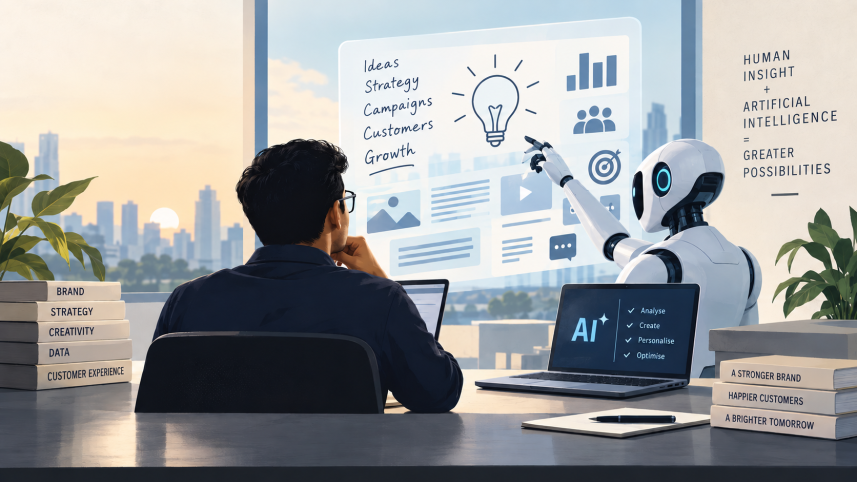
By now, every marketer has used some form of artificial intelligence — to draft an ad headline, sort through customer data, or generate a dozen versions of a social post before breakfast. That is not what this piece is about. What is coming next is a different, and much bigger, shift: not AI as a tool marketers reach for, but AI as the foundation marketing is built on. Call it AI-native marketing, and it is worth understanding now, before it becomes the price of staying in business.
The distinction sounds academic, but it isn't. Think of the difference between adding a solar panel to a house and designing a house around solar power from the first sketch. Most companies today, in Bangladesh and everywhere else, are doing the former with AI. A tool helps write copy, or crunches customer data, while the actual machinery of marketing — how strategy gets made, how campaigns are approved, how a brand talks to its customers — carries on largely as before. AI-native marketing is the second kind of house: intelligence is part of the blueprint, not an accessory bolted onto the roof.

This is not a distant, futuristic idea. Stanford University's AI Index Report, released this year, found that 88 percent of surveyed organisations used AI in some form in 2025, up from 78 percent the year before — and marketing and sales functions in consumer goods and retail were among the heaviest adopters of all. Whatever pace of change a marketer in Dhaka is currently planning for, the honest answer is that the pace is probably faster than that.
Why this wave is different
Marketing has absorbed new technology before — mass media, the internet, social platforms, data analytics — and each time, the job adapted. What makes this moment different is that earlier technologies mostly changed how marketers did their work. AI has the potential to change what marketing work even is.
Consider the customer journey that every marketing textbook still teaches: awareness, consideration, purchase, loyalty, in that order. Increasingly, a consumer's first encounter with a brand is not an advertisement at all — it is a conversation with an AI assistant that compares products, reads reviews, and makes a recommendation on the consumer's behalf.
That raises an uncomfortable question every brand should be asking itself right now: if an AI agent is the one recommending you to a customer, who is actually doing your marketing — you, or the algorithm standing between you and the buyer?
Five things that no longer work the old way
Research on this shift, including work published this year in the Journal of the Academy of Marketing Science, points to five areas where the ground is moving: strategy, creativity, customer experience, organisational intelligence, and how marketing departments are structured.
None of the five matters more than the others, which is itself a useful way to think about the change. This is not a single department getting a new tool. It is five different parts of the marketing function being redrawn at once. Take creativity, since it is the one most people worry about first. Generative AI can now produce dozens of ad concepts, scripts, and visual directions in the time it used to take a creative team to brief a single one. That sounds like a threat to the creative profession, and in the narrow sense of production speed, it is.
But when everyone can generate hundreds of content pieces on demand, content stops being the scarce resource. Judgment becomes scarce instead — the ability to decide what is actually worth making, what a brand should stand for, and, just as importantly, what should never be automated. The creative director of the near future may spend less time producing ads and more time deciding which of the machine's hundred ideas deserves the client's money.
Something similar is happening with personalisation. Digital marketing already let companies target segments — young professionals, budget-conscious shoppers, and so on. AI-native systems can work at a much finer grain, adjusting an offer for a specific person, in a specific context, at a specific moment. That precision is genuinely valuable to the customer. It is also genuinely unsettling if it feels less like service and more like surveillance.
Brands that get the balance wrong — chasing relevance while eroding trust — may find that a well-targeted offer did more damage to the relationship than a poorly targeted one ever could.
What this means for a market like ours
For businesses in Bangladesh, and for the wider South Asian market, the temptation will be to treat AI adoption as a technology purchase — buy the software, train a few people, tick the box. That approach will produce, at best, the "AI-assisted" version of the future, not the AI-native one. The companies that pull ahead will be the ones that ask a harder question before buying anything: if intelligent systems were available everywhere in our marketing function, how would we actually design the work? That is a strategy question and an organisational one, not a procurement one.
It also means the marketing leader's job description is quietly being rewritten. The CMO of the past managed brand, customer relationships, and growth. The AI-native CMO has to add two things to that list that used to belong to other departments entirely: technology and trust. That is a real expansion of the role, not a rebranding of it.
The reassuring part
None of this argues that human marketers are becoming irrelevant — quite the opposite. Machines are good at processing information, spotting patterns, and optimising toward a stated goal. They remain far weaker at the things that actually make a brand mean something to people: empathy, cultural judgment, a sense of what matters, and the willingness to be accountable when a decision goes wrong. The future of the profession is not "humans versus AI." It is a partnership in which the value of good human judgment goes up precisely because machine capability is going up around it.
The organisations that win this transition will not necessarily be the ones using the most AI. They will be the ones that figure out, with some precision, where AI genuinely creates value, where a human being still has to make the call, and how to get the two working together rather than working around each other. That is a harder problem than buying a subscription to a new tool — but it is the one that will actually decide who leads their category five years from now.
The writer is group chief executive officer and executive editor of Bangladesh Brand Forum
 For all latest news, follow The Daily Star's Google News channel.
Comments