


Satgaon as memory: Reading ‘Satgaoner Haoatantira’

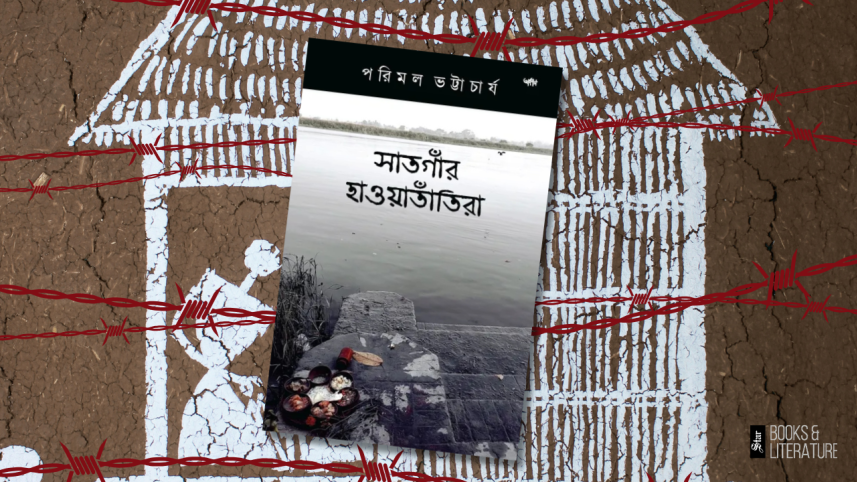
Some books do not simply tell a story; they slowly take hold of the reader while being read. Their worlds begin to feel more immediate than the room around you, their characters linger like people you have known, and even after the final page they refuse to leave. Parimal Bhattacharya’s Satgaoner Haoatantira is one such book. It has been months since I finished it, yet the world of Matsyabhumi and its many generations of inhabitants still returns to my mind. Few novels leave behind such a powerful afterimage. Fewer still do so while carrying the weight of centuries within their pages.
At the centre of the novel lies Satgaon, or Saptagram, once one of the most important river ports of Bengal. Situated in the Hooghly region, Satgaon flourished as a major commercial centre through much of the medieval period and remained significant into the 16th century. Its prosperity depended heavily on the waterways that connected it to broader trade routes across South Asia and beyond. Merchants from many regions passed through its river channels, helping make Satgaon one of Bengal’s busiest trading hubs. But history, as the novel reminds us repeatedly, is shaped as much by geography as by politics. As the Saraswati River gradually silted up and changed course, and as political and commercial power shifted elsewhere, Satgaon slowly declined. Over time nearby settlements such as Bandel, Chinsurah, Chandannagar, and Serampore rose in prominence under various European trading powers, and by the 18th century Calcutta had emerged as the dominant colonial port. Satgaon slipped from centrality into memory.

Yet Bhattacharya does not approach Satgaon as a historian reconstructing a lost city. He approaches it as something more elusive: a place half buried beneath history, half preserved in memory. Satgaoner Haoatantira is not merely the story of one vanished port or even one family. Through the history of a Smarta Brahmin family stretching across nine generations, the novel gradually unfolds into a broader story about the evolution of a region, a culture, and a civilisation. Satgaon becomes less a setting than a lens through which Bengal’s long historical transformation is viewed. The novel’s formal structure reflects this understanding of history.
Time in Satgaoner Haoatantira does not move in a straight line. The story shifts backward and forward across centuries. Past and present overlap. One generation’s memory suddenly opens into another’s history. Events surface in fragments rather than sequence. Bhattacharya is not interested in arranging the past neatly. He is interested in showing how history survives in lived memory--broken, layered, uncertain, and emotionally charged.
At the centre of this vast narrative stands Bappaditya Chakrabarti, an elderly man suddenly asked by the modern Indian state to prove his citizenship. To establish that he and his ancestors belonged to the country before a designated date, he must provide official documents. But he has none. What he possesses instead is memory. Family stories, inherited recollections, fragments of oral history—these become the only archive available to him. Through Bappaditya’s effort to use memory as proof, the novel quietly raises one of its most urgent questions: what makes a person belong to a place? Can identity be determined only by paperwork, or do memory, lineage, language, and inheritance also matter?
This political and philosophical dimension gives the novel a sharp contemporary relevance, but Bhattacharya never allows the book to become narrowly didactic. The narrative remains alive because it is constantly enriched by myth, folklore, and the surreal. In the world of Satgaoner Haoatantira, the miraculous exists beside the historical without contradiction. A girl arrives floating on banana trunks bearing the marks of enslavement on her body. A Portuguese-speaking cockatoo acquires an uncanny presence. Women communicate across distances through the hidden currents of the Ganges. These moments are not treated as shocking departures from reality. They emerge naturally from the story’s texture, as if memory and myth are simply alternate ways through which truth survives. This seamless blending of realism and the marvelous gives the novel its hypnotic atmosphere.
Because of this, many readers have compared Bhattacharya’s work to Gabriel García Márquez’s One Hundred Years of Solitude (1967), and the comparison is understandable. Just as Márquez used the Buendía family to narrate the history of Latin America through myth and memory, Bhattacharya uses the Chakrabarti family to explore centuries of Bengali cultural transformation. But Satgaoner Haoatantira also belongs in conversation with major South Asian historical-literary works such as Qurratulain Hyder’s River of Fire (1959) and Rizia Rahman’s Bong Theke Bangla (2018). Like these novels, Bhattacharya’s book is not simply concerned with historical events. Its true subject is time itself—how civilisations change, how identities form, and how the past remains alive within the present.
One of the greatest pleasures of reading the novel lies in its historical and geographical richness. The book is filled with names, places, and references that reward attentive readers familiar with Bengal’s history. Historical traces and local geographies are woven throughout the narrative in subtle ways. Bhattacharya trusts his readers enough not to overexplain these details. The result is a novel that feels deeply researched without ever becoming heavy or academic. Its knowledge is worn lightly. The history is never there to impress the reader; it is there because it forms the natural ground from which the story grows.
Equally impressive is Bhattacharya’s command of language and narrative pace. Writing a novel that spans centuries, multiple generations, shifting political regimes, folklore, memory, and philosophy is no small task. Yet his prose remains graceful and accessible throughout. The language is rich but never difficult. The novel carries enormous intellectual and historical weight, yet it never feels burdensome. Despite being more than 600 pages long, it moves with remarkable fluidity. Once its rhythm takes hold, the reader is carried forward almost effortlessly. The book’s only minor flaw is the presence of a few scattered typographical errors in the edition I read, which stronger proofreading could have corrected. But this hardly diminishes the achievement.
By the time Satgaoner Haoatantira ends, it does not feel as though it has concluded in any final sense. Rather, it recedes like a river disappearing beyond sight while still remaining audible. Satgaon stays in the reader’s mind not simply as a historical location but as a metaphor for memory itself—for everything time buries yet never fully erases. Parimal Bhattacharya has written a novel of extraordinary ambition and imaginative power: at once family saga, historical meditation, political reflection, and mythic remembrance. Without hesitation, I can say that Satgaoner Haoatantira is one of the finest Bangla novels I have ever read. It is not simply a book to admire. It is a book to return to, again and again, because like memory itself, it reveals something new each time.
Md Rabbi Islam is an official contributor to Cut to Cinema, a Dhaka-based English film magazine. He also writes for The Business Standard. After graduating from Notre Dame College, he is now studying in the Department of Film and Television at Jagannath University, Dhaka. Outside of his studies and writing, he spends his time as a street photographer. You can reach him at mdrabbi_islam@icloud.com.
 For all latest news, follow The Daily Star's Google News channel.
Comments