


Local Government reform demands election overhaul

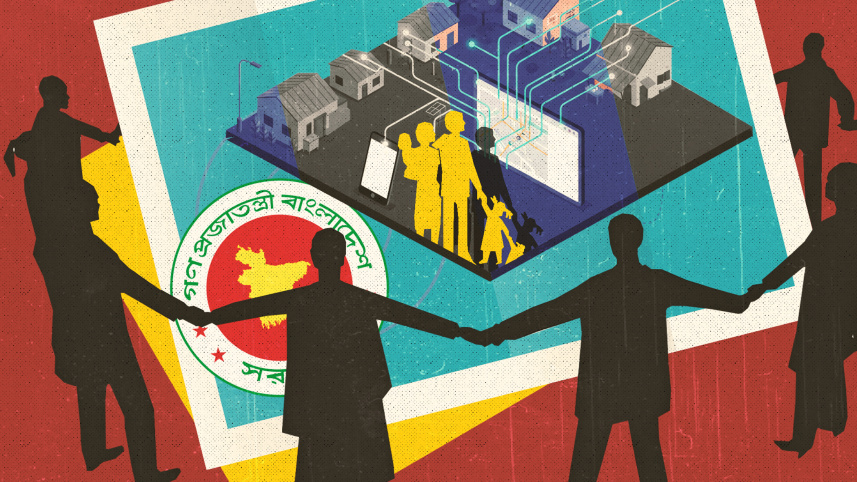
After a prolonged pause, Bangladesh has finally succeeded in establishing a democratically elected government through the 13th national election in February. It is encouraging that the government expressed its intention to hold local government elections within a year, as stated by the local government, rural development, and cooperatives (LGRD) minister Mirza Fakhrul Islam Alamgir last week. The nation is now looking forward to the restoration of democratic governance at the local level through free and fair elections, something that has been greatly missed for a long time.
In fact, over the past couple years of authoritarian rule, local government has been among the most severely weakened institutions. Recognising this, the Local Government Reform Commission, established by the interim government in 2024, conducted a comprehensive review of the sector and proposed a set of recommendations to address its structural and functional weaknesses. As the country embarks on a journey toward forming new local government bodies, the ruling party may consider implementing the commission’s recommendations while conducting elections. It is worth noting here that one of the key recommendations of the reform commission was to restore non-partisan local government elections, as had been a practice prior to 2015. The Awami League government introduced party-based local elections in 2015 through amending the relevant local government laws, allowing candidates to contest under party symbols. This shift contributed to making the local elections extremely violent, weakened representation of local communities, destroyed the social fabrics, and a corresponding decline in the effectiveness of local governance. In a welcome development, on April 9, 2026, the current parliament removed the provision for holding local government elections under party symbols. This decision is expected to usher in a positive and conducive environment for local level elections.

In addition to the suggestion for making local government election nonpartisan, the commission put forward a few more suggestions regarding local elections, which the new government may consider in order to make the local bodies truly representative and effective.
First, the local government election system currently lacks uniformity. Union parishads (UP), pourashavas, and city corporations are elected through direct voting, whereas the upazila parishad follows a partially direct system—only the chairman and vice chairman are directly elected by the local people while the elected UP chairmen within the upazila serve as the members of the parishad without having direct mandate over its governance.
Similarly, the zila parishad is formed through an indirect electoral process. The elected upazila parishad chairmen within the district act as its constituent members, yet they do not possess a direct representative mandate over the zila parishad. This arrangement creates structural and accountability gaps, which hinders the effective functioning of the zila parishad.
To address the existing gaps, the government may prioritise establishing a more consistent and uniform electoral framework across all tiers of local government. In order to ensure fair and effective representation, like UP, both the upazila and zila parishads could be reorganised into clearly defined electoral wards. For example, each union parishad could be treated as comprising three wards within an upazila parishad; thus, an upazila with five unions would have a total of 15 electoral wards. Similarly, each upazila could be considered as forming three constituent wards within a zila parishad. These wards would be created solely for electoral purposes, aimed at strengthening representation and improving institutional accountability.
Second, currently, local government elections to different tiers are held at different times under different schedules. The government may consider holding elections for different local government institutions (LGIs) on the same day under a single schedule. To do this, all five local government institutions (union parishad, upazila parishad, zilla parishad, pourashava, and city corporation) should be brought under a uniform legal framework. In this regard, the local government reform commission has drafted a unified law consolidating the existing five local government (LG) laws governing these institutions, along with relevant subordinate legislations, rules, and circulars. This draft law now needs to be reviewed and finalised for holding the elections to all five LG institutions simultaneously within a unified timeframe.
Holding elections under a single schedule is expected to significantly reduce electoral expenditure, potentially to one-fourth of the current cost. It would also mean that elections are held once every five years, rather than being conducted at different times throughout the year. Beyond cost and time savings, such an arrangement would enable all LGIs to commence their terms concurrently, which would improve coordination and facilitate more effective planning and budgeting at the local level.
Third, union parishads in Bangladesh vary significantly in both area and population. Some unions are large, while others are relatively small, with areas ranging from around 12 sq km to as much as 1,500 sq km, and populations vary from approximately 4,000 to 400,000. Despite these wide disparities, all union parishads are uniformly divided into nine wards, resulting in an uneven and often inefficient distribution of resources. This arrangement also poses serious challenges to effective community representation. In some larger, particularly hilly or coastal unions, members face considerable difficulties in maintaining meaningful contact with their constituents. The hilly Sajek Union of Baghaichhari upazila in Rangamati district may be cited as an example. With an area of some 607 sq km and inhabited by some 45,000 people, it has only nine male and three female members, which is widely regarded as insufficient for effective representation. During the commission’s visit to the area, some ward members themselves acknowledged that they were unable to physically cover all the wards they are responsible for.
Against this backdrop, it has become essential to reconsider the number of wards based on both area and population. Union parishads could be structured with nine to 39 wards, each comprising approximately 1,200 to 1,500 residents. Such a reconfiguration would help ensure more meaningful representation at UP and improve the efficiency of local governance and service delivery.
Fourth, the current system of women’s participation in local government needs to be revisited, as it has proven to be inefficient in practice. The Union Parishad Act of 1997 introduced direct elections for three reserved seats for women. Under this arrangement, each elected woman member is responsible for three wards, a structure that often overlaps and conflicts with the jurisdiction of male ward members. Various studies have shown that this system has not yielded the intended effectiveness in ensuring meaningful participation of women. Studies have revealed that female members are often unable to perform their duties and responsibilities with maximum efficiency as three male ward members also operate within the same constituency and frequently play a decisive role in local decision-making process. To make women participation more effective, it may be considered that 30 percent of wards across all local government institutions be reserved for women, to be filled through a rotational system over consecutive election cycle.
Putting these recommendations into practice may demand extra effort, but if strengthening local government is the goal, electoral reform is the essential starting point.
Dr Ferdous Arfina Osman is professor in the Department of Public Administration at the University of Dhaka, and former member of the Local Government Reform Commission.
Views expressed in this article are the author's own.
Follow The Daily Star Opinion on Facebook for the latest opinions, commentaries, and analyses by experts and professionals. To contribute your article or letter to The Daily Star Opinion, see our guidelines for submission.
 For all latest news, follow The Daily Star's Google News channel.
Comments