


The sachet trap: The hidden cost of mini packs

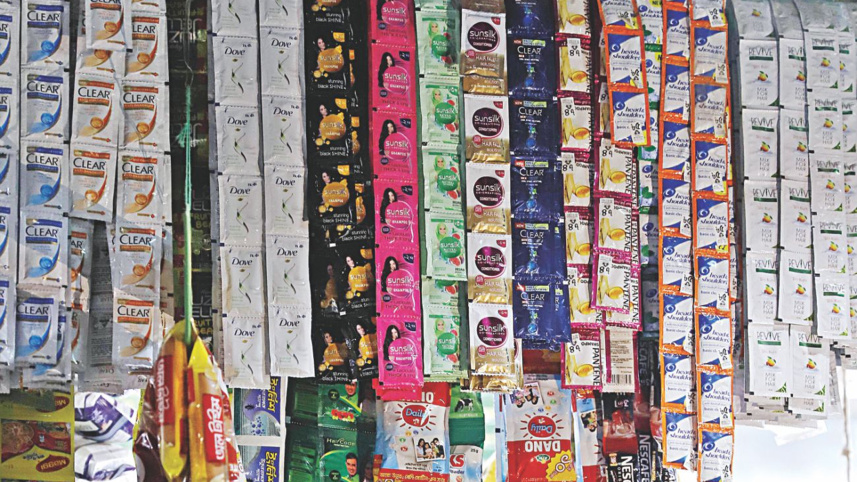
The global shift towards micro-packaging, particularly in the emerging markets of the Global South, represents one of the most significant transformations in fast-moving consumer goods (FMCG) distribution history. In Bangladesh, this phenomenon has coalesced into what experts identify as the “sachet economy,” a system designed to maximise market penetration among low-income populations through the delivery of high-frequency, low-volume goods. Recently, for my work, I started visiting slums in different parts of Bangladesh. Something that started bothering me in every other place was the availability of “mini pack” of almost every item. From shampoo and detergent to biscuits and chips, every item imaginable has been shrunk down to a sachet. Furthermore, beside the regular brands, I found brands I’ve never seen in the upscale or retail chain shops like Shwapno, Agora, or Meena Bazar in Dhaka. To dig deep into it, I started looking at the roads and ground while walking in different slums in Dhaka, Khulna, and Barishal. And what was not surprising was the presence of empty sachets of these minipacks.
But why is there a mini pack for every item? And why in slums? I tried to look into the value chain to find the answers. The existence of the sachet is not a “cosmetic choice” by manufacturers but a response to the “daily liquidity cycle” prevalent in informal settlements. While a middle-class family in Dhaka would prefer to buy a reasonably large pack of detergent or a bottle of shampoo monthly, a family residing in a slum who lives on a daily liquidity cycle cannot commit probably Tk 300 to a bottle or regular-sized packet but can spare Tk 5 or Tk 10 on a need basis. On the surface, it is a solution. Under the hood, they are often paying a 20-30 percent premium per gram compared to the bulk buyer. This is the “poverty premium” and it is quite astonishing that over 95 percent of consumer goods in Bangladesh are sold through more than 20 lakh small, informal retailers, commonly known as mudir dokan (corner shops). For these mudi dokandar (shopkeepers), the sachet is a high-velocity item that minimises inventory risk and appeals directly to the cash-constrained consumer. We are essentially charging the poorest people the highest unit prices for the “convenience” of being unable to afford more. Data shows that as the volume of the package decreases, the unit cost increases exponentially, creating a structural barrier to wealth accumulation for the poor.

Also, these “invisible” brands, regional giants that bypass expensive marketing, have flooded the market with direct influence at the corner shops. They have perfected the art of the micro-transaction, engineering products with extra spice and high calories to fuel labour-intensive lives. But while they have mastered the distribution of the product, they have completely ignored the retrieval of the packaging, leading to significant environmental issues as the discarded materials accumulate in urban areas. Moreover, data shows that many products commonly consumed in slums fail to meet health benchmarks, contributing to the rising incidents of non-communicable diseases. Excessive consumption of these products is linked with hypertension, heart disease, and stroke—conditions that are now responsible for 70 percent of all deaths in Bangladesh. Children are particularly at risk, as surveys indicate they consume ultra-processed foods (UPFs) approximately 21 times per week. These regional players often operate below the radar of high-end retail chains, focusing on the dense networks of urban slums and rural hubs. Their competitive advantage lies in their ability to provide higher margins to local shopkeepers. These brands leverage strategic alliances to surmount obstacles related to infrastructure and promote innovation in product engineering, specifically tailoring flavours and calories to the needs of labourers, such as those in the RMG sector or rickshaw pullers.
The environmental reality of the sachet economy is harsher; the flaw is visible in the soil of Dhaka, Barishal, and Khulna. These mini packs come in multi-layer plastic (MLP) packaging because it is cheap and indestructible. But because these sachets are small and contaminated, they hold zero resale value for the waste-pickers. Unlike a plastic bottle, a sachet is “worthless” to the circular economy. Therefore, they stay and become part of the soil.
We often talk about “localisation” and “sustainability” as if they are separate from the market. However, the “veins” of the urban slum, the drains, cannot function properly when the very products designed to “serve” the slums choke them. This is true not only for the poor communities or localities but also for the cities as a whole. For example, in Barishal, the “death” of canals and ponds due to encroachment and plastic littering has led to a situation where water remains on the streets for three to four days after every heavy rainfall. The existing 30-kilometre drainage of the city is largely non-functional, with experts estimating that not even five percent of it is in optimal condition. When we allow a value chain to profit from the micro-transaction while externalising the macro-waste, we aren’t innovating; we are extracting.
The sachet economy is a brilliant business strategy for market penetration, but it is a catastrophic failure for disaster management and urban health. We are trading the long-term viability of our soil and drainage systems for short-term “affordability.” Bangladesh demonstrates a clear pattern for addressing a plastic crisis. The soil here is physically choking on the remnants of a micro-transactional economy that failed to plan for its waste. The move towards refillable, sustainable, and equitable systems is the only viable path forward for the country’s future. If we want efficiency and equity in our urban environments, we have to shift the model from “disposable sachets” to “refillable systems” that respect local liquidity without destroying local ecology. At the end of the day, we must realise that the soil doesn’t lie.
Farah Mahboob is deputy manager at Social Innovation Lab in BRAC. She can be reached at fmahboobarc@gmail.com.
Views expressed in this article are the author's own.
Follow The Daily Star Opinion on Facebook for the latest opinions, commentaries, and analyses by experts and professionals. To contribute your article or letter to The Daily Star Opinion, see our guidelines for submission.
 For all latest news, follow The Daily Star's Google News channel.
Comments