


Water Rights
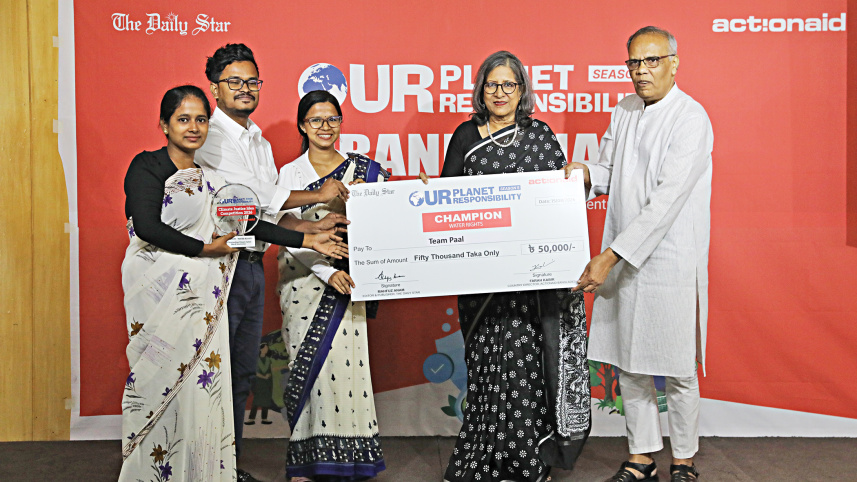
Champion
Team Paal

Portable, low-cost multi-layer water filter
Team Members: Md Riyad Hossen, Asma Akter, Monika Akter
Team Paal developed an affordable, highly portable, six-layer water filtration device designed specifically for low-income rural households in Bangladesh affected by severe water contamination. The product attaches directly to standard household bottles (0.5L to 2L) and utilizes a multi-tier purification system including locally sourced activated carbon, iron-arsenic removal material, and a micro-ceramic candle filter to eliminate 99.9% of bacteria, heavy metals like arsenic, and unpleasant odors. It addresses the steep financial barriers of existing commercial filters, high rates of arsenicosis-related fatalities, and lack of safe drinking water in vulnerable areas like Chandpur and Noakhali. They offer a direct-to-consumer micro-distribution model coupled with local assembly (“See, Try, Trust, Adopt”) to lower manufacturing costs and ensure community ownership. The product targets low-income rural families, households reliant on arsenic-contaminated tubewells, and underserved coastal communities, and the project aims to reduce waterborne diseases, prevent arsenic poisoning, and deliver safe drinking water at an ultra-low cost of BDT 0.70 per liter.
Other Finalists
Team IdeaForge
Modular, solar-powered community water purification
Team Members: Md Sazid, Tayeb Ibne Sayed, Asmita Guha Thakurta
Team IdeaForge initiated a standardised, modular, solar-powered water treatment platform designed to deliver continuous clean drinking water to climate-vulnerable communities across Bangladesh. It provides local villages with region-specific purification modules (such as arsenic, iron, or salinity removal), rainwater harvesting backups, off-grid battery operations, and portable emergency “cap-like” filtration units for disaster response. It eliminates high operational costs, dependence on failing traditional water infrastructures, and the burden of walking long distances for safe water. They offer a community-scale water utility model managed through micro-entrepreneurs trained for local operation and maintenance.
Project JOL-BINDU
Solar-driven, eco-friendly localised water filtration center.
Team Members: Rifat Hasan, Md. Rakibul Islam, Rudranil Mondal
Team Jolbindu developed a solar-powered, chemical-free decentralized water purification hub designed for salinity-affected coastal communities in Bangladesh like Sutarkhali, Khulna. It replaces high-maintenance reverse osmosis (RO) systems with Capacitive Deionization (CDI) technology to remove salt, combined with pre-filtration systems, IoT-integrated real-time quality monitoring, and zero-waste brine utilization for local aquaculture. It eliminates severe drinking water shortages, reliance on fragile electricity grids, expensive membrane replacement costs, and unsustainable subsidy models. They offer a community-based water distribution model with direct ownership and management given to local women.
 For all latest news, follow The Daily Star's Google News channel.
Comments