


The plunder that never stopped


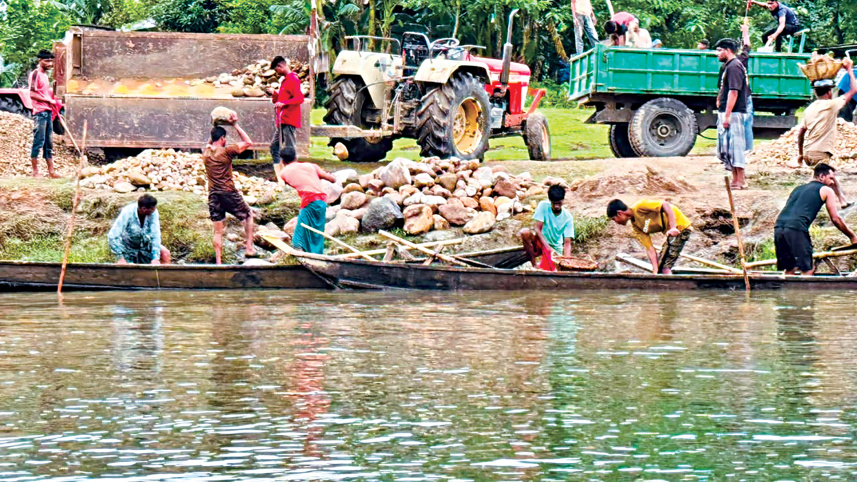
It was almost 5:00am as dawn slowly lit up the sky.
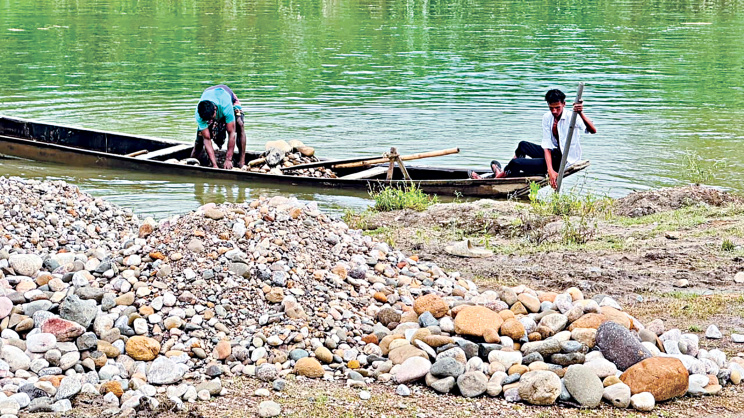
A small boat carrying two men arrived at Bichhanakandi through the Piyain river in Sylhet. As soon as they docked, they jumped ashore and began collecting stones from the riverbed. Their goal was to fill the boat as quickly as possible.

Working in unison, they loaded stone after stone onto the vessel, which would be transported to local markets within hours.
The same scene plays out across Sylhet district wherever stones and sand remain. Extraction continues through the night and into dawn, either evading or exploiting the local administration, police and the Border Guard Bangladesh (BGB).
Rampant stone and sand extraction is taking place in Bichhanakandi and Jaflong of Gowainghat upazila; Sada Pathor, Shah Arefin Tila, Utmachhara and the Railway Bunker areas of Companiganj; Lobhachhara in Kanaighat; and Sreepur, Rangpani and Borogang of Jaintiapur upazila.
The activities are taking place in Bichhanakandi and Jaflong in Gowainghat upazila; Sada Pathor, Shah Arefin Tila, Utmachhara and the Railway Bunker areas in Companiganj; Lobhachhara in Kanaighat; and Sreepur, Rangpani and Borogang in Jaintiapur upazila.
During recent visits to several sites, these correspondents found organised groups operating unchecked. Stones and sand were being transported by boat to riverbanks before being loaded onto trucks bound for markets across the country.
The reality, however, is far more troubling. The unchecked extraction poses a serious threat to the environment, biodiversity, infrastructure and tourism.
Eight quarries in Sylhet district -- gazetted by the Bureau of Mineral Development (BOMD) -- had been leased for manual extraction for more than two decades until 2020.
To protect the environment, Jaflong’s 14.93-square-kilometre area was declared an Ecologically Critical Area (ECA) in 2015, while a court banned mechanical extraction at all eight quarries in 2014.
But despite the restrictions, machines dug deep pits, extraction spread beyond quarry boundaries, and the government’s 2020 ban slowed -- but never stopped -- the activity.
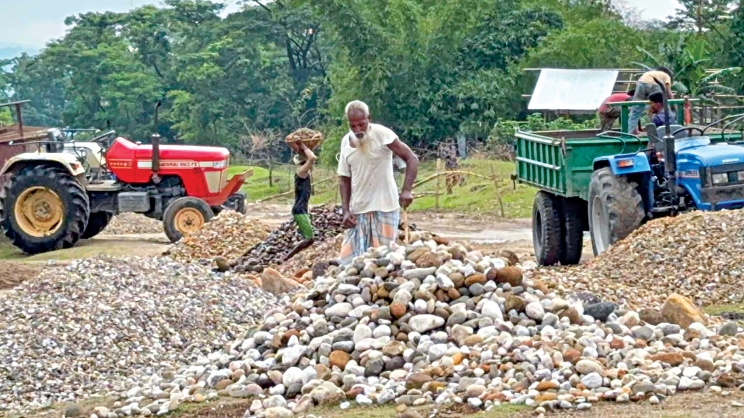
When the Awami League government fell on August 5, 2024, looting spread across every quarry site on a massive scale.
The administration later estimated that stones worth Tk 200 crore were taken from Jaflong alone within days since August 2024. The 15-acre Bholaganj Sada Pathor tourist site was stripped bare within a year.
“After 5 August, the scale of destruction has been catastrophic. This period’s plundering far exceeds the total looting of the past 15 years, and the authorities have failed to stop it,” said Abdul Karim Kim, member secretary of Dhoritry Rokkhay Amra (Dhora), Sylhet.
Then environment adviser Syeda Rizwana Hasan acknowledged the situation on July 26, 2025, saying, “I see an all-party consensus on stone extraction. For four years as an activist, I halted extraction in Jaflong. As an adviser, I cannot.”
The looting triggered an administrative shake-up. Sylhet’s then deputy commissioner, Muhammad Sher Mahbub Murad, was withdrawn.
On March 25, 2025, the Department of Environment (DoE) filed a case against 31 people, including four local BNP leaders, over the Jaflong looting.
Following the looting at Jaflong, the environment ministry on April 27, 2025 banned the leasing of all 17 stone quarries in the country, including the eight in Sylhet.
Following the Sada Pathor looting in August, the Bureau of Mineral Development (BOMD) filed a case against unnamed individuals on August 15, 2025. The following month, the Rab arrested Sahab Uddin, president of the upazila BNP unit.
The Anti-Corruption Commission (ACC) opened a probe in August 2025. Its preliminary report found the involvement of government officials, law enforcers and political leaders from the BNP, Jamaat, NCP and the Awami League. The final report, however, has yet to be submitted.
 For all latest news, follow The Daily Star's Google News channel.
 In both cases, the BNP suspended the accused leaders. However, it later reinstated Sahab Uddin ahead of the 13th national election.
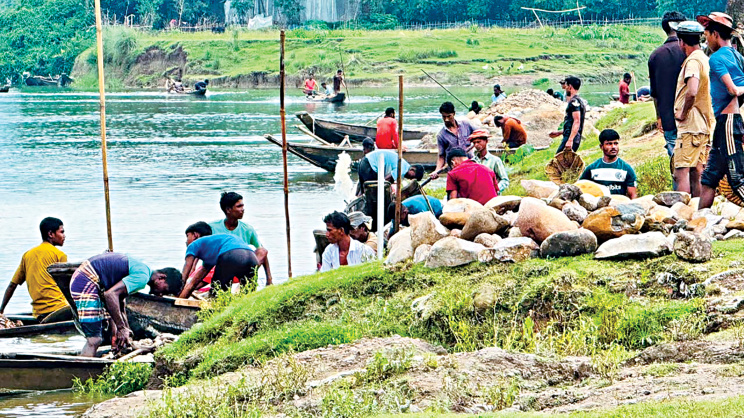
Meanwhile, the syndicates, allegedly backed by local BNP leaders, continued extraction under the cover of darkness and at dawn, and further expanded their activities after the BNP formed the government following victory in the February 12 national election.
Extraction has spread beyond riverbeds. Sand extractions from around the pillars of Jaflong Bridge in Gowainghat and Dhalai Bridge in Companiganj have raised fears among residents that the structures could collapse.
A recent visit also found looters digging beneath Jaflong Palace -- a 500-year-old heritage site of the Jaintia Kingdom (now a part of Gowainghat upazila) -- to remove stones from its foundation.
“Earlier, strict enforcement had largely stopped these activities. Now they have started again. Whenever BGB or administrative teams patrol the area, workers flee, but they return once the patrols are over,” said Md Amzad Hossain, a resident of East Jaflong.
Another resident, Nurul Islam, said, “The removal of sand from the riverbed is altering the river’s natural flow. It may increase riverbank erosion during the monsoon and is causing significant environmental damage.”
Tourists visiting these popular attractions have also noticed the changes.
Mujahid Bappi, a student at Jagannath University who visited Jaflong, said, “We visit this place for its natural beauty, especially the stones and waterfalls. If the stones continue to be extracted, we may no longer want to come here.”
“We witnessed stone extraction taking place in the river when BGB personnel were not present.”
Contacted, Abul Kalam Azad, director of the DoE in Sylhet division, said, “The BOMD and the district administration are responsible for monitoring these areas, not us. As the custodian of Jaflong’s ECA, I can say no stones are being extracted there because we are maintaining vigilance.”
BOMD Director Mohammad Rabiul Faysal said, “To stop illegal stone and sand extraction, we are working with district and upazila administrations. During our drives, we seize illegally extracted stone and sand, which are later sold through tenders. Our executive magistrates also conduct mobile courts twice a month.”
Pinki Saha, acting deputy commissioner of Sylhet, said, “We are aware of the situation, and our drives against illegal stone and sand extraction are ongoing. The task force, comprising all concerned authorities, remains active and continues to conduct drives. Besides, we are coordinating with BGB and police to take any necessary action.”
Meanwhile, the BNP government has initiated a move to reopen all quarries or add more to the list, in line with a promise made by its Sylhet-4 candidate, in a district where seven of the district’s eight quarries and several unlisted extraction sites are located.
The candidate, Ariful Haque Choudhury, later joined the cabinet as minister for labour and employment and expatriates’ welfare and overseas employment.
At his initiative, Home Minister Salahuddin Ahmed on May 7, 2026, announced a high-level committee to examine limited stone extraction in selected areas of Sylhet and Sunamganj. The committee visited the sites and is now preparing its recommendations.
On June 24, Ariful Haque Choudhury said the stone quarries would reopen for traditional manual extraction.
“We will not allow uncontrolled extraction and will strictly monitor the process. But reopening may take time because of concerns raised by different ministries and the court,” he said.
Environmental activists, however, warned that years of illegal extraction have already put Sylhet’s ecological balance at risk. The natural flow of rivers has been severely disrupted, biodiversity has declined, and several hills have disappeared, permanently changing the landscape in many areas.
Allowing extraction to resume, they warned, would only cause further environmental damage.
“Illegal extraction is a serious threat to the environment, biodiversity, river systems and the tourism this region depends on. Strict enforcement and community involvement are the only answer,” said Shah Israt Azmery, chief executive of the Environmental Innovation and Research Network.
Shah Shaheda Akther, Sylhet regional coordinator of Bangladesh Environmental Lawyers Association, said, “There are standing HC orders closing the stone quarries to protect Sylhet’s environment and nature. Whatever the government decides, it should not violate those court orders.”
Abdul Karim Kim added, “Now that the BNP government is considering reopening the quarries for manual extraction, it is no different from the way the fallen AL government allowed looters to ravage the environment. We strongly condemn the move.”
Comments