


A mother’s heart in a doctor’s world
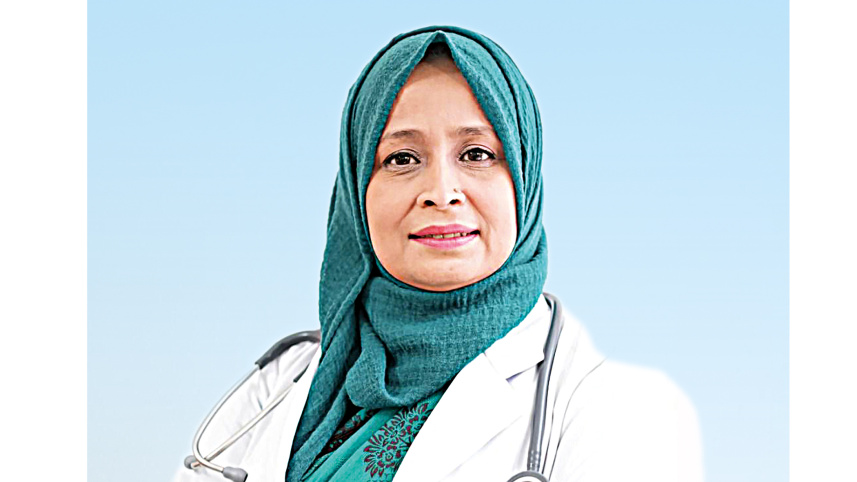
Assoc. Prof. Dr Farzana Deeba
Associate Professor
Department of Reproductive Endocrinology and Infertility (REI)
BMU (Bangladesh Medical University)

I am incredibly grateful to my mother and my mother-in-law. Without their support, a female doctor’s career can rarely be successful.
The journey of a physician often requires a harmony between the clinical demands and the emotional nuances of nurturing a home. By combining medical innovation with the lessons learned from raising her own children, Dr Farzana Deeba highlights the shared responsibility of partners in infertility and the value of family support system.
The Daily Star (TDS): Could you share what motivated or inspired you to join this profession?
Dr Farzana Deeba (FD): Becoming a doctor was my parents' wish. My grandfather was a doctor. From a young age, I heard that I had to become a doctor. It was fixed in my mind, and I never really considered any other profession or even sat for admission tests elsewhere. I graduated from Dhaka Medical College.
After completing my MBBS, I started my career in Gynaecology. During my training, I worked under National Professor Shahla Khatun. She is one of my biggest inspirations; if my mother had the most contribution, she was the second.
While practicing, I noticed that infertility is a significant issue for women. In our society, women were often blamed first. I saw women coming in with their mothers or mothers-in-law, and it was always assumed to be the woman's fault. Men rarely accompanied them. I felt this needed to be addressed because both husband and wife are responsible.

TDS: Did your perspective with patients change after becoming a mother? How do you connect with and inspire patients struggling with infertility?
FD: Becoming a mother brings a complete change to a woman's life. Without being a mother, you can't fully understand the affection, the longing, or the sense of incompleteness when a child isn't there. It helps me understand the small joys, like tying a child's hair or buttoning their shirt.
My tone has definitely softened. I used to be harsher, but now I speak more gently. When an infertile woman comes to me, she isn't just coming with a physical issue; she is often psychologically upset. Patients often change doctors because they don't feel they were given enough time or assurance. I try to build that trust so that even if I can't provide an immediate cure, I can guide them on the next steps and the work-up process.
TDS: How do you take care of your children while managing such a busy career?
FD: Every working mother feels a sense of guilt. My mother was a home maker and gave us all her time, but my children never got that. I remember passing my FCPS Part 1 only 15 days after my son was born, and I was pregnant with my daughter during Part 2. I couldn't give them the time I should have.
Despite the busy schedule, I made it a point to sit with my kids every night-not just for studies, but to talk about their day. We call it "quality time." My son is now in his 4th year at Salimullah Medical College, and my daughter is in her 1st year at Chittagong Medical College. They chose this profession themselves because they saw us and didn't find it "uninteresting" or "hard," despite our busy lives. We still try to have dinner together every night we are in Dhaka.
TDS: Have you introduced any innovations or technologies in your department?
FD: Yes, particularly in our infertility department. We have introduced several new methods:
PRP (Platelet-Rich Plasma) Therapy: We use this for patients with ovarian issues.
Stem Cell Research: We are conducting research using stem cells in the ovary and endometrium.
FCPS Degree in Infertility: Under the leadership of Professor Parveen Fatima, we started the first FCPS fellowship in infertility under the BCPS (Bangladesh College of Physicians and Surgeons).
Student Involvement: We now train about 20-25 students per session specifically in infertility and women's health.
Interview conducted by Afrina Sultana.
 For all latest news, follow The Daily Star's Google News channel.
Comments