


How haor women found self-reliance through duck farming

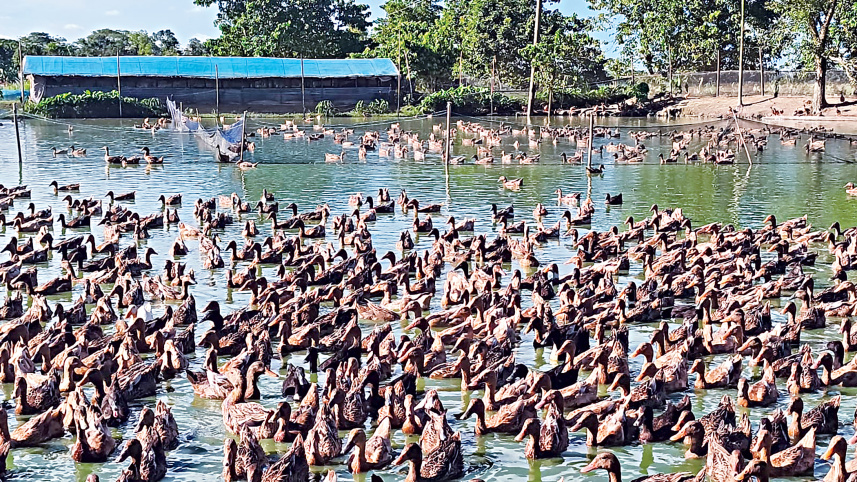
In the midst of the haor region in Netrokona’s Madan upazila, Kuturikona -- a small village -- is gradually transforming into a hub of duck farming, bringing self-reliance to its residents, especially the women.
Even in the 90s, almost all villagers there earned a living through sharecropping or working as farm labourers for paddy cultivation in the haor lands. Their meagre earnings could hardly ensure two meals a day, while natural disasters meant significant damage to crops and a gruelling year of poverty ahead.

One man, Hadis Ullah, came up with a different idea. Around 1990, he began using rice husk and oil lanterns (locally known as hurricane lamps) to hatch duck eggs brought from other areas and then sold the ducklings among the villagers to encourage them in duck farming.
While he started on a small scale, it did not take long for the villagers to realise how beneficial the initiative was.
Unfortunately, Hadis Ullah could not live long enough to witness the transformation he had envisioned. He passed away in 2016.
“Now almost everyone in our village has become financially solvent. In particular, women are at the forefront of this transition from poverty to self-reliance through duck farming. I wish my husband could live to see it,” said Shahena Akter, wife of Hadis Ullah.
Hadis Ullah started with a small batch of ducklings hatched from eggs. He kept experimenting with his idea and refined the method to scale it up while keeping it low cost.
Over the years, he exhausted his capital and even had to sell off some land to remain afloat before production eventually expanded and became profitable.
Locals used to grow one crop and then remain idle for the rest of the year. As such, many were interested in duck farming, as the haor region provided the perfect setting for it.
The birds could be reared free-range in the swamps, where they fed on insects, small fish, and snails, thereby requiring hardly any expenses on feed, making it a considerably simple and profitable venture for the villagers.
The only issue was that they had to bring ducklings from other areas, which was not convenient due to poor connectivity back in the day.
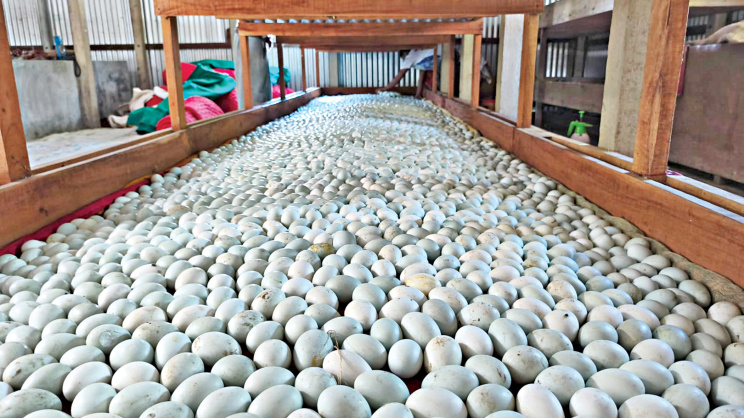
Hadis Ullah’s initiative, therefore, soon saw growing demand among villagers, and almost every family became engaged in duck farming. While most of the men worked the fields, women reared the ducks, sold eggs and hatchlings, and gradually achieved self-reliance for their families.
Together with his wife Shahena and his brothers, Hadis Ullah continued hatching ducklings using the rice-husk-and-hurricane-lamp method to cater to the local demand, while local livestock officials provided training and technical advice.
Soon, hatching ducklings and rearing ducks became popular in other villages in the region beyond Kuturikona.
Yasin Mia, Hadis Ullah’s younger brother, later formed an association called the “Rice Husk Incubation System Society” with 138 small-scale hatchery owners of Kuturikona village and serves as its president.
He also owns the largest hatchery in the village and provides training to rural women on duck farming and egg hatching using the natural method at home and abroad, including in India and Indonesia. His work has received support from the European Union.
Describing the rice-husk-and-hurricane-lamp method, Yasin said it is an inexpensive, traditional rural technique for artificially hatching duck eggs without electricity or modern incubators. The heat from lanterns provides the necessary temperature, while rice husk is used to conserve and regulate that heat, creating the required environment for the eggs to hatch.
To hatch about 1,000 eggs, Yasin and Shahena explained that a suitable place first needs to be selected. Alongside, it requires roughly four cubic feet of wood, six sacks of rice husk, two bamboo baskets, three kilograms of cotton, four hurricane lamps, five litres of kerosene, a kerosene container, about 50 pieces of black cloth, two blankets, 7–8 yards of thick cloth, five egg trays and a thermometer. Most of the materials are reusable.
“First we collect 30-40 fertilised eggs weighing 60-70 grams for each batch. Then the eggs are washed in lukewarm water mixed with disinfectant, dried in the sun, covered in black cotton cloth, and placed in a bamboo basket filled with rice husk. A hurricane lamp is lit underneath the basket to provide heat. To ensure even heat distribution, the eggs are turned every two to three hours,” Yasin said.
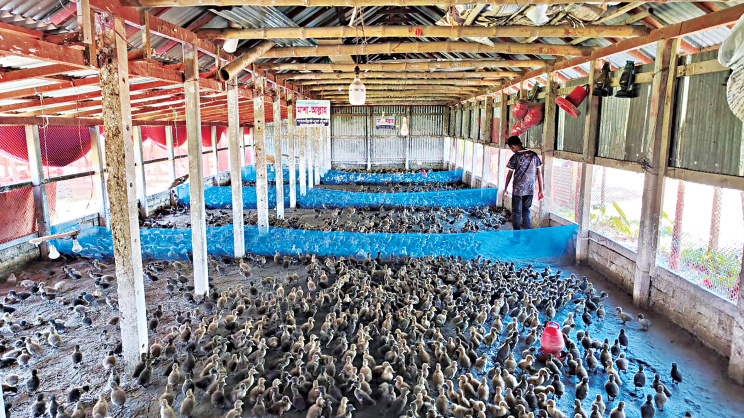
After 18 days, the eggs are removed from the baskets, placed in wooden boxes lined thickly with rice husk, and covered with blankets. The ducklings hatch within 28-30 days, he also said.
 For all latest news, follow The Daily Star's Google News channel.
 “My farm alone produces 1,00,000 ducklings monthly, while the total production from 138 small and large hatcheries in the village stands at 3 million ducklings a month. Fertilised eggs are collected at Tk 20 each, while ducklings sell for Tk 40–50. Even after all expenses, there is profit,” Yasin added.
Other hatchery owners said they hatch Khaki Campbell, Indian Runner, Jinding, Nageswari, Beijing and Muscovy breeds. The current production value stands roughly at Tk 120 crore annually, employing around 250-300 families in the village.
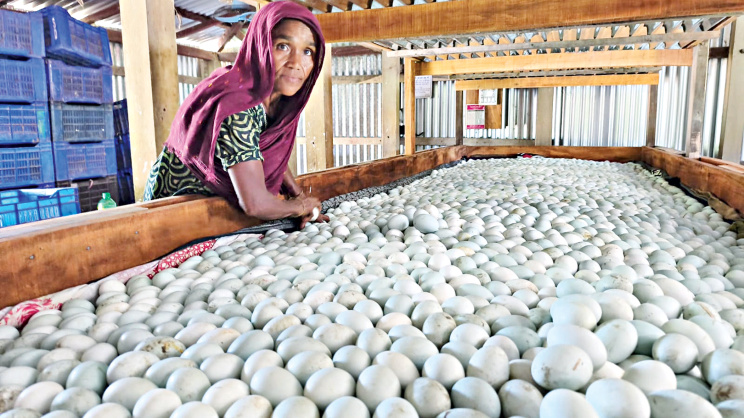
“Almost everyone in the village, aged 10-70, is engaged in the work in some way or other. Women are the most involved, carrying out the tasks including collecting eggs, washing, drying, placing them in the trays, and turning them,” said Shahena.
Hawa Akter, who owns a hatchery, said, “We set up a hatchery for 10,000 ducklings with our small savings. The family members run it together. Now we earn about Tk 50,000 monthly from it. It has made us financially solvent.”
Majida, another hatchery owner, said, “I work with my family members in our hatchery in addition to household chores. This keeps operational costs low without requiring hired labourers.”
Yasmin Akter, who works in a hatchery, said she earns Tk 20,000 a month and is able to easily support her family with it.
Describing the special value now placed on the girls of the village because of their self-reliance, Shahena said, “There is now huge demand for girls of our village. No one dares to ask for a dowry in marriage. Almost all the girls in the village know this method of hatching eggs, thereby becoming an asset to her family and making herself highly valued.”
“Society often undervalues women, but I have seen that if a woman has income, everyone respects her. The women of Kuturikona have earned that respect,” said Yasin.
He urged financial institutions to provide loans on simple terms to help small initiatives like the hatcheries in Kuturikona to expand further.
Dr Mohammad Shahidul Islam, district livestock officer in Netrokona, said the rice-husk-and-hurricane-lamp method is an effective, low-cost way to hatch ducklings, enabling around 300-400 families in Kuturikona village to become self-reliant.
“Women are participating equally with men in the workforce. We are supporting them with technical knowledge, treatment facilities and training. About 2,500 men and women have become employed through the 138 hatcheries there,” he added.
Netrokona Deputy Commissioner Khandaker Mushfiqur Rahman said, “This village has become an excellent example of how community resilience can translate to women’s empowerment and socio-economic development.”
Comments