


Budget should prioritise resilience over expansion


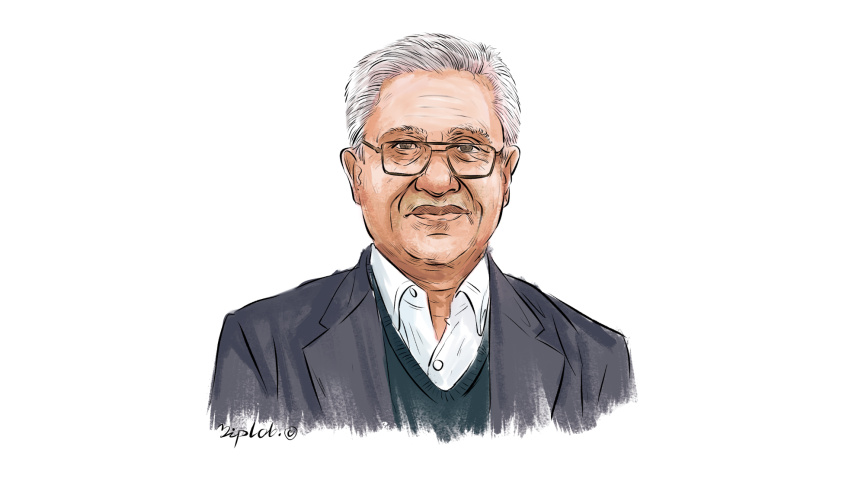
Zahid Hussain, former lead economist of World Bank’s Dhaka
office, says economy is facing prolonged external pressures

Concessional financing from the World Bank, ADB, IMF, JICA and other development partners could allow a slightly larger budget without stressing domestic banks. “Even so, under realistic assumptions, I do not see the government implementing a budget much beyond Tk 7.5 to Tk 8 lakh crore,” he said.
Bangladesh’s next national budget should focus on strengthening economic resilience rather than increasing spending, said Zahid Hussain, former lead economist at the World Bank’s Dhaka office.
He warned that weak fiscal buffers, high inflation, and serious vulnerabilities in the financial sector have left little room for a large or expansionary budget.
In an interview with The Daily Star, Hussain said the economy is facing prolonged external pressures stemming from elevated global fuel, fertiliser, and commodity prices, limiting Bangladesh’s ability to absorb further shocks.
“The economy is now facing a global trade shock,” he said, noting that import costs have risen sharply while access to essential goods has become increasingly difficult. Even if geopolitical tensions ease, prices are unlikely to return to pre-war levels anytime soon, he added.
Hussain explained that Bangladesh is paying more for imports but receiving less in return, resulting in a net income loss. “The key question is how we will absorb these losses,” he said.
He added that policy choices are increasingly constrained by limited fiscal space.
“Except for foreign exchange reserves, most buffers are nearly exhausted,” he said, noting that inflation remains above 9 percent and the banking sector is under severe stress.
He said the economy is now facing stagflation -- high inflation, low growth and weak shock absorption capacity -- while election promises and the new government’s budget plans are increasing pressure to raise spending.
“How do we balance these conflicting pressures?” he asked.
LIMITED SPACE FOR EXPANSIONARY BUDGET
Hussain said printing money is not a viable option because inflation is already high and could rise further.
“If inflation were very low, money financing might have been considered, but that is not the case,” he added.
He also said domestic borrowing is constrained as interest rates are already high, with businesses facing double-digit lending rates. Higher government borrowing would push rates up further and restrict private credit.
A large portion of the budget is already locked into mandatory spending.
IMF projections suggest interest payments could reach Tk 1.7 lakh crore in FY27. In FY26, salary expenditure is close to Tk 85,000 crore, while pension payments exceed Tk 35,000 crore.
“These are mandatory costs that are difficult to reduce,” he said, adding that many development projects are already in advanced stages and cutting them would waste past investment.
 For all latest news, follow The Daily Star's Google News channel.
World Bank studies show that 70 to 80 percent of Bangladesh’s public spending is pre-committed, compared to 50 to 60 percent in other lower-middle-income countries and 40 to 50 percent in better-governed Asean economies.
With inflation eroding purchasing power and weak real wage growth, Hussain said tax revenue cannot rise sharply. Bangladesh typically struggles to collect even Tk 4.5 lakh crore.
Given the constraints, he said, “If we respect these constraints -- no money printing, limited domestic borrowing, large fixed expenditures, and rising interest costs -- then a realistic revenue target would be around Tk 5 lakh crore, with a deficit of about Tk 3 lakh crore.”
“That would put the maximum feasible budget size at roughly Tk 8 lakh crore.”
He warned that financing even this deficit would be challenging. Domestic borrowing needs could exceed safe limits unless external financing rises significantly.
Net external financing may need to reach Tk 1.1 lakh crore, while domestic borrowing of around Tk 1.9 lakh crore would still pressure financial stability.
“For this reason, the overall budget size would need to remain tighter,” he said.
He added that concessional financing from the World Bank, ADB, IMF, JICA and other development partners could allow a slightly larger budget without stressing domestic banks.
“Even so, under realistic assumptions, I do not see the government implementing a budget much beyond Tk 7.5 to Tk 8 lakh crore,” he said.
STRUCTURAL REFORMS OVER SPENDING PUSH
On the IMF programme, Hussain said challenges go beyond subsidy cuts or electricity price adjustments.
Key reforms in tax policy, exchange-rate management, banking sector restructuring, Bangladesh Bank governance, and separating the National Board of Revenue remain incomplete.
“I don’t think simply increasing electricity prices will bring the IMF programme back on track,” he said.
Hussain said Bangladesh no longer has the option to prioritise either inflation control or growth.
The problem, he said, is supply-side constraints rather than weak demand.
“If you don’t have diesel, LNG, or fertiliser, higher government spending will not increase growth,” he said. “Instead, it will mostly lead to higher prices or exchange rate pressure.”
He said the budget should prioritise resilience by protecting food security, energy security, healthcare, and social protection.
“You cannot cut spending on vaccinations, medicines, schools, or support for the poor and vulnerable,” he said.
However, he warned against broad subsidies that often benefit higher-income groups more than those in need.
Hussain said low tax collection is mainly due to a complex tax system and weak administration.
Multiple VAT and customs duty rates, he said, create corruption risks and revenue leakage.
“If the rate structure is simplified and the tax system is automated, revenue can increase without adding pressure on taxpayers,” he said.
He called for urgent reforms in energy, banking, ports, regulation and skills development.
Bangladesh has around 30,000 megawatts of installed power capacity, while peak summer demand is about 18,000 megawatts.
“The problem is not power generation capacity,” he said. “The real issues are fuel supply and limitations in the transmission grid.”
He also highlighted inefficiencies in ports, complex regulations, and weak vocational training.
“Bangladesh exports labour but imports skills,” he said.
Hussain said structural reforms, rather than higher spending, now offer the most practical path to improving investment, lowering costs, and stabilising the economy.
He said Bangladesh is still facing a global trade shock, with both import prices and volumes under pressure.
“Prices have increased, and even if you are willing to pay more, it is still difficult to get the required quantities, especially as global supply chains remain strained,” he said.
He concluded that Bangladesh needs a more productive economy driven by reforms, not a larger budget based on fragile borrowing.
“Without such reforms, the economy could remain stuck in repeated crisis management, while private investment confidence continues to weaken,” he said.
Comments