


Improve climate planning to access more global funds


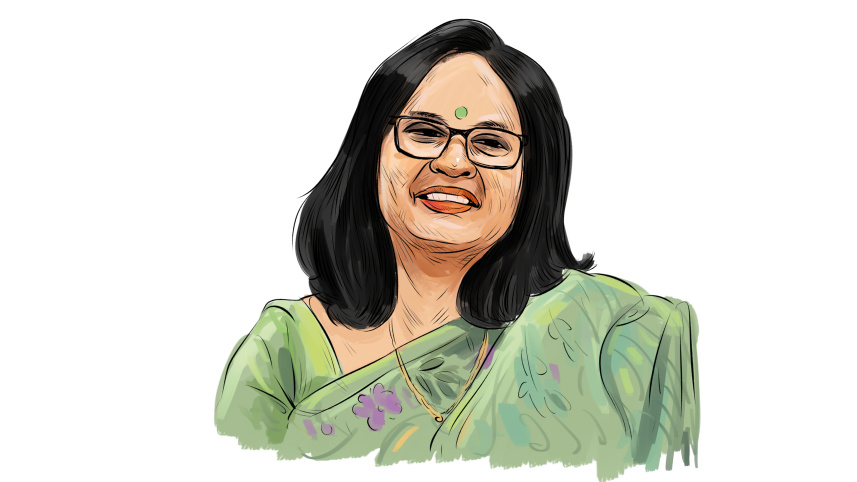
Sharmind Neelormi,
Economics professor at Jahangirnagar University, says budgeting should be knowledge-based

Referring to infrastructure projects and the relocation of tanneries, she said approvals are often influenced politically without obtaining mandatory environmental clearances.“If these practices continue, Bangladesh will not be able to build a sustainable economy, even if roads are raised or drainage systems are improved,” she said.
Climate budgeting in Bangladesh must become more knowledge-based and technically stronger to help the country access global climate financing more effectively, said Sharmind Neelormi, professor in the Department of Economics at Jahangirnagar University.
In an interview with The Daily Star, she said Bangladesh once played a leading role in global climate research by combining scientific and social science approaches to climate adaptation, and this strong knowledge base should have strengthened the country’s international position.
Neelormi praised the introduction of climate budgeting, saying it has improved institutional capacity within the Finance Division. Around 25 ministries now prepare climate-related budgets, with about 28 to 30 percent of their allocations linked to climate-related activities.
Bangladesh first published a climate-related budget in FY18, covering six ministries and divisions.
Explaining how the system works, she cited examples such as rebuilding roads in flood-prone areas like Feni, where roads are now elevated and include improved drainage to cope with floods and rising water levels.
She said these added costs reflect real “climate additionality” in development spending.
Neelormi also mentioned farming in the haor region, where early floods have pushed researchers to develop faster-maturing rice varieties. “We would not need these extra costs without climate change,” she said.
However, she warned that the system still has major technical gaps. Although project documents require officials to note climate and gender impacts, the development project proposals do not have a clear section to measure additional climate-related costs.
“As a result, ministries cannot properly track climate spending in the budget,” she said.
She added that agencies such as the Local Government Engineering Department and the Bangladesh Water Development Board have technical expertise, but the system does not fully capture it.
She also raised concerns over weak enforcement of environmental regulations, saying some projects proceed without proper environmental impact assessments despite legal requirements.
Referring to infrastructure projects and the relocation of tanneries, she said approvals are often influenced politically without obtaining mandatory environmental clearances.
“If these practices continue, Bangladesh will not be able to build a sustainable economy, even if roads are raised or drainage systems are improved,” she said.
EXPORT PRESSURE, FINANCE CHALLENGES AND GOVERNANCE CONCERNS
On export competitiveness, Neelormi warned that Bangladesh faces growing pressure from European and American markets over carbon emissions as it approaches LDC graduation.
She said stricter carbon compliance rules after 2030 could significantly affect exports if emissions are not reduced.
She noted that Bangladesh Bank has made progress through sustainable finance and green finance initiatives aligned broadly with European Union standards.
The central bank has also instructed commercial banks to allocate parts of their lending portfolios and CSR funds to climate-related investments. However, she said implementation remains difficult due to a shortage of skilled professionals to verify sustainability compliance.
 For all latest news, follow The Daily Star's Google News channel.
 “This is a highly technical and labour-intensive process,” she said, adding that banks are not unwilling but often lack experience.
She urged Bangladesh Bank to train financial institutions and build a compliance system that supports, rather than discourages, small and medium-sized enterprises.
She also suggested using taxes, tariffs, and trade incentives so producers can manage sustainability costs without losing competitiveness.
Neelormi further warned that even if Bangladesh gets extra time before LDC graduation, the transition period will be short, and the country should focus more on bilateral agreements to secure market access.
On gender-responsive budgeting, she described Bangladesh’s framework as a strong initiative that has improved through integrated tracking linked with the iBAS (Integrated Budget and Accounting System) platform.
Gender budgeting began in FY10, initially covering four ministries. However, she criticised the government for publishing spending data without assessing effectiveness, saying, “The ministries clearly have the data, but the effectiveness indicators are not made public.”
She also highlighted the lack of sex-disaggregated data, which forces policymakers to rely on estimates rather than precise information.
On women’s issues, she pointed to safety, employment, and rising cybercrime as urgent concerns, stressing that stronger laws are needed.
She said increased police budgets alone are not enough unless improvements are also made in public transport, urban safety and digital protection.
Referring to the Dhaka metro rail system, she said it has improved efficiency and safety while reducing carbon emissions, but questioned whether Bangladesh is properly documenting these savings under its Paris Agreement commitments.
She added that emissions reduction should be part of the national development strategy, not just external pressure from export markets.
Criticising what she called overly simplistic views on climate finance, she said many people wrongly assume Bangladesh should receive only grants due to its vulnerability.
She noted that climate finance is now mainly delivered through concessional loans, blended finance and reimbursable grants rather than direct compensation. “The world will not give grants simply because we ask for them,” she said.
She stressed that Bangladesh must strengthen its ability to access modern global climate finance, especially highly concessional funds such as the Green Climate Fund.
Looking ahead to the next budget, Neelormi said Bangladesh’s key challenge is not only shrinking fiscal space but also inefficient spending, weak institutional practices, and a continuing crisis of confidence among investors and citizens.
She noted that the government is entering the budget cycle under rising pressure from debt servicing, which is restricting investment in productive sectors.
She also said that the inefficient use of already limited resources remains a persistent problem, making improving spending efficiency an urgent priority. “Even the limited resources we have are often spent inefficiently,” she said.
She added that while political transition may improve the investment climate, rebuilding economic confidence will take time.
Comments