What Bangladesh’s historic Test victory in Australia means for Bangladeshi-Australians

There are sporting victories, and then there are victories that seem to mean something beyond the boundary rope.
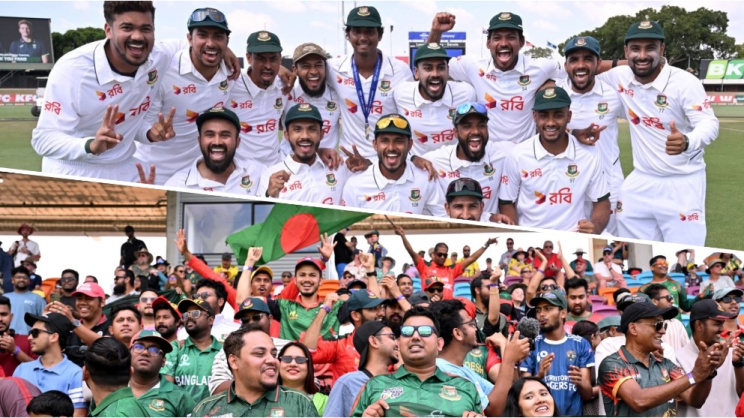
As I write this from Darwin, in the far north of Australia, Bangladesh have achieved something extraordinary: a Test victory over Australia on Australian soil. Bangladesh dominated almost every session of a match that, before it began, most people would have expected Australia to win.
For a Bangladeshi-Australian who has loved cricket for most of his life, this is more than a scorecard.
It is difficult to explain to people who have not experienced it what it means to watch Bangladesh beat one of the great cricketing nations. Cricket is one of the few arenas in which Bangladesh can announce itself to the world with an uncomplicated, positive message.

Bangladesh has too often entered the international news through stories of floods, poverty, political turmoil, corruption and disaster. These things are real, and they should not be minimised. But they are not the totality of Bangladesh. A country of more than 170 million people contains extraordinary ambition, ingenuity, resilience and talent. Cricket gives the rest of the world a glimpse of that Bangladesh.
And it gives Bangladeshis themselves a glimpse of it.
A sporting victory cannot fix a country. It cannot repair institutions, eliminate corruption, create jobs or resolve political disagreements. We should be wary of turning a cricket match into a political metaphor for everything that Bangladesh needs to become.
But neither should we underestimate the psychological importance of collective achievement.
Nations need moments in which their citizens feel that they are moving forward. They need occasions when people from different political, social and economic backgrounds can look in the same direction.
Sport can provide those moments more powerfully than almost anything else.
Bangladesh is also going through a period of enormous turbulence, with a new government attempting to establish itself amid deep political and social uncertainty. At such moments, a country needs confidence. It needs a sense of possibility. It needs institutions and individuals demonstrating that discipline, competence and perseverance can produce results. That is precisely what has been so impressive about Bangladesh in Darwin.
Bangladesh is also going through a period of enormous turbulence, with a new government attempting to establish itself amid deep political and social uncertainty. At such moments, a country needs confidence. It needs a sense of possibility. It needs institutions and individuals demonstrating that discipline, competence and perseverance can produce results.
That is precisely what has been so impressive about Bangladesh in Darwin.
This has not been a fluke victory. Bangladesh have played with discipline. They have applied themselves. They have remained calm under pressure. They have constructed partnerships rather than constantly searching for spectacular shots. Their bowlers have maintained pressure. Their fielding has been purposeful, and the batsmen have shown patience.
Tanzid Hasan's century was particularly symbolic. His 101 was the first Test century by a Bangladeshi in Australia. He made it in only his second Test, after being dropped from the side following an unremarkable debut. He responded not with panic, but with application and composure.
That is the Bangladesh I want to see.
Because Bangladesh cricket has sometimes been a shambles. There have been periods of organisational dysfunction, allegations of corruption, inconsistency and poor administration. There has been a familiar pattern of enormous expectation followed by disappointment: Bangladesh getting close, creating excitement, and then somehow falling at the final hurdle.
This time feels different.
They look organised, confident and methodical.
They look as though they believe they belong.
Perhaps that is the most important change of all.
I have a personal connection to this story that makes watching this Test particularly poignant. Nearly 30 years ago, when I was a medical student doing a fellowship at the ICDDRB, I had the extraordinary opportunity to trial for Mohammedan Sporting Club in Bangladesh.
For a young Bangladeshi who had grown up in Australia, it was thrilling. I had always loved cricket, but suddenly I was experiencing it in Bangladesh itself, surrounded by people for whom cricket was not merely a sport but part of the national conversation.
My cricketing career in Bangladesh was, unfortunately, rather short-lived.
I contracted hepatitis after eating with part of the team. Looking back, this was probably more my fault than theirs. But the experience remains one of those wonderfully strange memories that stay with you.
What I remember most was the excitement.
This was almost three decades ago, when Bangladesh cricket was still establishing itself internationally. The country was beginning to believe that it could have a place in world cricket. Watching the sport develop from those early days into the team we are seeing now is enormously satisfying.
And perhaps this is why I find myself watching this Test in Darwin with such pleasure.
Bangladeshis in Australia are often invisible as a distinct community.
Australians tend to place us within the much larger and more familiar category of "South Asians". India is enormously prominent. Pakistan, Sri Lanka and Nepal have their own identities. Bangladesh is often less well understood.
Many Australians would know little about Bangladesh's extraordinary history: its relationship with India, its incorporation into Pakistan after Partition, the bloody struggle that produced independence in 1971 and the remarkable development of the country since then.
They may know even less about Bangladeshi-Australians.
A sporting victory cannot fix a country. It cannot repair institutions, eliminate corruption, create jobs or resolve political disagreements. We should be wary of turning a cricket match into a political metaphor for everything that Bangladesh needs to become. But neither should we underestimate the psychological importance of collective achievement.
That matters particularly now.
Australia is experiencing a period of growing anxiety about migration. Last year, protests in Melbourne directed at Indian migration reflected a broader unease about the scale and nature of migration from South Asia. International students have become a particular focus of public debate.
Bangladeshis can easily become part of that generic category of "South Asians", regardless of our different histories, cultures and experiences.
Sport can puncture that anonymity.
When Bangladesh plays Australia, suddenly Australians have a reason to learn the name. They see the flag. They hear the national anthem. They learn about the players. They discover that Bangladesh is not simply an amorphous part of South Asia.
It is a country with its own story.
And when Bangladeshis in Australia celebrate, we become more visible too.
There is something profoundly positive about that kind of visibility.
Not visibility through crime statistics, migration controversies or political arguments, but through excellence.
This is one reason cricket has such enormous symbolic power across the subcontinent. It may be true that cricket has become disproportionately dominant at the expense of other sports. The football World Cup, for example, regularly demonstrates how powerful a different sporting culture can be.
But the reality is that cricket remains one of the most effective ways for Bangladesh to build international prestige.
The 2011 Cricket World Cup, which Bangladesh co-hosted, was one of those moments when the country deliberately presented a more ambitious image of itself to the world, investing heavily in infrastructure and showcasing a country that wanted to be seen as modern, capable and confident.
Sport cannot substitute for national development.
But it can accompany it.
And perhaps that is what we should take from this remarkable Test.
Let us not demand that the cricketers solve Bangladesh's problems. Let us not pretend that one victory heralds a new golden age.
But let us allow ourselves to enjoy what it represents.
A team from a country too often described by its problems has travelled to Australia and demonstrated discipline, composure, competence and courage.
For Bangladeshis, that should be a source of immense pride.
For Bangladeshi-Australians, perhaps there is an additional satisfaction. We get to watch a country that is part of our heritage demonstrate itself to a country that is part of our home.
Tanveer Ahmed is a Sydney based psychiatrist and author. He can be contacted at drtahmed@gmail.com.
Send your articles for Slow Reads to slowreads@thedailystar.net. Check out our submission guidelines for details.

Remembering Sumit Sarkar, a historian who questioned orthodoxy
The unfinished histories of Partition
In conversation with William Dalrymple / ‘Britain didn't conquer India’
Sheikh Mujib’s killing: What the newspapers told and what they omitted

Mirrors of Empire / The bureaucrats and intellectuals who shaped the Mughal Empire

To feel Bengali, to think beyond Bengal: Dipankar Gupta in conversation

Bangladesh's visual history / The enduring allure of vintage photographs
The enduring legacy of the 2nd Bangladesh Liberation War Course

In conversation with Harbans Mukhia / Beyond kings and dynasties: Rethinking medieval Indian history